Showing posts with label US. Show all posts

Friday, July 29, 2011

Debt Ceiling Debate is Moot: USG Owes More Dollars than in Existence

Image by Images_of_Money
The current debate in Washington as to whether or not and under what conditions to raise the debt-ceiling has for the past week dominated global news coverage and the public mind.  Absent from the debate and mainstream coverage is a discussion of the debt limit in the context of the American monetary system, which creates a structural monetary deficit in the American economy and makes inevitable ever-increasing debts and deficits in the public and private sectors.  It is this system which has fostered the current situation, which is not so simply that the federal government has hit the debt limit imposed by congress, but that it owes more US dollars than there are in existence.  The failure to recognise the structural causes of public and private debt in the US brings the debate and politicking surrounding the federal debt into focus as grand political theatre and media circus, calling into question the education and/or motives of those involved in the decision making. 

That the US debt is unsustainable at more than $14trillion, is obvious.  At the current rate, the US is adding more than $1trillion to the debt each year through deficit spending.  For each dollar that the USG earns, it spends $1.63.  These facts are being thrown around as an argument for spending cuts by Republicans and tax hikes by Democrats.  The issue has created a platform for ideologues and interest groups to point fingers at one another and attack government programs and policies which don’t fit their ideology.  However, no plan yet put forward will in any remote way relieve the debt and deficit problem of the Federal Government, or problems of solvency in the wider economy.  No plan yet discussed will prevent the need to raise the debt-ceiling now, which will be the 73rd time it has been raised since 1962, or even a 74th within a couple more years. 

US Structural Monetary Deficit

Each week the Federal Reserve publishes statistics on the US money supply.  Currently, by the Fed’s largest measure, “m2,” there is roughly $9trillion in circulation, fully $5trillion less than the USG currently owes.  The situation appears even more fantastic and preposterous when one considers the total US debt, a number which includes the debts of households, private businesses, financial institutions, as well as state, local and federal government agencies.  This stands at over $54.9trillion dollars.  In other words, Total USD denominated debt in America is 6 times greater than the amount of USD available to pay it off.  

This imbalance is a direct result of the American money creation system and its ill-conceived and poorly regulated practice of fractional reserve banking.  It is a system which fundamentally and incontrovertibly REQUIRES and makes inevitable bankruptcies and asset foreclosures: a means of automatic self-correction which wipes out debts and re-balances the economy by narrowing the gap between the total amount of money in circulation and the total existing debt.  This gap has a major impact on the volume of money that is effectively available to the economy at any given time, and this unstable availability of money is what drives the business cycle:  A nauseating pattern of boom and bust typified by alternating periods of easy credit, leveraging and asset accumulation resulting in rising stock and commodity prices; followed by deleveraging, asset divestment, tight credit markets and cash hoarding­–as soon as it becomes obvious that markets are overbought and the economy and existing money supply are too out of balance to make lending and investment profitable or desirable for those able to do so. 

US Money Creation Scheme Guarantees Structural Monetary Deficit, Insolvency

For every US dollar created, an equal and interest bearing debt obligation is created, or more plainly, money in the US is created out of nothing by commercial banks and the Federal Reserve, and lent into the economy at interest.  For instance, when a home buyer gets a mortgage from a bank, the bank simply creates the principal out of thin air, which the mortgagee will have to pay back, plus interest.  Loans/debts are the genesis of all money in circulation.  Conversely, when a debt is repaid to a commercial lending institution, the principal sum is erased from existence.  If there was no USD denominated debt, there could be no USD in circulation.  Thus, for every dollar (principal) in circulation, there is a greater amount of debt (principal + interest) that is owed to banks.  It is, for most initially, an exercise in mental gymnastics to consider how such a system could be accepted and institutionalised.  One is left to wonder where the money to pay the interest will come from, when only the principal was created.  This is the source of America’s Structural Monetary Deficit. 

The macro-economic consequence of this policy is simple:  There is never enough money in the economy to allow all entities to meet all their obligations at once, thus bad loans, bankruptcy, and wealth transfer is inevitable.  On any given day, a number of people and institutions will have financial obligations to fulfill, such as monthly or balloon payments on car-loans, student-loans, business-loans, mortgages, etc.  Naturally, because more debt than money exists, not all entities that have loans coming due can possibly have the funds to pay it back at the same time.  Some must therefore seek refinancing in order to maintain their business, car or home ownership etc.  When lenders and commercial bank reserves become so leveraged that they can no longer lend safely or legally; or when lenders and banks lose confidence that borrowers as a group can pay debts back because–ironically–the economy is too indebted relative to the amount of money in circulation, they become less willing to renew or make new loans.  The result is debt defaults, lost businesses, asset seizures and foreclosed homes. 

Economic Losers

Within this paradigm, individuals; small businesses; large companies; governments and even banks themselves–regardless of solvency, intrinsic value or profitability­–are forced into asset foreclosures, bankruptcy and austerity, simply because they hold a share of the inevitable debt in the economy at the wrong time.  Like a game of musical-chairs, the music stops when credit markets tighten in reaction to cyclical circumstances endemic to the American economic system.  Everyone must compete to find a chair (lender) to park their debt with, and those that can’t, lose. 

In the wake of the housing bubble–which is more aptly described as a credit bubble–many analysts, media figures and pundits railed against US home-owners who were foreclosed on: that they should accept the blame for their own compromised circumstances and accept that they are economic “losers” for taking bad mortgage terms and causing the US housing crisis.  This is an extremely simplistic view.  While it is true that some home-owners did accept terms which they should not have and which they could never fulfill, and while it is also true that many institutional lenders committed crimes of mortgage fraud, predatory lending and asset stripping; it must be understood that regardless of the general level of intelligence, propriety, honesty, business acumen or caution exercised by the population, the system of money creation in the US and the resulting monetary deficit will perpetually create “losers”–whose homes, assets, and even the fruits of their future labours can be legally appropriated or garnished by those who are prepared and able to take advantage of their misfortune.   

The numbers describing the housing crisis are way out of whack with historical averages, and on their own point to a systemic problem, rather than just the imprudence of a few home owners.  Since the start of 2007, roughly 3.5 million homes have been repossessed in the US.  Many more are in default, and according to analyst Rick Sharga, 5 million more home-loans are seriously delinquent and likely to go into foreclosure.  Mr. Sharga expects 3 million of these homes to be repossessed by 2013 (0.4 million have already been repossessed since he made his statements at the beginning of 2011, leaving roughly 2.6 million to go)  According to the US census bureau, there are roughly 115 million households in the US, which translates to 1 out of every 30 homes in the US having been seized by banks since 2007.  If Sharga’s prediction is correct, the ratio will change to 1 out of 20 existing US homes, 6 million in total, being seized by banks by 2013.  Furthermore, these millions of families are not the only “losers” the US financial system has created.  There are millions more who have struggled immensely through job and income loss, business failures, etc., but have managed to stay in home ownership by downsizing their homes, selling off other real assets, such as cars or collectibles, and cashing in retirement savings and investments–all at reduced prices in depressed markets, to the benefit of those sitting on their cash waiting for such a “buying opportunity.” 

An Economic System Built to Fail?

The mind is naturally boggled by a system seemingly built to fail.  But while it fails some it works for others.  It is a system designed to allow private banks to create money from nothing and charge interest on it for private profit, with the side effect that debts are created in the economy–a proportion of which mathematically cannot be repaid except by forfeiture of real-asset collateral.  It creates a massive and consistent transfer of wealth, as commercial banks reap huge profits from the interest on loans of money they create out of thin air, and from the real assets they accumulate when debtors cannot repay.  It is rather an astounding thing to think of families being made homeless because of an inability to pay “back” to the bank money which the bank never had in the first place–money which was literally created at the time the mortgage agreement was signed.   The few benefactors of this system reap immensely thereof; while Americans at large are ever vulnerable to its whims. 

In fact, one could look at borrowers as unwitting agents of this ongoing transfer of wealth.  They are armed with money the bank conjured for them out of thin air, and sent out into the economy to harvest interest and collateral goods required in the loan contract.  Either the loan + interest is paid back to the bank, or the debtor defaults and the bank seizes the collateral.  In both cases, the principal is written out of existence, and in both cases, wealth and assets flow out of the broader economy and into the coffers of the bank, who took on very little risk by lending check-book money they created on a computer at the moment the loan was executed.  Thus an “up-trickle” is created:  a lawful redistribution of wealth in favour of banking corporations and their benefactors, driving the 40 year trend of widening income and wealth gaps in the US. 

The Tea-fault Party

Many Americans, especially Tea-Partiers, seem aware on some level that monetary policy, the Federal Reserve Act, and the deregulation of the financial sector in the 1990’s were policies written for bankers, by bankers.  They are rightly outraged, that in spite of these advantages that the banking industry has over all other individuals and industries, bankers still overstep themselves and compromise the viability (and deposits) of their own institutions, as well as the broader economy, only to be rewarded by those on the other side of the revolving door with multi-billion-dollar taxpayer-money bailouts.  It is not surprising that anyone finds reason to mistrust this system and its overseers.  However, in knee-jerk fashion, the Tea Party has reacted with mindless opposition to President Obama and his Wall-Street cabinet’s insistence that the debt ceiling must be raised.  The Republican congressmen the Tea Party elected are holding the economy hostage by refusing to allow the debt ceiling to rise, posturing for their Tea Party constituents, mindful of their future political careers.

The reality, however, is that the Tea Party movement, made up mostly of middle and working-class Americans, could not have picked a position more antithetical to their aims.  If they succeed in stopping the ceiling from being raised, either through default or cutting the budget by a third, they will have left the root cause–the system of US corporate welfare and monetary policy–intact, while the repercussions and write-downs resulting from the loss of value in US bonds after a default would seize credit markets, accelerating the process of private debt-defaults and appropriation of real-wealth from the greater economy by creditors.  Many Tea-Partiers in their own right would find themselves homeless and out of jobs.  Far better would be to accept the short-term need to raise the debt ceiling, address the true causes of the debt–monetary policy, corporate welfare and ceaseless war­–and campaign for broad reforms. 

By August 2nd, so the story goes, the US government must pass a law to raise the debt ceiling, so that it can continue to borrow the money it needs to operate on a day-to-day basis.  However, both congress and President Obama have the means to extend government resources and obligations beyond August 2nd, without raising the debt ceiling, which would forestall the potential default and allow more time for further (pointless?) debate.  Thus, a default on August 2nd would seem unlikely, and any default at all is not anticipated by many serious analysts.  However, as we have seen, not all is as it appears in the US financial system.  The US dollar is not solely a means of exchange, it is a means of creating unsustainable debt-loads and a system of wealth transfer.  It throws up the illusion of free-market-capitalism, while what exists is plutocratic-socialism.  It presents the facade of equal-opportunity, while certain people have the special right to create money out of nothing, and the rest of the economy must pay to use it.  There is a well known saying–that in a depression, wealth is never destroyed, merely transferred.  There are inevitably entities which would profit immensely, financially and materially, from a US default driven depression­­–the same creditors and investors who profit from the monetary deficit.  They, along with the Tea Party, have their representatives in Washington.  The world can for now only hope that this assemblage of interests prefer to keep the status-quo-gravy-train rolling, rather than gamble on a big score.  In a country where the government can be allowed to owe more of its money than exists, anything seems possible.  A spectre looms large.


Check out the US debt clock:

Read Rick Sharga's analysis of the housing market at Bloomberg:

Monday, July 4, 2011

Greek Sovereign Debt Crisis a Sovereignty Crisis

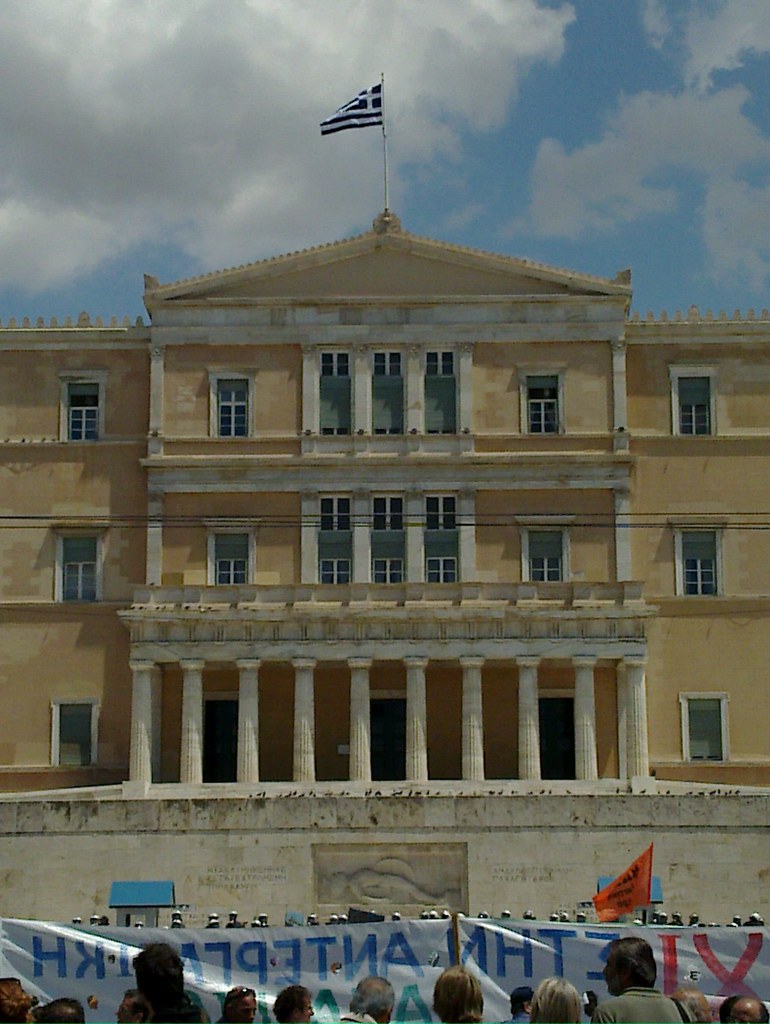
Greek Parliament, Syntagma Athens - by kouk
News outlets around the world have focused heavily on the so-called Greek Sovereign debt crisis this week.  The proposed solution–an IMF loan package requiring “austerity measures” and a fire-sale of public assets–has sparked massive unrest in the capital, where people from all walks of life are decrying a loss of democracy, sovereignty, economic means, public services- the viability of their futures and of Greece itself. 

Many have insisted that these “measures” are necessary.  If one is speaking about maintaining the share value of many European banks and institutional investors, such is true.  The IMF loan package to Greece, boiled down, is a global taxpayer bailout of European banks which have made poor investment decisions in purchasing Greek bonds. 

Even while the US debt has reached its ceiling, the US Senate has recently rejected a Republican measure attempting to restrict the IMF’s ability to dip directly into the US treasury to the tune of $100billion.  In the twisted game of hot potato that now typifies international finance, the IMF is making loans to Greece so that Greece can pay back its loans to the various private European banks and investors holding Greek bonds, while the member nations of the IMF, all of whom are similarly in debt to private banks, will have to seek more loans from private international banks (or China) in order to cover additional deficits that the IMF causes them as it takes their money and dumps it into the sieve that is the Greek economy.  Almost every tax-payer in the world will see a portion of their taxes swept into this bailout scheme for these investment institutions, which over many years have irresponsibly funded the institutionally corrupt Greek government.  More and more, the European Union–if not the globalised economy entirely–appears to be a supranational bank-controlled state-capitalism and less and less the free market as it is advertised.

Flush with this bailout of world taxpayer money channelled through the IMF–money which in a truly free market should have been lost as a consequence of the impropriety of lending to a state which everyone now seems ready to admit was rife with corruption–private European banks and investment firms will, like rapacious vultures, descend upon the carcass of the Greek economy.  The transportation and social service infrastructure of Greece will be bought up at fire-sale prices, as will small and mid-size local businesses that are struggling in an increasingly volatile economy and facing an extremely uncertain future.  As is their legal obligation to their shareholders, these foreign corporations will attempt to squeeze as much profit as possible from their Greek buyouts, through further rounds of asset-stripping and layoffs, the profits of which will be repatriated to investors outside Greece.  As Greeks lose their jobs and their businesses, as those lucky enough to keep their jobs lose income to pay cuts and higher taxes, as retirees lose income to pension cuts, as credit becomes scarce and money circulation becomes restricted, many will be forced into personal asset liquidations and home foreclosures in a depressed market paying pennies on the Euro.  This will come just as the people of Greece will desperately need reasonable access to the services being hawked by the Papandreou government and whatever remains of Greece’s gutted social security net.  

The whole enterprise reaches a higher level of absurdity in light of the fact that a similarly massive loan package last year failed to do anything but forestall the problem for a year.   Anyone who has juggled debt between two lines of credit knows that borrowing from one to pay the other leads to precisely nothing but a higher debt-load due to accumulating interest.  The only step in the right direction, and likely in any case inevitable, is a default by Greece on their debt, orderly or not.  Independent economists at the UN and elsewhere agree:  Austerity measures increase unemployment and reduce wages, thus lowering economic activity and tax revenues needed to repay national debts.  They do not work.

In this context, the governments and investment community of Europe–by their actions–seem keen to ensure that the Greek people are made destitute by having their collective assets stripped down and turned over to foreign interests before allowing a default.  That is what this is about.  Business and media have propagated the idea that the fault of the Greek debt crisis lies squarely with the Greek people, and this is the bitter pill they must now swallow.  However, those who pay the costs will not be the benefactors of Greece’s famously corrupt “culture” of bribes and patronage that everyone wants to blame.  Rather, it will be the middle and lower-classes who have all along suffered paying these bribes and corruption to have access to fundamental services.  These are the people now protesting in majority across Greece and in Syntagma square of Athens.  The police, who have lost all credibility as defenders of public security, have employed exemplary violence.  There are several videos posted to YouTube of police attacking restaurants bars and cafes near the protests, as well as the corralling and kettling people into sidestreets and subway stations, pelting them with tear gas and rocks, and beating them with shields and batons as they try to escape through police lines.  They have even been accused on Greek TV–with amateur video seeming to corroborate–of the deployment of agents-provocateurs among the protests: police posing as anarchists dressed in black, damaging property and threatening violence in order to give pretext for and initiate the police crackdowns.  While it will likely be impossible to verify these charges through police admission–as the Quebec Provincial police admitted to doing in Montebello, Canada in 2007–one might weigh the evidence and draw a parallel line:  if it is possible in Canada, it is possible in Greece. 

The schizophrenia of fiscal policy, or the flock of interests it serves, is evident when the situation in Greece is juxtaposed with the global financial crisis of a few years ago.  While it is demanded of Greece to sell off public assets and cut social spending, including gutting pensions and laying off civil servants–which is ostensibly supposed to restore the viability of and confidence in their economy- the US faced their crisis by going in the opposite direction:  Employing a Keynesian program of public spending to increase employment and economic activity.  Rather than allow critical industries to be gutted by private markets, companies such as GM were partly nationalised until they could recover, to prevent massive unemployment.  The recovery plan in the US was funded by “money creation,” when the US federal reserve wrote into existence billions of dollars to buy a new issue of US T-bills to fund the government.  While neither of these solutions is desirable, their “necessity” is rooted in the same problem.

Some time ago Greece, like most of the world, gave into the liberal economic idea that private banks should be allowed to create Greece’s money.  Evidently, under the yoke of the European Economic Community, Greece has now completely lost its sovereign right to create any of its own money at all.  They cannot repatriate their debt or use inflationary means to mitigate it.  Thus, Greece has lost its freedom and nationhood.  According to the words of Prime Minister of Canada William Lyon MacKenzie King, who in 1935 addressed the issue which is clearly at the root of the debt crises of not only Greece, but of Portugal, Spain, Ireland and the US, “Once a nation parts with the control of its currency and credit, it matters not who makes that nation's laws. Usury, once in control, will wreck any nation. Until the control of the issue of currency and credit is restored to government and recognized as its most conspicuous and sacred responsibility, all talk of the sovereignty of Parliament and of democracy is idle and futile.”


The videos below attest to the different tactics Police have used to break-up demonstrations and impose their will on the local community in Athens.
Watch Police attack a restaurant:


Watch club-wielding alleged Agents Provocateurs retreat behind Police lines:


 Watch Police corner and herd demonstrators into subway tunnel before gassing them:


Watch the above event from inside the subway tunnel:


Watch a Police line attack a peaceful march:


Watch Police move in to clear a demonstrator camp after tear gassing it:


Read more about the efficacy of "austerity" measures:

Monday, June 27, 2011

Egypt Rejects IMF, Revolution Lurches Forward

by Jonathan Rashad
Egyptians have evaded a great pitfall in their quest for freedom, democracy and sovereignty in their rejection this week of loan proposals from the IMF.  Nations across the world, especially in Africa, have time and again during periods of turmoil been tempted into bailouts and loan deals with the IMF and World Bank, always with strings attached: Steeled strings which pull the borrowing nation apart.

While successful in the ouster and trial of Hosni Mubarak, as with any revolution, the true test for Egypt is now coming after the removal of the regime’s figurehead.  A ratification of the revolution is yet to be completed, as the protest movement continues to fight against the faceless architecture of Egyptian power, which is still concentrated in the military, the oligarchy and foreign capitals.  Continued dealings with institutions such as the IMF would leave intact a central pillar of that architecture. 

Among other things which helped to destroy the Egyptian economy was the Mubarak regime’s system of patronage, as well as its borrowing from lenders such as the IMF; who always dictate how their loans are to be spent, as well as dictate economic and social policies generally as conditions for their lending.  These two forces helped to gut social projects, create massive unemployment and exacerbate poverty- ironically laying the groundwork and providing impetus for popular revolt.  Now the IMF and multinational corporations who did much business with Mubarak and who are the ultimate destination for IMF loans- loans which the taxpayers of the host nation must repay- want back in, but the Supreme Military Council has rejected the loans for now, amid popular distrust of the IMF in Egypt. 

Indeed, regardless of whether or not one would argue as to the virtue of the IMF loan package, one cannot deny that democracy has been served:  The people of Egypt do not want dealings with the IMF.  In fact, a rejection of the dictates of foreign influence, international finance and corporate power, in which the IMF is at the center, was a critical theme of the revolution.  While this fact mostly escaped the western media, Egypt’s current leadership is at least aware of it. 

Revolution:  Still in progress...

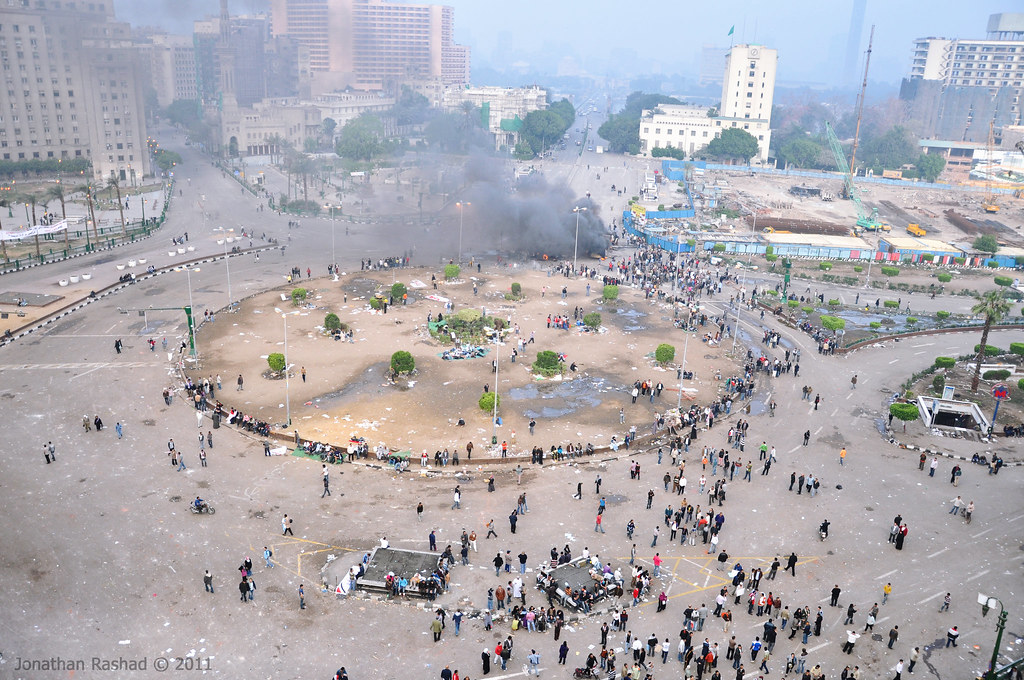
Apr 8 - Tahrir Square protests continue - Jonathan Rashad
Protests have continued since General Mubarak was finally forced from office on February 11.  There was much speculation afterwards as to how far Mubarak’s ouster would go in assuaging public outrage, which until earlier this year was for a long time a widespread but unexpressed reality.  Would the Egyptian street be placated by a simple rotation of figureheads?  This was the hope of the beneficiaries of the regime in Egypt, the US and in Israel.  According to Reuters, the Mubarak regime had been receiving an average of $2billion per year since 1979, making it the second largest recipient of US “aid” money, neighbouring Israel being the first.  It was always well known that the lion’s share of this money went to paying and equipping the coercive police/military apparatus which held the population in check through violence, subterfuge and torture.  As such, it is not surprising that the US administration did not support the ouster of their ally until the very last, until it became clear that such was already inevitable and perhaps necessary to stifle a more complete revolution which would sweep away not just Mubarak, but in one fell swoop the political, economic and military assets the US has bought in that country.  While Barack Obama spoke platitudes about freedom and democracy in Egypt, US and other foreign officials were working busily in the background to preserve the framework of Mubarak’s regime and find a successor who would be equally compliant to US interests, in spite of the aspirations to freedom of the populist, secular, anti-violent movement which demanded change at Tahrir Square and across Egypt. 

April 9 - Military crackdown continues - Jonathan Rashad
Since February 11, the Supreme Military Council of Egypt has been the official seat of power in that country.  It is made up of close allies of General Mubarak, and has been “overseeing” the transition to democracy in Egypt.  Under this “new” administration, Egyptians have continued to see crackdowns on protesters and torture of detainees.  The hope in the latter case is simply that the wretched habits of police and torturers die hard; however, in the former case the Supreme Military council is responsible for using violence to quell continued protests and criminalising the protesters through trials in military courts without due process.  Roughly 7000 sentences of groups of protesters have been meted out to up to 50,000, whom military officials continue to label as “thugs.” There is still an organised and determined enemy of the revolution wielding power in Egypt.

The land of the Pharaohs has also become a den of spies, with reports and arrests of foreign agents, most recently of one Mr. Ilan Grapel, a dual American Israeli citizen who has been in Egypt since February, and is reported as a former Israeli paratrooper wounded in the 2006 Israel-Lebanon war, a journalist, a law student and/or a spy, depending on what source one checks.  The truth of Mr. Grapel’s intentions in Egypt may never be revealed, but what is on record is that countries with vested interests in Egypt, such as Israel and the US, have in their respective and massively funded intelligence agencies a secretive behemoth with a mandate for espionage, disinformation and interference in favour of the interests of their employers.  This is while the aims of the Egyptian revolution are in vocal opposition to those interests.  Parsing between reality and contrived fiction, between honest help and the Faustian kind, between empty rhetoric and veiled threats is one of the prime challenges to the revolution in Egypt. 

How successful they are at such parsing will be in evidence later this Fall.  Former officials and collaborators of the Mubarak regime are busy rebranding themselves ahead of Presidential and Parliamentary elections set for later this year, with the hopes of maintaining their influence and access to the public treasury.  Other forces whose intentions are less clear are also clamouring; some looking perhaps to exploit divisions which in the past characterised Egyptian society.  The revolution is further threatened by the economic impact of the deconstruction of Mubarak's corrupt economic system and the loss of tourist dollars, which is to say that things always get worse before they get better.  Officials with much to lose in Egypt, foreign and domestic, are beginning to blame the revolution for continued rising unemployment and inflation- people such as the cheerleaders for the rejected IMF loans- as if Egypt’s economic woes are not the culmination of 3 decades of Mubarak’s cannibalistic policies.

However, if an honest parliament can be elected, who with the help of an engaged public can bring out of Tahrir and institutionalise the spirit of dignity, unity and humanity that struck Mubarak down and still grips most of the country, Egypt can begin to pull itself along the long road to reclaiming all that it has lost in more than a half-century:  Having suffered military invasion by Britain, France and multiple times by Israel, trade sanctions and threats by the US and the World Bank, and the wholesale looting of the country’s wealth by Mubarak’s three decades of international cronyism, Egypt now finds itself in a deep hole.  Printed everywhere on signs, painted on walls, sprayed on tanks and chanted on the streets is the continued call of the people of Egypt, as well as Arabs across Syria, Yemen, Tunisia, Bahrain and so on:   

“Aash’ab yureed issqaat in-nithahm!”
“The people want the fall of the system/regime!”
 (!الشعب يريد إسقاط النظام)

By rejecting the IMF, the people of Egypt have rejected the nonsensical idea of digging themselves out of their hole with the same tools that got them there.  


 “Aash’ab yureed issqaat in-nithahm!” 
Hear the people of Tahrir square and across the Arabic world


Read more about Egypt and the IMF:

Egypt since Mubarak’s fall:

Conflicting sources on the strange case of Ilan Grapel:

Wednesday, January 12, 2011

China: Fear of its Rise is Fear of Ourselves

A recent Economist article, The dangers of a rising China, leads a 14 page report loosely discussing the dangers posed to the world by China's eclipsing of the USA's international economic and military order.  The article attempts to draw parallels in the power-balance shift between Britain and Germany which led to the first World War, and that between the US and Britain, which is seen to have been peaceful.  Alternatively positive and negative outlooks are presented as The Economist offers its superficial analysis and weak solutions, but as to how to foster peace between the People's Republic of China and the West, the article does offer one shining and perhaps accidental insight.    

San Fran Olympic Torch Rally by tomnono
The parallels drawn between the hegemonic shifts of the 20th century at first appear credible.  Indeed, the competitive quest for empire and economic primacy on the European continent and elsewhere was the cause for the British-German arms race, ultimately which manifested in the orgiastic violence of the Great War which saw 16 million deaths and 21 million wounded, civilian and military.  This pessimistic view is countered with the absurd assertion that "Unlike the 19th-century European powers, it (China) is not looking to amass new colonies."  If colonialism was a method of expropriating the wealth of and creating markets in foreign lands, then China will surely remain at odds with the West on this basis, as both compete as Germany and Britain once did; in Asia, Africa and Latin America, employing trade agreements, capital and cooperation with corruption, as well as providing economic and military advisors to grease the wheels of neocolonialism; that which is the demonstrable policy of both the West and of China.

The Economist also looks hopefully to the main hegemonic shift of the 20th century, that from British to American.  This is ironic, since it was the devastating global conflagration of World War 2 which dismembered the British Empire and broke the British people's will to maintain it.  The British homeland itself was left in ruins, and thereby a hegemonic shift was a defacto result.  Thus it was war that ushered in the shift of global power, eventually in favor of the US.  However, the American global order was not immediately secured, but only itself born out of a further 40 years of global militaristic/economic expansion; major US wars in Korea and Vietnam; the Soviet war in Afghanistan; the littany of military actions across the third world; and a Nuclear standoff with Soviet Russia.  That this hegemonic shift "went well" as The Economist puts it, seems in the light of history preposterous.

What The Economist's hopeful bias will not permit in its report is a recognition that economic, technological and social structures are infinitely different than at any time in history, thus such a shift as it would happen today or in the future is without any useful precedent.  To start, the previous examples involve competing powers sharing in European heritage, culture and languages, and a similarity of social ethics, aspirations, and global outlook.  In the case of China, these are much different.  Not only are there vast differences in all these catergories between China and the West, but Chinese Nationalism is keenly aware of its recent history as a colonial subject of the West, and sees the economic and political elites in the US as the inheritors of that imperialist know-how and infrastructure.

Chinese Nationalism looks upon its long-time enemy Japan, perhaps correctly, as simultaneously a base for the projection of American military and economic power, and an unapologetic beligerrent whose political class still absolves and honors as heroes the Imperial Army Generals and Soldiers who committed the occupation of China and the rape of Nanking.  Offerings by Japanese Prime Ministers, most recently in 2009 by Taro Aso, at the Yasukuni Shrine and War Memorial where recognised war criminals are honored, have created tremendous popular backlashes in China.  China sees itself surrounded by the American military and its proxies in the pacific, with the US Navy sitting in South Korean and Taiwanese waters within shooting distance of the Chinese coast.  Such a situation could only be hypothetically balanced in size and proximity by China's occupying Cuba, the Bahamas and the Canadian Province of Nova Scotia with 70,000 troops and therein installing and equipping dozens of Naval, Air-Force, and Army bases to the tune of billions of dollars. This is to say nothing of the demonstrated willingness of the US to apply its military resources in China's neighborhood, such as in the Korean War and the holocaustal Vietnam War wherein millions died.  These both took place within living Chinese memory.  Taking place now: "The US Navy has begun to deploy more forces in the Pacific," The Economist reports.

A brief study into the history of China's relations with its neighbors and the West reveals fact after fact lending support to the attitude of indignation in China towards the US and Europe.  The Economist article asserts that a number of things will help to ease the transition.  These range from the briefly insightful to the absurd.  It suggests that "America and China need rules for disputes" and "America and China should try to work multilaterally (in Asia)"  But in the absence of demonstrated trust and mutual respect, rules and agreements will be broken, and multilateral discussions and organisations will be but another battlefield for diplomatic and economic clout.  The article comes close to the spirit of the answer to this terrifying question when it posits that "If America wants to bind China to the rules-based liberal order it promotes, it needs to stick to the rules itself."  This is a remarkable admission by the Economist of the US's hypocrisy.

Moreso, such is a tacit recognition that the current Empire must lead by example and act under the principles that it can only hope China will abide by once it overtakes the seat of global power.  The US must do much more to value economic equality, education and democracy at home, and respect the sovereignty and human rights of those abroad.  It must do more to promote freedom and peace for all nations; Not attempt to impose them as a pretext to military intervention in places such as Iraq and Afghanistan.  The US must make difficult decisions as to how to unwind the relationship between its military and its economy; these are understood in China and other quarters as so entwined that the US must perpetuate conflict and imperialism in order to survive.  China will never see in the US plutocracy a credible partner in any undertaking, but only a group of self-serving aristocrats guided by the ethics of capitalism, greed and consolidation.  It may be possible to avoid a conventional military conflict between China and the US during this great hegemonic shift if the US recognises China's military and economic clout and begins to bargain away its stack of chips in Taiwan, the South China Sea, Japan, Korea etc.  But such is likely to promote the further moulding of China into a militarist/imperialist economy whereby all of the fears of an opaque and unaccountable Chinese world leadership will be realised. Such will not lead to any type of greater peace.

The only chance for a true and peaceful resolution of the conflicting interests of China and the US to come about is by a change in those very interests:  Away from militaristic/economic dominion and global paternalism which sows discord, misery and disenfranchisement everywhere; toward finally abiding by the principles which the people of the West have always espoused: Peace, human rights and equality of opportunity for everyone everywhere.  Continued posturing by the US as the world's indomitable military and economic power requires China to assert itself globally through economic control of resources and military capability.  A graduation by the West to a higher moral ground; by a recognition of reality and a genuine redress of the ills of its own and society abroad, through education and democratic change; only these changes can compell lasting peace and inspire in China the changes it requires to be a more just and accountable world power. 


Read the Economist Article:
http://www.economist.com/node/17629709

Read more about it:
http://www.taipeitimes.com/News/editorials/archives/2010/09/27/2003483897
http://www.opendemocracy.net/democracy-china/nationalism_3456.jsp

Monday, January 10, 2011

Switzerland: Swiss Franc -ly Under Attack

Separate reports this week in the Swiss newspaper Neue Zuericher Zeitung (NZZ) are highlighting the difficult choices Switzerland, and by extension other nations, are facing in the continued onslaught of effective currency devaluation by US and Eurozone officials. The Greenback and the Euro have fallen significantly against the Franc and other currencies in the past years as their governments and central banks have created a glut of supply; by loosening monetary policy, lowering interest rates and creating massive amounts of new debt to bail out ailing banks, businesses and governments.   The choices for nations such as Switzerland are clear:  Reduce living standards and income values through inflation, or see a massive outflow of jobs and industry from their borders. 

Swiss Banknotes by kalleboo
The Swiss National Bank (SNB) has announced losses of 8.5bil Swiss Francs in the first 3 quarters of 2010, resulting from their foreign exchange interventions intended to curb the effect of the inflating Euro and Greenback on their economy.  These losses stem from the SNB's massive selling of Swiss Francs and purchasing of Euros in order to simultaneously increase market supply of Swiss Francs to lower it's exchange rate; and increase competition in the Euro-dollar market to help support/increase its value.  Despite these efforts and the losses thereof, the Eur/Chf (Euro/Swiss Franc) exchange rate has fallen from late 2007 highs of 1.68 to current levels of 1.25.  This has had a severe effect on Swiss industry, most of whom must repatriate sales made in the Eurozone in order to book profits.  This peak to trough fall represents a loss to Swiss exporters of 0.43 Chf in every dollar they earn, or roughly 0.25 in aggregate terms.

Such extreme cuts to profits have Swiss industry chiefs remarking that in current conditions they cannot consider new hiring or expanding production in Switzerland, and making controversial threats to move jobs out of Switzerland and into the Eurozone, where wages have dropped along with the Euro relative to the Swiss Franc.  Retailers are also complaining that more and more Swiss shoppers are travelling the short distance to make their purchases accross the border, which is not far from any point in the small landlocked Alpine country.  The tourism industry is also feeling the pinch, as it is more expensive for Europeans to buy Francs.  Some doubt the long term viability of small and mid-sized businesses in Switzerland if the Franc's value to the Euro cannot be stabilised above 1.30.  The NZZ this week specifically quoted Georges Hayek, chief of Swatch-Group and Hans Hess, president of Swissmem, an association representing the mechanical and electrical engineering industry, as calling for government intervention in this regard.

However, such government intervention would in all cases amount to a rapid inflation of the Swiss currency.  This would cause prices of goods to rise generally, affecting the value and purchasing power of all Swiss incomes, from wage-earners to business owners to pensioners.  The Swiss authorities thus face a double-edged sword:  To take action is to lower living standards for all Swiss residents and cut the value of savings; to hold firm is to risk a general flight of industry and jobs and support a loss of value in local stock market investments.  In all cases jobs, savings and investments are threatened.  This dilemma is at the root of the murmurrings of currency war surrounding the G20 meetings in Seoul, which saw the US and Europe insisting that China allow the yuan to rise, and China along with Brasil, Korea and a host of other nations from across the globe complaining of the ill-effects to their economies caused by the effective devaluatoin of the Euro and Dollar by Western central banking authorities. 

Just as the European central bank (ECB) was forced to bail out Greece and Ireland by helping to create new money, and is currently fighting to prop up the Portuguese national budget with bond purchases, so are Federal authorities in the US now facing calls to bail out hopelessly indebted states and municipalities.  The Wall Street Journal reports that Federal Reserve chairman Bernanke has scuttled such talk by pointing out that new rules under the Dodd-Frank laws enacted by the federal government last year limit the fed`s ability to intervene should states or municipalities go into default/bankruptcy.  Such issues in Europe and America will, regardless of how they are addressed, create more instability in foreign exchange markets, to the detriment of economies outside their borders; from first world economies such as Switzerland, Canada and Japan, down to China, Brasil, India and all others dependent on the global economic model. 

Read more:

German Language Sources:
http://www.nzz.ch/nachrichten/wirtschaft/aktuell/tiefer_euro_gefaehrdet_wohlstand_1.8958738.html
http://www.nzz.ch/nachrichten/politik/schweiz/schweiz_nationalbank_verlust_85_milliarden_franken_2010_1.8356119.html

Other English Language Reports on the Swiss Franc and US Debt:
http://online.wsj.com/article/SB10001424052748704739504576067602380461160.html
http://online.wsj.com/article/BT-CO-20101112-701368.html
http://www.swissinfo.ch/eng/specials/swiss_franc/Strong_franc_continues_to_haunt_Swiss_economy.html?cid=17955460

Wednesday, December 22, 2010

Afghanistan: War, Power and Illusion

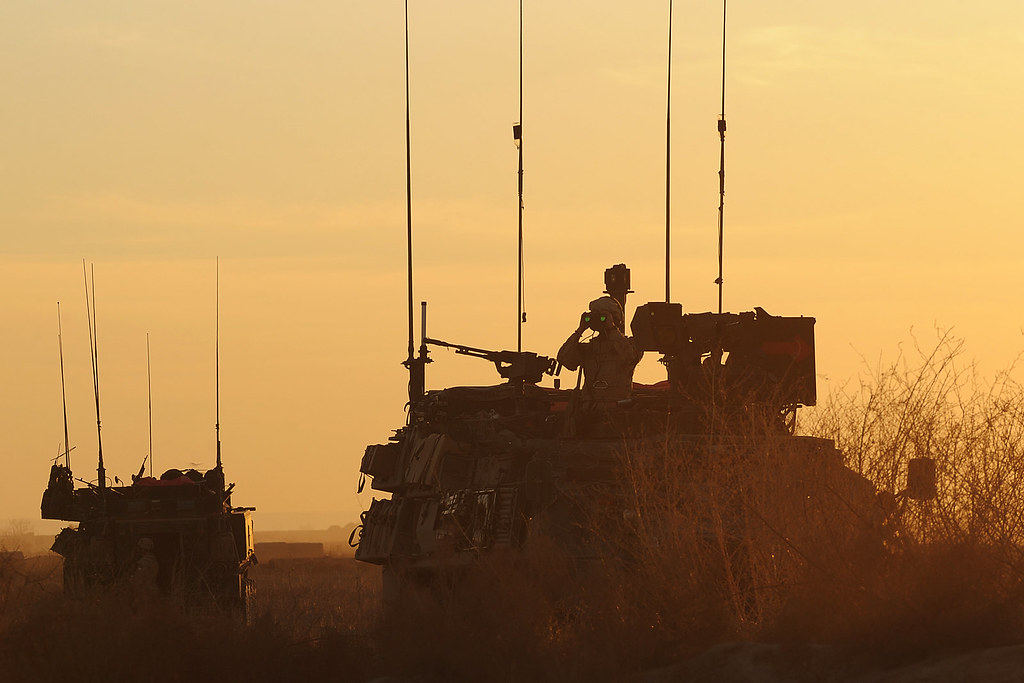
Canadian LAVs, Afghanistan, by isafmedia
This week, Project Censored has released its annual list of top 25 censored news stories in a volume entitled Censored 2011: The Top Censored Stories of 2009-2010.  An astounding article published by The Nation on November 11, 2009; How the US funds the Taliban, resurfaces as the main source for the 10th ranked censored story on the list.  Perhaps Project Censored and The Nation, and as usual the general public, have misunderstood the implications of what this story uncovers; that the West’s war and nation-building effort in Afghanistan is an exercise of utter self-deception and a complete failure. 

Recent coverage of the war in Afghanistan has surrounded revelations from the USG cables leaked by Wikileaks, which paint an endless landscape of deceptions, divided loyalties, corruption, depravity and laughable optimism in the face of virtual anarchy.  The incremental release of these documents by Wikileaks provides an ongoing stream of tidbits and fodder for headlines and public debate, especially as they concern Afghanistan; however, they so far have failed to create the mass of public interest and scrutiny required in the West to bring an end to the war.  That is a tragedy in light of the ongoing situation described a year ago in the Nation, which in spite of official representations, effectively demonstrates that NATO and the Karzai Government exert no authority anywhere in Afghanistan outside their fortified bases and government offices.

The article is entitled How the US funds the Taliban, and examines two sides of the same coin: “The first is the insider dealing that determines who wins and who loses in Afghan business, and the second is the troubling mechanism by which "private security" ensures that the US supply convoys traveling these ancient trade routes aren't ambushed by insurgents.”

While the corruption that defines the first of these realities is worth examination and condemnation, it is the implications of the second which are inescapable and final in their depth. 

The piece begins with a short bio of Ahmad Rateb Popal who is cousin to Hamid Karzai, a former Taliban official, mujahedeen fighter and a convicted drug trafficker who was released from Prison in the US in 1997.  He is now, along with his convicted drug-trafficking brother Rashid Popal, principally in control of the Watan Group, which is a consortium of communications, logistics and security companies in Afghanistan.  The Popal brothers are just the article’s introduction to the characters which fill positions of official and effective power in Afghanistan: “Welcome to the wartime contracting bazaar in Afghanistan. It is a virtual carnival of improbable characters and shady connections, with former CIA officials and ex-military officers joining hands with former Taliban and mujahedeen to collect US government funds in the name of the war effort.”

Private security firms in Afghanistan are most importantly charged in the defence of highway convoys which supply NATO’s network of bases with every last thing needed in the war effort; food to fuel to ammunition to toilet paper.  “The epicenter is Bagram Air Base, just an hour north of Kabul, from which virtually everything in Afghanistan is trucked to the outer reaches of what the Army calls "the Battlespace"--that is, the entire country.”

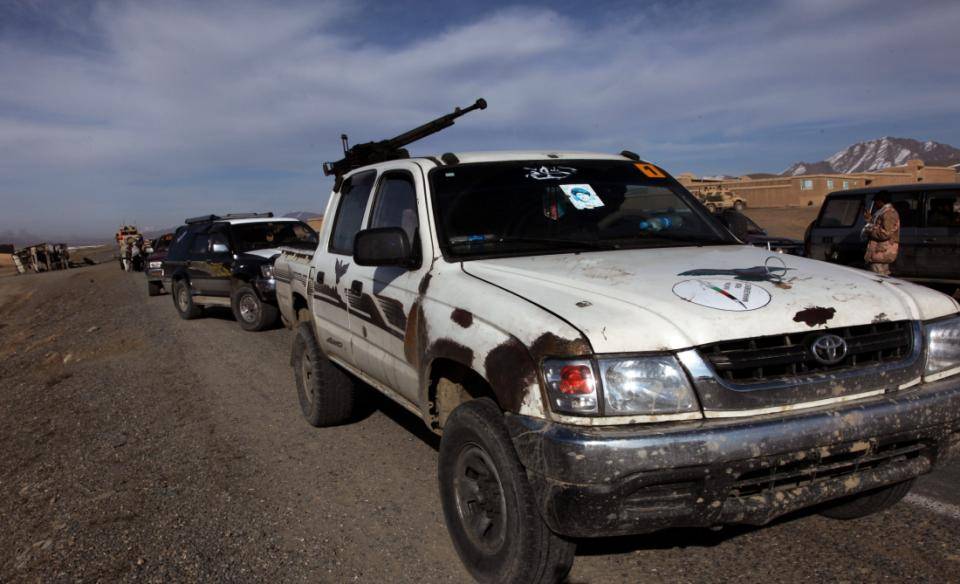
Private Afghan Security, by isafmedia
The article states, “The real secret to trucking in Afghanistan is ensuring security on the perilous roads, controlled by warlords, tribal militias, insurgents and Taliban commanders.”  It quotes an American executive: “The Army is basically paying the Taliban not to shoot at them. It is Department of Defense money;” Project Manager Mike Hanna, for trucking company Afghan American Army Services: “You are paying the people in the local areas--some are warlords, some are politicians in the police force--to move your trucks through... We're basically being extorted. Where you don't pay, you're going to get attacked. We just have our field guys go down there, and they pay off who they need to;” A veteran American manager who has worked as a soldier and a private security contractor in the field: “What we are doing is paying warlords associated with the Taliban, because none of our security elements is able to deal with the threat;” Transportation entrepreneur: “Two Taliban is enough... One in the front and one in the back.  You cannot work otherwise. Otherwise it is not possible.”

Apparently the term ‘private security company’ has in Afghanistan become something of a euphamism for Warlords and militia drawing from the deep well of Western taxpayer cash ‘intended’ to fund the stabilisation and reconstruction of the country.  “Every warlord has his security company,” is the way one executive put it to the article’s author, Aram Roston.  These ‘companies’ run by Afghan strongmen who find themselves in the favour of the corrupt Karzai administration, having divided loyalties and ulterior motives, must themselves hand over money to local powers to make the way secure along this or that highway. 

These private firms are so mistrusted by the US and Karzai, both because of their affiliations with the enemy and their own private interests which conflict with those of the Karzai family, are prohibited by law from arming themselves beyond AK-47 rifles.  In the face of Rocket-Propelled-Grenade attacks from insurgents targeting massive caravans of trucks, this seems much like trying to use brass-knuckles to protect a pack of antelope from attacking lions.

This problem is universal in Afghanistan, extending even to the most important highway there, aptly named highway 1.  The previously mentioned Watan group, run by the Popal brothers, is charged with securing this highway, the virtual jugular of the West's war complex in Afghanistan, which runs between Kabul and Bagram Airforce Base in the east; south-west toward Kandahar and the southern half of the country.  According to the article's author, "Watan's secret weapon to protect American supplies heading through Kandahar is a man named Commander Ruhullah.  Said to be a handsome man in his 40s, Ruhullah has an oddly high-pitched voice.  He wears traditional salwar kameez and a Rolex watch.  He rarely, if ever, associates with Westerners.  He commands a large group of irregular fighters with no known government affiliation, and his name, security officials tell me, inspires obedience or fear in villages along the road.  It is a dangerous business, of course: until last spring Ruhullah had competition--a one-legged warlord named Commander Abdul Khaliq.  He was killed in an ambush.  So Ruhullah is the surviving road warrior for that stretch of highway.  According to witnesses, he works like this:  he waits until there are hundreds of trucks ready to convoy south down the highway.  Then he gets his men together, setting them up in 4x4s and pickups.  Witnesses say he does not limit his arsenal to AK-47s but uses any weapons he can get.  His chief weapon is his reputation.  And for that, Watan is paid royally, collecting a fee for each truck that passes through his corridor.  The American trucking official told me that Ruhullah charges $1,500 per truck to go to Kandahar.  Just 300 kilometers."

This is clearly an extortion racket which reveals the true balance of power in Afghanistan, with the various and shadowy forces at large in the country playing the role of competing mafias and NATO that of the fearful barbershop owner, dutifully paying 'protection' money to the people who would otherwise pop his kneecaps and put him out of business.  In this strange case the Barber contends publicly that he has the extortionists on the run. 

The overarching fact is that the West’s ostensible war and reconstruction effort is impossibly dependent on collusion with the forces it is pretending to fight.  The need for local payoffs 8 years after the war began points to a reality that the US, NATO, and the Karzai government they support have established Zero effective control over the country outside of the fortified city-bases of Kabul, Kandahar, and a precious few others.  This fact is so simple it is difficult to conceptualize.  The issue is not that paying the enemy is against principle, nor that it bolsters the enemy’s resources and perception of itself, but that it is in fact direct proof of failure.  To what purpose are any efforts in Afghanistan, when Western armies have not even secured the single-most important and fundamental logistical objective of warfare, which is to secure supply lines?  NATO forces have no logistical control of Afghanistan.  They cannot even eat without the approval of those they pay off.  Is there in fact a war there?  Or are NATO’s forces just part of a complex, factionalised Western/Afghan kleptocracy, wrestling with itself as its parties secure their interests and consolidate their power against each other?  The military goals of the West seem quite unclear given that its forces cannot move anywhere without corrupting themselves by paying the enemy. 

If the publicly-stated objective of the West’s mission is in fact peace, security and freedom, it would seem that this would begin by securing freedom of movement and safe passage throughout the country.  Freedom of movement is paramount to building a free nation where goods, services and ideas can reach out and address the poverty of mind, means and opportunity that exists in Afghanistan’s isolated countryside.  If this has not been achieved, than what has been done?  Rather, there is a far-flung network of multi-billion-dollar bases providing security in provincial capitals for unpopular and fraudulently elected governments; completely dependent on payoffs to unscrupulous and opaque power structures for the maintenance of supply lines.  One can only speculate as to the exact nature of the conflicting goals existing in the strange association of interests at work in Afghanistan; an association which ties together a dizzying myriad of Western government policy and taxpayer money, billion dollar contracts, executives, bureaucrats and politicians; Afghanistan’s proximity to Iran, Russia, Pakistan and its geopolitical importance as a bottleneck for Central Asian Trade routes; as well as its mujahedeen, the Taliban, Tribalism and the Karzai family.  Western polls show a majority, even in militant America, that public opinion is against the war.  To what depths must Afghanistan’s interminable corruption, murderous war, poverty and the (sometimes self-) deceptions of Western officials descend before the Western public not only oppose, but refuse to cooperate in it?  


Read 'The Nation' article and more:


Wednesday, December 8, 2010

Drones, Torture, Rendition: Democratic Values?

A Huffington Post column by Johann Hari summarizes certain revelations stemming from the leaked USG diplomatic cables by Wikileaks.  The piece posits that Julian Assange's efforts have made the world safer and are a boon to US National Security, that a better educated public with proof of government wrongdoings can better bring its government to account.

Hari's column touches on a cable which proves the US Armed Forces were operating in Yemen while denying it publicly, and references an article which discusses 'Reaper' or 'Predator' drone attacks in Pakistan.  Drone attacks there are a very messy situation; Pakistani officials publicly deny their tacit approval of US drone attacks within their territory, rejecting them as a violation of their sovereignty and of dubious value and causing massive civilian casualties. According to Pakistani Foreign Ministry spokesman Abdul Basit, drone attacks "are having long-term negative consequences.”  Indeed, the Pakistani and American governments likely will suffer "long-term negative consequences" from the resulting radicalization of Muslims when they employ drone tactics such as attacking a funeral procession; waiting for a time until villagers come out from cover after the attack in search for survivors and to pray for the newly slain; then attacking again.  Certainly they make bitter enemies of the villagers who lose their homes and family members in such wanton displays of imperial might; people who may have nothing left to do to support themselves except to take up arms, if it does not generally galvanize the entire population against them, to whom the notion that US forces are in the region to restore security and human rights must seem something of a Hitlerian joke.

The article also highlights pressure the US Government exerted on Germany to quash an investigation into the rendition of an innocent man, Khaled El-Masri, who was mistaken for an insurgent with a similar name. El-Masri was kidnapped from Europe and brought to the CIA's infamous 'Salt Pit', a secret interrogation facility in Afghanistan.  A Harper's Magazine article, The El-Masri Cable, describes the treatment he received: "Despite El-Masri’s protests that he was not al-Masri, he was beaten, stripped naked, shot full of drugs, given an enema and a diaper, and flown first to Baghdad and then to the notorious “salt pit,” the CIA’s secret interrogation facility in Afghanistan. At the salt pit, he was repeatedly beaten, drugged, and subjected to a strange food regime that he supposed was part of an experiment that his captors were performing on him. Throughout this time, El-Masri insisted that he had been falsely imprisoned, and the CIA slowly established that he was who he claimed to be. Over many further weeks of bickering over what to do, a number of CIA figures apparently argued that, though innocent, the best course was to continue to hold him incommunicado because he 'knew too much.'"  While this kidnapping, torture, sexual violation and starvation of an innocent man had already been revealed, the leaked cables show the US Government's expectation of impunity for its agents who execute these illegal actions in sovereign foreign nations; in this case, Germany's unwillingness to cooperate by dropping charges in the matter against 13 USG agents is met with threats from US diplomats.

Hari's article points to other abuses by Western governments and the lies they tell their people to cover it up.  He expresses outrage in the poignant observation that "There is a squalid little irony when you see people who are literally bombing innocent civilians every day feverishly accuse a man (Julian Assange) who has never touched a weapon in his life of being 'covered in blood.'"  He names Western governments as the prime threats to their own population's security, and suggests that the unmasking of this hypocrisy must lead to positive change, stability and security.  What will the view of the Muslim and 3rd world be, if Western 'democracies' fail to address the abuse of power by their governments?  Al Qaeda already names Western voters as sponsors of the military occupation of Palestine and the general misery of the third world, offering that ignorance is not an excuse for imperialism.  Many amongst the populations of the world's Muslim nations already view Westerners, especially Americans, as ignorant, militarist and corrupt materialists.  Now that Western tax-payers and voters cannot hide behind the veil of ignorance, how will the world view of Western 'democracies' change, should they fail to expel the ruling classes who have sown war, death, torture and poverty in their people's name?  What is the risk that Westerners come to be seen as knowingly complicit in the heinous crimes of their governments by their 'democratically' expressed unwillingness to stop these crimes, let alone rectify and bring their authors to justice?  Whatever blood Julian Assange and the American government have on them, it is more and more smeared onto each of us, here in Canada, in the US and in Europe.


Read the Johann Hari- Huffington Post article here:
http://www.huffingtonpost.com/johann-hari/julian-assange-has-made-u_b_793504.html

More on Drones by Johann Hari and others:
http://www.independent.co.uk/opinion/commentators/johann-hari/johann--hari-obamas-robot-wars-endanger-us-all-2106931.html
http://news.antiwar.com/2009/06/23/at-least-65-killed-as-us-drones-attack-south-waziristan-funeral-procession/
http://www.qatar-tribune.com/data/20101202/content.asp?section=pakistan1_3
http://geo.tv/6-24-2009/44711.htm

Harper's Magazine on El-Masri Rendition:
http://harpers.org/archive/2010/11/hbc-90007831

BBC on American intervention in Yemen:
http://www.bbc.co.uk/news/world-middle-east-11918037

Tuesday, November 30, 2010

Wikileaks: Misanthropy and the Spectre of Scrutiny

Amid the bluster surrounding the public release of 278 of 251,287 secret and confidential USG diplomatic cables by Wikileaks as of Monday November 29th; more telling as to the behaviour and thinking of governments and vested interests is the current reaction in the world media and of public officials, than any information so far to be gleaned from these documents.  This author has read the majority of the 278 published cables, and perused the remainder, the greater share originating from embassies in Europe, the middle-east and central Asia, where the US armed forces are most active, and a smattering of cables from east-Asia, Africa and the Americas rounding out the balance.  Read in volume, they provide a fascinating glimpse as to the psychology and priorities of USG foreign policy.

The characterization by the Pentagon of Wikileaks being “reckless” in their release of the documents came in fact ahead of their release, as were Sunday’s headlines quoting the White House statement that their publication is “reckless and dangerous.”  If the documents so far released are dangerous at all, it is mostly to the continued perception by the American public that their government stands above other nations on a moral high-ground, and that USG foreign policies are in any tangible way amenable to and affected by democratic processes at home.  Wikileaks has in fact respected the danger that confidential informants and private citizens inside Iran, Afghanistan and Korea face by censoring their names, though the names of foreign diplomats, statesmen and US officials are rarely spared, as they are ostensibly publicly accountable.  Such statements from sources protected by Wikileaks’s self censorship are in any case usually the least revealing as to actual policy, and are interesting only in their insight as to what foreign insiders and parties want the USG to do or think.  

The statement by White House press secretary Robert Gibbs which has formed the leading paragraph in so many news outlet’s headlining stories: "To be clear -- such disclosures put at risk our diplomats, intelligence professionals, and people around the world who come to the United States for assistance in promoting democracy and open government," is a falsehood, as the cables themselves demonstrate that the USG, with abandon, continues to support on a quid pro quo basis innumerable corrupt dictatorial regimes such as in Bahrain, Qatar, Oman, the UAE, Saudi Arabia, Kuwait, Azerbaijan, Kazakhstan, Uzbekistan, Kyrgyzstan, Tajikistan, Turkmenistan and Afghanistan.  The notion that anyone anywhere is soliciting the USG in the aid of “promoting democracy and open government” is absurd in the light of these cables, which instead demonstrate foreign governments soliciting the USG for money, weapons and military action against their neighbours, or in the cases of Syria, Azerbaijan and Turkey, that the USG not continue to provoke the Iranian regime and desist from sponsoring terrorism, subterfuge and the foment of dissent within Iran’s borders, which they believe strengthens the Islamic leadership by providing it pretext for the further curtailing domestic freedoms of movement and expression, and which convinces the Iranian leadership that an attack by American forces is imminent and forestalled only by its current difficulties in neighbouring Afghanistan and Iraq.  The cables reveal that many representatives of middle-eastern nations believe that Iran’s operations and attempts to destabilise Iraq and Afghanistan stem from the Iranian government’s conviction that allowing a military success in Iraq or Afghanistan would precipitate a rather immediate invasion of Iran itself by Western forces. 

French President Nicholas Sarkozy has called Wikileaks a “Threat to democracy,” which seems understandable only if one extrapolates that the release of the cables will motivate people such as him to dispense with it.  For the moment, exactly how the exposure of secretive government workings to the public threatens that public’s right to rule itself (democracy), if it does not in fact do the opposite, remains unexplained.  Canada’s foreign affairs minister, Lawrence Cannon, called the leaks “deplorable” and reportedly continued that ‘leaks like this one do not serve anybody's national interests and may threaten national security.’

Hilary Clinton’s statement that the leaks are “An attack on the international community, the alliances and partnerships, the conversations and negotiations that safeguard global security and advance economic prosperity," seems ironic in light of the continual proliferation of weapons and conflict on every continent and the ongoing global economic crisis; and thereby causing one to wonder about exactly whose security and economic prosperity she speaks, and to whom she is referring when she invokes the name “international community,” a rather ambiguous and ubiquitous term of late.   There are also the calls from News outlets such as Fox News and NY Rep. Congressman Peter King that Wikileaks be deemed a terrorist organisation, and that its assets be seized and donors be considered sponsors of terrorism, which is an obvious absurdity, inconsistent even with the USG’s loose definition of terrorism, and would define innumerable US citizens as terrorists.

One of the few reasonable reactions by any government to the scandal is from David Cameron’s Conservative UK government, who as very recent newcomers to power are perhaps not (yet?) a part of Secretary Clinton’s ‘international community’.  A spokesman for the UK government discussed the matter with reporters, stopping short of branding Wikileaks as a criminal or terrorist organisation, and relating simply that the released cables and a lack of confidentiality on matters “is inhibiting the conduct of governments.”  While an honest observation, the merit of the conduct of any government and which matters merit strict confidentiality is itself a matter which clearly requires debate.

Overall, the picture is one of public leaders worldwide closing ranks in face of what they view as a clear attack on their authority and mandate to continue the types of behaviours described in the cables, which it is.  They deplore the leaks as a threat to “national” security, mistaking themselves as the nation and not merely its representatives, and are weary of the possibility that an informed public may better understand their government’s duplicity and actions against the public welfare in favour of privately profitable wars and support for autocratic/oligarchic regimes abroad, causes which almost no citizens of western nations find virtue in.  A massive PR campaign is being mobilised in the mainstream media, beginning with a repetitious doublethink mantra which in its essence suggests to the public mind that to hold its leaders to task on matters most important is antithetical to their freedoms and democratic rule.  

Only 278 of the 251,287 cables obtained by Wikileaks have thus far been released.  The relative voracity of global leadership’s reaction to the publication of these cables, which have provided very little extra insight beyond information which is already publicly available, if not conveniently located in a single place from a single source, is perhaps indicative that the ruling echelon is convinced the most damning evidence of their self-interest and misappropriation of public trust is yet to come.

Tuesday, November 23, 2010

East eats West?

This week's Economist magazine's headlining articles and cover-page, 'Buying up the world- The coming wave of Chinese takeovers' highlight the process and nature of foreign takeovers by Chinese firms.  The piece offers surprisingly little discussion or speculation as to China's deeper motivations and timing in its recent takeover bids for large multinational companies, or as to the reasoning of other governments and critics who would resist the emerging trend before concluding that rejecting China's advances would "be a disservice to future generations." 

There is something absurd about the reasoning in these articles, which do point out the "opaque and arbitrary" nature of authority within large Chinese companies, and which do briefly note that takeover bids are most often made on companies working in strategic resource sectors; but which base their conclusions on speculation that Chinese firms will "bring new energy and capital to flagging companies around the world," that "Chinese companies will have to adapt" and that its investments in the global economy will help to make China's interests "increasingly aligned with the rest of the world's."  That the Economist can readily admit to not understanding the motivations and interests of "opaque" Chinese government and authority but then predict its evolution is a failure of logic and a cause for concern should policy makers around the world find agreement with this thesis.

A steady accumulation of bonds and hard currency in all denominations, especially of its largest rivals in the US and Euro-zone, coupled with a well timed and targeted increase in the rate of takeover of global means of production and access to raw materials represents an obvious, well planned, forward looking and ongoing effort to supplant Western hegemony in favor of an ill-defined future global order over which a preeminent China presides.

This is the Chinese mission according to Chinese leaders and state-owned news outlets, as discussed in a 2008 CSIS report which states among other things: "The PRC-owned Hong Kong daily Wen Wei Po opined that the elevation of the “harmonious world” theory in the congress work report indicates that Hu (Jintao) is “assuming an even more important role in international affairs that is, as ‘formulator, participant and defender of world order,’ in order push the entire world toward harmony.”  Other such thinking among leading Chinese thinkers is evident in Zhao Tingyang’s The Tianxia System: The Philosophy for the World Institution (2005) and Liu Mingfu’s book The China Dream: Great Power Thinking and Strategic Positioning of China in the Post-American Age (2010).  All of these sources are united in their assumption that a Chinese eclipse of Western economic power is inevitable, though they may differ on their view of that post-ecliptic world.  Without knowing the truth about China's aims, the West should be wary of allowing a monolithic foreign government access to its strategic resources and internal economies.  

The Economist article gives further evidence that China's entry into global capitalism is not motivated by the usual basic greed and desires of Western investors when it reports that "Natural-resources firms can become captive suppliers to China, rather than selling on the open market... Westerners realised their new objective was to maximise production, not profits" and "Chinese firms... risk political fallout if they fail.  Their sense of mission makes them 'transparent', says one European executive."  That China's is a long term view is undeniable in the context that they would forgo immediate profit by selling to the highest bid on the market in favor of repatriating newly exploited resources. 

Western economic domination of the world reached its zenith in the 20th century, when according to this weeks Economist articles "Britain owned 45% of the world's FDI (Foreign Direct Investment) in 1914; America's share peaked at 50% in 1967."  It is undeniable that, in competition and in concert, Western powers used their public institutions and militaries to further their economic-imperial goals, making the 20th century the bloodiest and most warlike known to history.  Entire continents were subjugated and looted in the pursuit of profit and 'civilisation',- including China, and large parts of Central and South America, Asia and Africa remain captive to the national and corporate institutions which have inherited that legacy.  While the West so often points out China's human rights abuses and excesses of power, the Chinese are always quick to point out the hypocrisy of such criticisms, as it did in its recent report on the US's human rights record published in the China-daily; a startling and credible list of very recent abuses.  If there are any worries among people in the West as to the waning of Western power in favor of Chinese influence, it should perhaps not be in lament of a lost golden age of economic and military triumph, but in fear that the emerging power in China, accountable to no one and secretive in their aims and motivations, will as it hijacks a global economic system which promotes greed and consolidation of power, look upon and treat the West in the same manner that the West has China and the rest of the world.  


Read the Economist reports and other related articles here:

The Economist:
http://www.economist.com/node/17463473
http://www.economist.com/node/17460954

Regarding Chinese policy and statements about US human rights abuses:
http://csis.org/files/media/csis/pubs/080129_murphydecoding.pdf
http://www.chinadaily.com.cn/china/2010-03/12/content_9582218.htm

Regarding takeovers:
http://news.bbc.co.uk/2/hi/7967604.stm
http://www.cbc.ca/money/story/2010/11/03/potash-ottawa-review.html 
http://www.thetrumpet.com/?q=6336.4792.0.0

Thursday, November 18, 2010

Seoul G20: Perplexing Conclusion, Clear Result

The conclusion of the most recent G20 summit in Seoul last Friday, hailed as a success for political reasons by attending politicians, was punctuated with the following agreed upon statement: "Uneven growth and widening imbalances are fueling the temptation to diverge from global solutions into uncoordinated action... uncoordinated policy actions will only lead to worse outcomes for all."  In other words, 'while we agree in principal that it is best to agree, we disagree.'  I can only imagine that, if only the leaders of nations in times past, who with the specter of wars and economic strife looming before them, had been privy to such wisdom, things would have turned out exactly the same...

In spite of ambiguous political statements made in Seoul last week, markets have been remarkably unified in their response.  Since markets closed on the Wednesday (Nov. 10) before the summit began in earnest, every single major US dollar denominated market has fallen.  Several of these markets had been gaining steadily leading up to the G20 summit, but all have dipped in response to the G20's conclusion.  Here is a quick statistical rundown of some of those losses up to the Wednesday Nov. 17 close:

Dow Jones   -350 points (-3.1%);
S&P 500   -40 points (-3.2%);
NYSE Comp.   -259 points (-3.3%)
Crude $/Brl   -6.77 (-7.7%)
Copper $/lb   -0.24 (-6.0%)
Gold $/oz   -62 (-4.4%)
Platinum $/oz   -97 (-5.6%)


Thus, money (or value) is coming out of stock and commodity markets across the board.  Furthermore, Treasuries, both 30yr and 5yr notes, fell 1.5% and 0.9% respectively, during the same period; markets which often gain when stock markets are in turmoil.  Taken in the context of a rise of 1.44 points (+1.9%) during the same period, in the US Dollar Index (USDX) which is a guage of the value of the dollar relative to other world currencies, we can reasonably assume that losses in the value of stocks and commodities are partly, if not mainly, a result of a strengthening US dollar.  This represents deflation.  What is the cause of this deflationary pressure?  It could be that investors have responded to the G20's failure to resolve its differences over state manipulations in currency markets by pulling out of markets and deleveraging, or paying off debts.  The US dollar being a debt-based currency, any net reduction in USD debts effectively reduces the amount of USD in the system, producing deflation. 

Perhaps the dirtiest word in modern economics, many analysts of late, even Fed chief Bernanke, have begun to broach the issue of deflation.  That it is impossible in America has been the misplaced hope of so many bank and fund chiefs.  The Japanese banking crisis of the 1990s has resulted in persistent deflation for over a decade.  The more recent global recession, particularly the crash in the summer of 2008, was a deflationary crash, which saw all markets lose value at break-neck speed after being inflated by Bush's bank bailouts and stimulus spending.  That extra money was un-created nearly as quickly as it was created when it was used by large institutions to pay off debts and deleverage.  So what to expect?  With interest rates already at historical lows and failing to stimulate more borrowing, look for the Federal Reserve to enact more quantitative easing, the modern equivalent of printing money.  This will complete another round in the cycle, and further consternate the US's G20 partners, especially China, who will see it as another salvo in the much denied currency war.  However, if they fail to do so, fear of another credit crunch may trigger another US dollar exodus from markets everywhere, and the global 'double dip' recession will be upon us.  It seems that there is no positive alternative, and no way out of the rabbit hole the US has dug for itself and the rest of us.

Perhaps the only thing keeping the floundering juggernaut of global finance afloat is the placebo effect of the actions of its masters who maintain a public image of confidence and certainty about their actions.  If at any time any major player all at once goes bust or pulls their money off the table, everyone else may just decide to cash in.  It seems since the summit, a few players at least, have decided to pocket at least a few of their chips, just in case.