 |
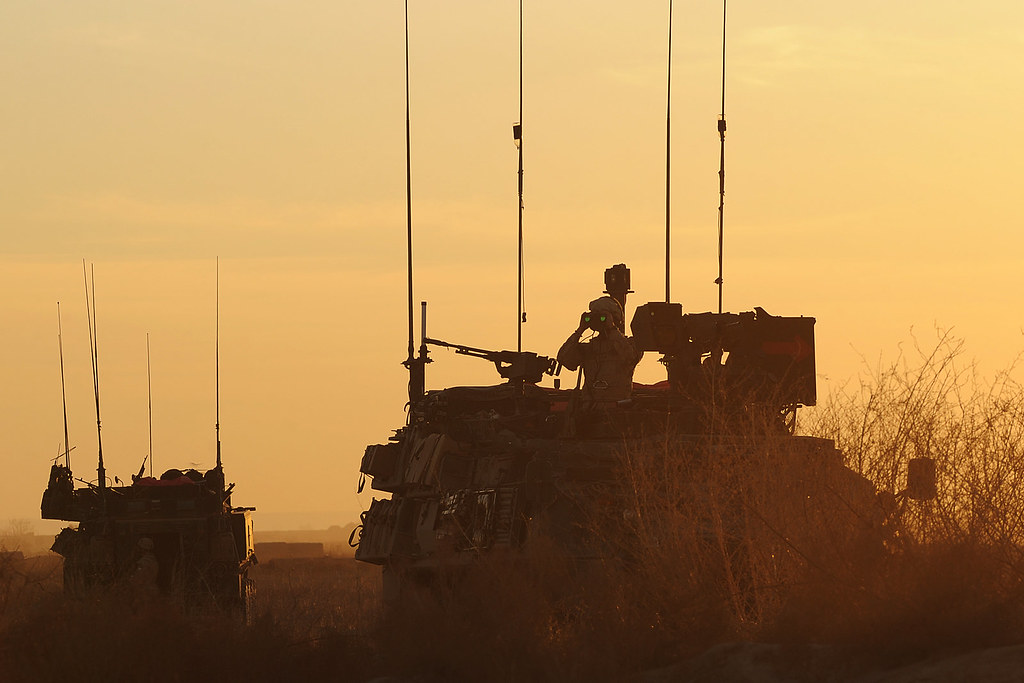
| Canadian LAVs, Afghanistan, by isafmedia |
Recent coverage of the war in Afghanistan has surrounded revelations from the USG cables leaked by Wikileaks, which paint an endless landscape of deceptions, divided loyalties, corruption, depravity and laughable optimism in the face of virtual anarchy. The incremental release of these documents by Wikileaks provides an ongoing stream of tidbits and fodder for headlines and public debate, especially as they concern Afghanistan; however, they so far have failed to create the mass of public interest and scrutiny required in the West to bring an end to the war. That is a tragedy in light of the ongoing situation described a year ago in the Nation, which in spite of official representations, effectively demonstrates that NATO and the Karzai Government exert no authority anywhere in Afghanistan outside their fortified bases and government offices.
The article is entitled How the US funds the Taliban, and examines two sides of the same coin: “The first is the insider dealing that determines who wins and who loses in Afghan business, and the second is the troubling mechanism by which "private security" ensures that the US supply convoys traveling these ancient trade routes aren't ambushed by insurgents.”
While the corruption that defines the first of these realities is worth examination and condemnation, it is the implications of the second which are inescapable and final in their depth.
The piece begins with a short bio of Ahmad Rateb Popal who is cousin to Hamid Karzai, a former Taliban official, mujahedeen fighter and a convicted drug trafficker who was released from Prison in the US in 1997. He is now, along with his convicted drug-trafficking brother Rashid Popal, principally in control of the Watan Group, which is a consortium of communications, logistics and security companies in Afghanistan. The Popal brothers are just the article’s introduction to the characters which fill positions of official and effective power in Afghanistan: “Welcome to the wartime contracting bazaar in Afghanistan. It is a virtual carnival of improbable characters and shady connections, with former CIA officials and ex-military officers joining hands with former Taliban and mujahedeen to collect US government funds in the name of the war effort.”
Private security firms in Afghanistan are most importantly charged in the defence of highway convoys which supply NATO’s network of bases with every last thing needed in the war effort; food to fuel to ammunition to toilet paper. “The epicenter is Bagram Air Base, just an hour north of Kabul, from which virtually everything in Afghanistan is trucked to the outer reaches of what the Army calls "the Battlespace"--that is, the entire country.”
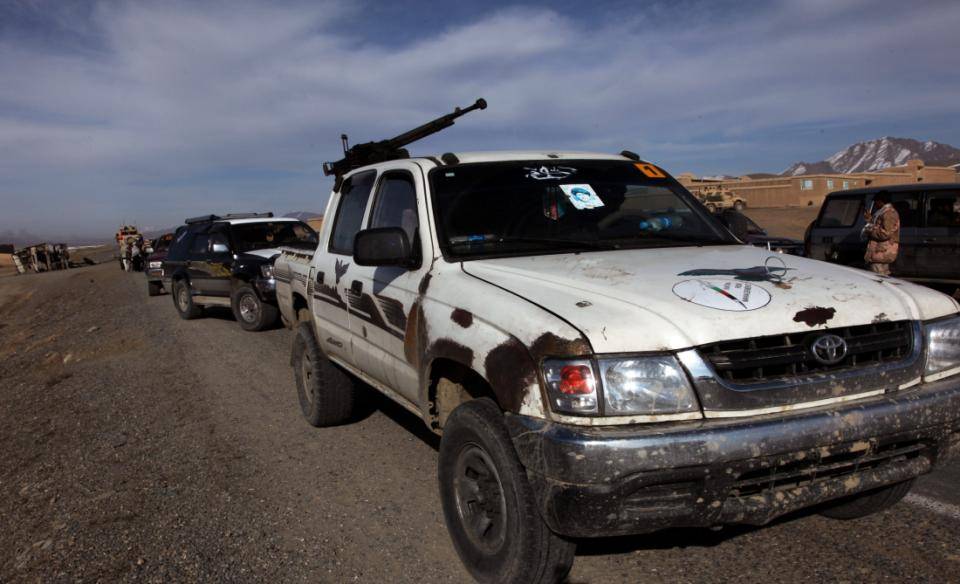 |
| Private Afghan Security, by isafmedia |
The article states, “The real secret to trucking in Afghanistan is ensuring security on the perilous roads, controlled by warlords, tribal militias, insurgents and Taliban commanders.” It quotes an American executive: “The Army is basically paying the Taliban not to shoot at them. It is Department of Defense money;” Project Manager Mike Hanna, for trucking company Afghan American Army Services: “You are paying the people in the local areas--some are warlords, some are politicians in the police force--to move your trucks through... We're basically being extorted. Where you don't pay, you're going to get attacked. We just have our field guys go down there, and they pay off who they need to;” A veteran American manager who has worked as a soldier and a private security contractor in the field: “What we are doing is paying warlords associated with the Taliban, because none of our security elements is able to deal with the threat;” Transportation entrepreneur: “Two Taliban is enough... One in the front and one in the back. You cannot work otherwise. Otherwise it is not possible.”
Apparently the term ‘private security company’ has in Afghanistan become something of a euphamism for Warlords and militia drawing from the deep well of Western taxpayer cash ‘intended’ to fund the stabilisation and reconstruction of the country. “Every warlord has his security company,” is the way one executive put it to the article’s author, Aram Roston. These ‘companies’ run by Afghan strongmen who find themselves in the favour of the corrupt Karzai administration, having divided loyalties and ulterior motives, must themselves hand over money to local powers to make the way secure along this or that highway.
These private firms are so mistrusted by the US and Karzai, both because of their affiliations with the enemy and their own private interests which conflict with those of the Karzai family, are prohibited by law from arming themselves beyond AK-47 rifles. In the face of Rocket-Propelled-Grenade attacks from insurgents targeting massive caravans of trucks, this seems much like trying to use brass-knuckles to protect a pack of antelope from attacking lions.
This problem is universal in Afghanistan, extending even to the most important highway there, aptly named highway 1. The previously mentioned Watan group, run by the Popal brothers, is charged with securing this highway, the virtual jugular of the West's war complex in Afghanistan, which runs between Kabul and Bagram Airforce Base in the east; south-west toward Kandahar and the southern half of the country. According to the article's author, "Watan's secret weapon to protect American supplies heading through Kandahar is a man named Commander Ruhullah. Said to be a handsome man in his 40s, Ruhullah has an oddly high-pitched voice. He wears traditional salwar kameez and a Rolex watch. He rarely, if ever, associates with Westerners. He commands a large group of irregular fighters with no known government affiliation, and his name, security officials tell me, inspires obedience or fear in villages along the road. It is a dangerous business, of course: until last spring Ruhullah had competition--a one-legged warlord named Commander Abdul Khaliq. He was killed in an ambush. So Ruhullah is the surviving road warrior for that stretch of highway. According to witnesses, he works like this: he waits until there are hundreds of trucks ready to convoy south down the highway. Then he gets his men together, setting them up in 4x4s and pickups. Witnesses say he does not limit his arsenal to AK-47s but uses any weapons he can get. His chief weapon is his reputation. And for that, Watan is paid royally, collecting a fee for each truck that passes through his corridor. The American trucking official told me that Ruhullah charges $1,500 per truck to go to Kandahar. Just 300 kilometers."
This is clearly an extortion racket which reveals the true balance of power in Afghanistan, with the various and shadowy forces at large in the country playing the role of competing mafias and NATO that of the fearful barbershop owner, dutifully paying 'protection' money to the people who would otherwise pop his kneecaps and put him out of business. In this strange case the Barber contends publicly that he has the extortionists on the run.
The overarching fact is that the West’s ostensible war and reconstruction effort is impossibly dependent on collusion with the forces it is pretending to fight. The need for local payoffs 8 years after the war began points to a reality that the US, NATO, and the Karzai government they support have established Zero effective control over the country outside of the fortified city-bases of Kabul, Kandahar, and a precious few others. This fact is so simple it is difficult to conceptualize. The issue is not that paying the enemy is against principle, nor that it bolsters the enemy’s resources and perception of itself, but that it is in fact direct proof of failure. To what purpose are any efforts in Afghanistan, when Western armies have not even secured the single-most important and fundamental logistical objective of warfare, which is to secure supply lines? NATO forces have no logistical control of Afghanistan. They cannot even eat without the approval of those they pay off. Is there in fact a war there? Or are NATO’s forces just part of a complex, factionalised Western/Afghan kleptocracy, wrestling with itself as its parties secure their interests and consolidate their power against each other? The military goals of the West seem quite unclear given that its forces cannot move anywhere without corrupting themselves by paying the enemy.
If the publicly-stated objective of the West’s mission is in fact peace, security and freedom, it would seem that this would begin by securing freedom of movement and safe passage throughout the country. Freedom of movement is paramount to building a free nation where goods, services and ideas can reach out and address the poverty of mind, means and opportunity that exists in Afghanistan’s isolated countryside. If this has not been achieved, than what has been done? Rather, there is a far-flung network of multi-billion-dollar bases providing security in provincial capitals for unpopular and fraudulently elected governments; completely dependent on payoffs to unscrupulous and opaque power structures for the maintenance of supply lines. One can only speculate as to the exact nature of the conflicting goals existing in the strange association of interests at work in Afghanistan; an association which ties together a dizzying myriad of Western government policy and taxpayer money, billion dollar contracts, executives, bureaucrats and politicians; Afghanistan’s proximity to Iran, Russia, Pakistan and its geopolitical importance as a bottleneck for Central Asian Trade routes; as well as its mujahedeen, the Taliban, Tribalism and the Karzai family. Western polls show a majority, even in militant America, that public opinion is against the war. To what depths must Afghanistan’s interminable corruption, murderous war, poverty and the (sometimes self-) deceptions of Western officials descend before the Western public not only oppose, but refuse to cooperate in it?
Read 'The Nation' article and more:

