Showing posts with label Economist. Show all posts

Wednesday, January 12, 2011

China: Fear of its Rise is Fear of Ourselves

A recent Economist article, The dangers of a rising China, leads a 14 page report loosely discussing the dangers posed to the world by China's eclipsing of the USA's international economic and military order.  The article attempts to draw parallels in the power-balance shift between Britain and Germany which led to the first World War, and that between the US and Britain, which is seen to have been peaceful.  Alternatively positive and negative outlooks are presented as The Economist offers its superficial analysis and weak solutions, but as to how to foster peace between the People's Republic of China and the West, the article does offer one shining and perhaps accidental insight.    

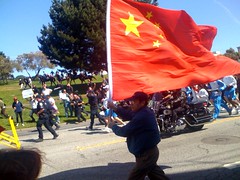
San Fran Olympic Torch Rally by tomnono
The parallels drawn between the hegemonic shifts of the 20th century at first appear credible.  Indeed, the competitive quest for empire and economic primacy on the European continent and elsewhere was the cause for the British-German arms race, ultimately which manifested in the orgiastic violence of the Great War which saw 16 million deaths and 21 million wounded, civilian and military.  This pessimistic view is countered with the absurd assertion that "Unlike the 19th-century European powers, it (China) is not looking to amass new colonies."  If colonialism was a method of expropriating the wealth of and creating markets in foreign lands, then China will surely remain at odds with the West on this basis, as both compete as Germany and Britain once did; in Asia, Africa and Latin America, employing trade agreements, capital and cooperation with corruption, as well as providing economic and military advisors to grease the wheels of neocolonialism; that which is the demonstrable policy of both the West and of China.

The Economist also looks hopefully to the main hegemonic shift of the 20th century, that from British to American.  This is ironic, since it was the devastating global conflagration of World War 2 which dismembered the British Empire and broke the British people's will to maintain it.  The British homeland itself was left in ruins, and thereby a hegemonic shift was a defacto result.  Thus it was war that ushered in the shift of global power, eventually in favor of the US.  However, the American global order was not immediately secured, but only itself born out of a further 40 years of global militaristic/economic expansion; major US wars in Korea and Vietnam; the Soviet war in Afghanistan; the littany of military actions across the third world; and a Nuclear standoff with Soviet Russia.  That this hegemonic shift "went well" as The Economist puts it, seems in the light of history preposterous.

What The Economist's hopeful bias will not permit in its report is a recognition that economic, technological and social structures are infinitely different than at any time in history, thus such a shift as it would happen today or in the future is without any useful precedent.  To start, the previous examples involve competing powers sharing in European heritage, culture and languages, and a similarity of social ethics, aspirations, and global outlook.  In the case of China, these are much different.  Not only are there vast differences in all these catergories between China and the West, but Chinese Nationalism is keenly aware of its recent history as a colonial subject of the West, and sees the economic and political elites in the US as the inheritors of that imperialist know-how and infrastructure.

Chinese Nationalism looks upon its long-time enemy Japan, perhaps correctly, as simultaneously a base for the projection of American military and economic power, and an unapologetic beligerrent whose political class still absolves and honors as heroes the Imperial Army Generals and Soldiers who committed the occupation of China and the rape of Nanking.  Offerings by Japanese Prime Ministers, most recently in 2009 by Taro Aso, at the Yasukuni Shrine and War Memorial where recognised war criminals are honored, have created tremendous popular backlashes in China.  China sees itself surrounded by the American military and its proxies in the pacific, with the US Navy sitting in South Korean and Taiwanese waters within shooting distance of the Chinese coast.  Such a situation could only be hypothetically balanced in size and proximity by China's occupying Cuba, the Bahamas and the Canadian Province of Nova Scotia with 70,000 troops and therein installing and equipping dozens of Naval, Air-Force, and Army bases to the tune of billions of dollars. This is to say nothing of the demonstrated willingness of the US to apply its military resources in China's neighborhood, such as in the Korean War and the holocaustal Vietnam War wherein millions died.  These both took place within living Chinese memory.  Taking place now: "The US Navy has begun to deploy more forces in the Pacific," The Economist reports.

A brief study into the history of China's relations with its neighbors and the West reveals fact after fact lending support to the attitude of indignation in China towards the US and Europe.  The Economist article asserts that a number of things will help to ease the transition.  These range from the briefly insightful to the absurd.  It suggests that "America and China need rules for disputes" and "America and China should try to work multilaterally (in Asia)"  But in the absence of demonstrated trust and mutual respect, rules and agreements will be broken, and multilateral discussions and organisations will be but another battlefield for diplomatic and economic clout.  The article comes close to the spirit of the answer to this terrifying question when it posits that "If America wants to bind China to the rules-based liberal order it promotes, it needs to stick to the rules itself."  This is a remarkable admission by the Economist of the US's hypocrisy.

Moreso, such is a tacit recognition that the current Empire must lead by example and act under the principles that it can only hope China will abide by once it overtakes the seat of global power.  The US must do much more to value economic equality, education and democracy at home, and respect the sovereignty and human rights of those abroad.  It must do more to promote freedom and peace for all nations; Not attempt to impose them as a pretext to military intervention in places such as Iraq and Afghanistan.  The US must make difficult decisions as to how to unwind the relationship between its military and its economy; these are understood in China and other quarters as so entwined that the US must perpetuate conflict and imperialism in order to survive.  China will never see in the US plutocracy a credible partner in any undertaking, but only a group of self-serving aristocrats guided by the ethics of capitalism, greed and consolidation.  It may be possible to avoid a conventional military conflict between China and the US during this great hegemonic shift if the US recognises China's military and economic clout and begins to bargain away its stack of chips in Taiwan, the South China Sea, Japan, Korea etc.  But such is likely to promote the further moulding of China into a militarist/imperialist economy whereby all of the fears of an opaque and unaccountable Chinese world leadership will be realised. Such will not lead to any type of greater peace.

The only chance for a true and peaceful resolution of the conflicting interests of China and the US to come about is by a change in those very interests:  Away from militaristic/economic dominion and global paternalism which sows discord, misery and disenfranchisement everywhere; toward finally abiding by the principles which the people of the West have always espoused: Peace, human rights and equality of opportunity for everyone everywhere.  Continued posturing by the US as the world's indomitable military and economic power requires China to assert itself globally through economic control of resources and military capability.  A graduation by the West to a higher moral ground; by a recognition of reality and a genuine redress of the ills of its own and society abroad, through education and democratic change; only these changes can compell lasting peace and inspire in China the changes it requires to be a more just and accountable world power. 


Read the Economist Article:
http://www.economist.com/node/17629709

Read more about it:
http://www.taipeitimes.com/News/editorials/archives/2010/09/27/2003483897
http://www.opendemocracy.net/democracy-china/nationalism_3456.jsp

Tuesday, November 23, 2010

East eats West?

This week's Economist magazine's headlining articles and cover-page, 'Buying up the world- The coming wave of Chinese takeovers' highlight the process and nature of foreign takeovers by Chinese firms.  The piece offers surprisingly little discussion or speculation as to China's deeper motivations and timing in its recent takeover bids for large multinational companies, or as to the reasoning of other governments and critics who would resist the emerging trend before concluding that rejecting China's advances would "be a disservice to future generations." 

There is something absurd about the reasoning in these articles, which do point out the "opaque and arbitrary" nature of authority within large Chinese companies, and which do briefly note that takeover bids are most often made on companies working in strategic resource sectors; but which base their conclusions on speculation that Chinese firms will "bring new energy and capital to flagging companies around the world," that "Chinese companies will have to adapt" and that its investments in the global economy will help to make China's interests "increasingly aligned with the rest of the world's."  That the Economist can readily admit to not understanding the motivations and interests of "opaque" Chinese government and authority but then predict its evolution is a failure of logic and a cause for concern should policy makers around the world find agreement with this thesis.

A steady accumulation of bonds and hard currency in all denominations, especially of its largest rivals in the US and Euro-zone, coupled with a well timed and targeted increase in the rate of takeover of global means of production and access to raw materials represents an obvious, well planned, forward looking and ongoing effort to supplant Western hegemony in favor of an ill-defined future global order over which a preeminent China presides.

This is the Chinese mission according to Chinese leaders and state-owned news outlets, as discussed in a 2008 CSIS report which states among other things: "The PRC-owned Hong Kong daily Wen Wei Po opined that the elevation of the “harmonious world” theory in the congress work report indicates that Hu (Jintao) is “assuming an even more important role in international affairs that is, as ‘formulator, participant and defender of world order,’ in order push the entire world toward harmony.”  Other such thinking among leading Chinese thinkers is evident in Zhao Tingyang’s The Tianxia System: The Philosophy for the World Institution (2005) and Liu Mingfu’s book The China Dream: Great Power Thinking and Strategic Positioning of China in the Post-American Age (2010).  All of these sources are united in their assumption that a Chinese eclipse of Western economic power is inevitable, though they may differ on their view of that post-ecliptic world.  Without knowing the truth about China's aims, the West should be wary of allowing a monolithic foreign government access to its strategic resources and internal economies.  

The Economist article gives further evidence that China's entry into global capitalism is not motivated by the usual basic greed and desires of Western investors when it reports that "Natural-resources firms can become captive suppliers to China, rather than selling on the open market... Westerners realised their new objective was to maximise production, not profits" and "Chinese firms... risk political fallout if they fail.  Their sense of mission makes them 'transparent', says one European executive."  That China's is a long term view is undeniable in the context that they would forgo immediate profit by selling to the highest bid on the market in favor of repatriating newly exploited resources. 

Western economic domination of the world reached its zenith in the 20th century, when according to this weeks Economist articles "Britain owned 45% of the world's FDI (Foreign Direct Investment) in 1914; America's share peaked at 50% in 1967."  It is undeniable that, in competition and in concert, Western powers used their public institutions and militaries to further their economic-imperial goals, making the 20th century the bloodiest and most warlike known to history.  Entire continents were subjugated and looted in the pursuit of profit and 'civilisation',- including China, and large parts of Central and South America, Asia and Africa remain captive to the national and corporate institutions which have inherited that legacy.  While the West so often points out China's human rights abuses and excesses of power, the Chinese are always quick to point out the hypocrisy of such criticisms, as it did in its recent report on the US's human rights record published in the China-daily; a startling and credible list of very recent abuses.  If there are any worries among people in the West as to the waning of Western power in favor of Chinese influence, it should perhaps not be in lament of a lost golden age of economic and military triumph, but in fear that the emerging power in China, accountable to no one and secretive in their aims and motivations, will as it hijacks a global economic system which promotes greed and consolidation of power, look upon and treat the West in the same manner that the West has China and the rest of the world.  


Read the Economist reports and other related articles here:

The Economist:
http://www.economist.com/node/17463473
http://www.economist.com/node/17460954

Regarding Chinese policy and statements about US human rights abuses:
http://csis.org/files/media/csis/pubs/080129_murphydecoding.pdf
http://www.chinadaily.com.cn/china/2010-03/12/content_9582218.htm

Regarding takeovers:
http://news.bbc.co.uk/2/hi/7967604.stm
http://www.cbc.ca/money/story/2010/11/03/potash-ottawa-review.html 
http://www.thetrumpet.com/?q=6336.4792.0.0

Monday, November 15, 2010

Famine Present, Brazilian Future?

A recent Economist article is shocking, if not blindly optimistic in its revelations about the world's prospective ability to feed itself.

The piece, published in the Aug. 28th edition, attempts to present Brazil's agricultural reforms of the past 40 years as a road map to insuring against future famines.  However misguided in its conclusions, the article is honest in its presentation of the problem of world hunger, acknowledging that "by 2050 world grain output will have to rise by half and meat production must double to meet demand."  One may wonder if these increases would only serve to maintain the current balance of global food supply and demand, which provides enough food at low enough prices to properly feed only 5 out of 6 people on the planet (WHO statistic), leaving more than 1.1 billion people in a constant state of mortally dangerous hunger and malnutrition.  The author also admits that these increases must come in spite of "flattening" growth in global grain-yields, a lack of "extra farmland" and "renewable water running short.".

The article opens with the suggestion that the current Malthusian pessimism, as far as agriculture is concerned, is trivial enough to be fit for making puns, and that the world has been subject to such doomsaying before, such as in the 1968 Best-seller The Population Bomb by Paul Erlich, which predicted that in the "1970's and 1980's hundreds of millions of people will starve to death."  Nevermind the fact that Erlich was essentially correct in his prediction, and nevermind that such a state of affairs continues to be true, with current WHO estimates attributing 36 million deaths per year to hunger and malnutrition.

Attempting to offer constructive and positive suggestions as to the problem's solution, the Economist lays out the basis for what it terms "Brazil's agricultural miracle."  Brazilian farms are "many times the size even of American farms," America being the home of large-scale industrial farming; that "Farmers... sell crops on a scale that makes sense only if there are world markets for them... they depend critically on new technology," and that "Brazil's progress has been underpinned by the state agricultural-research company and pushed forward by GM crops."  The article minimizes damage to the Amazon rainforest as a part of the "miracle" to the point of incredulity, saying that Brazil is an example of how to "save the world's imperilled ecosystems" by growing "so much food elsewhere that nobody would need to touch the natural wonders."  One is left to speculate on what type of statistics underpin this fantastic argument. 


Ambiguation and pun making aside, the article makes no account for certain troubling facts.  According to the WHO, 11 million Brazilians remain "undernourished," even as Brazil is a net food exporter, and while this number is on the decline, one cannot separate the economic, agricultural and land reforms of the past 40 years in Brazil from the military dictatorship which initiated them in the late 1960s and early 1970s.  It was an iron fist that swept aside property rights and civil liberties, and held down working-class wages in the name of agro-industrial progress and upper-class economic growth.  Former General/President Emilio Medici famously gave an honest assessment of his government's policies: "A economia vai bem, mas o povo vai mal"- "The economy does well, but the people do poorly." 

If the Economist is correct in its assertion that food production will need to increase dramatically in the next 40 years to meet demand, it remains unclear how other countries could manage to duplicate the 'milagre Brasileiro,' which would require them to conjure new farmlands and sources of fresh water, of which Brazil had untapped abundances of; to make multiple technological breakthroughs allowing more and more efficient use of those ever more scarce lands and resources and to abandon democracy, property rights and free markets in favor of central planning and speedy consolidation. To replicate this "miracle" outside Brazil seems less an option than a strange dystopic pipe-dream of plutocratic control and alchemy, perhaps just as nightmarish as any Malthusian prediction.


Read the Economist article at http://www.economist.com/node/16889019

Saturday, October 9, 2010

The ANA: Afghan National Army or Afghan Notional Army?

An article in the August 21st 2010 edition of the Economist, 'Fixing the Unfixable', describes in colorful detail the challenges facing the American effort to create a cohesive Afghan National Army (ANA).  The article makes the argument that a capable ANA is a prerequisite to Western forces leaving the country, if the Afghan government is to be spared collapse.  In making its case, the article draws attention to different aspects of the ANA's situation, which reeks of amateurism from top to bottom.

While credible reports as to the the Afghan National Army and Police's moral corruption abound, whether it be the routine torture of detainees or the pedophilic practice of bachabazi, the Economist provides insightful data as to the actual capability of the ANA, or lack thereof.  The article cites a report released earlier this year by Arnold Fields, the US inspector general for Afghan reconstruction, which says that only 23% of ANA soldiers and 12% of police can be trusted to work unsupervised.  Senior officers are known to be stealing food and fuel, and are accused of stealing weapons.  Certainly the capability of the ANA to govern itself and command respect from its own members is under serious question.

As to the ANA's capability in the field, the Economist presents some interesting numbers: "During operations, they remain almost totally reliant on NATO troops, who suffer twice as many casualties."  The image this conjures is one of ANA troops taking full cover at first sign of the Taliban, before calling in Western forces to clean up the mess.  An episode is described where, without the operational support of NATO, 300 ANA soldiers managed to get themselves ambushed by the Taliban in Laghman.  A quick look into this story, reported in the Wall Street Journal, August 10, 2010, tells that the ANA commando units, such as the one defeated in the ambush "are supposed to be the force's best units."  Many were killed and captured and the unit was "missing" according to the words of Gen. Zahir Azimi of the Afghan Defense Ministry. 

Another concern raised by the Economist is over the ANA's sustainability and identity as a 'National' army.  "Less than 3% of recuits to the ANA are from the Pushtun south, from where the Taliban draw most support."  This is a huge discrepancy, as the Pushtuns are the largest ethnic group within Afghanistan.  Apparently translators are often required not just for NATO officers, but also for ANA officers when operating in Pushtun districts, where most of the insurgency is being fought.  That the makeup of the ANA is being drawn along the same divisive ethnic and tribal lines as the rest of Afghanistan is a concern to many as to the viability of the ANA, as to who the ANA truly represents and is willing to defend, and as to whether or not the ANA can help avoid a civil war after Western forces leave, or whether it would infact help precipitate one. 

The article mentions that Army pay has been increased from $120 to $165 a month.  While this is apparently good pay in Afghanistan, it does raise the question of motivation.  To speculate, it would seem likely that in such a poor and divided country, with no national military tradition, it is the pay and the pay alone that motivates recruits to keep coming back.  In combat, as we have seen, the ANA forces seem to shrink from confrontation, which may be a sign that ANA soldiers show up to work to get paid, not to risk their necks.  In many cases the pay does not seem to be enough, as the ANA's desertion rate is astronomical.  A Nov. 26, 2009 article in the Asia Times cites an Inspector General for reconstruction report revealing that one in every four combat soldiers quit the ANA during the year ending in September 2009. 

The Economist discusses all of these problems in the context of their appraisal and addressing by General William Caldwell, who upon recently taking charge of organising the ANA, is reported as "horrified" that the focus was on "quantity, not quality".  Horrifying perhaps, but unsurprising that priorities at the ANA are out of place.  That much is already evident.  But the type of training received by many recruits may also have spoken to them about the nature and strength of the West's commitment to the ANA.  Caldwell reports that "The ratio of instructors to students was 1 to 80... On one base, it was 1 to 466 - There were no training standards... It was just, eight weeks and you're done."  It may have seemed to many recruits that the type of Army they were joining was one of appearances.  "Some contractors failed even to show recruits how to calibrate the sights on their weapons" the article reports.  With this being the level of preparation, losses in the field and desertion in the ANA ranks seems to find context.

To learn that contractors are responsible for the dismal type of training given to ANA recruits is to consider another aspect which puts the viability of not only the ANA, but the entire mission into question.  While the profit motive is ever present in any military adventure, and particularly American ones, in this instance it has undermined its objectives.  It is astounding that such an integral part of the American strategy for reconstruction, the training of an effective national army, could be commoditised and offered up for contract, and then to be administered privately and with such little oversight.  It leaves one to question the administration of the entire operation, and where else profit motives are being allowed to hinder the objectives of the Afghan mission.

Perhaps General Caldwell may find it more horrifying, the prospect of forming a credible modern army out of an ill-equipped ragtag group of illiterate peasants, pedophiles, corrupt officers and amateurs with mixed loyalties, ill-trained by foreigners more interested in making a quick buck than in the future of Afghanistan.  Perhaps he is deluded: his goal is to expand the army from 134,000 to 171,600 over the next 12 months.  This would represent an increase of some 37,000 soldiers, which is as much as the ANA has grown in the last 5 years when the focus was on "quantity, not quality".  These numbers are pie in the sky, as much as the mission is itself. 

That such an army, divided against itself, could ever prop up a national government seems a far away prospect.  Indeed the ANA appears to be something of a joke, and an army more in name than in reality.

Read the Economist article at http://www.economist.com/node/16846714

Wednesday, October 6, 2010

Western taxpayers to bail out Karzai's Kabulbank?

An article in the September 11 edition of the Economist, "House of Karzai", sheds light on the corrupt regime of Hamid Karzai. It investigates the causes of a run on an Afghan bank, Kabulbank, mired in corruption and on the brink of failure.  The Economist describes a group of people working together, including Mahmoud Karzai, president Karzai's brother, who have managed to control Kabulbank and use it to invest in their own speculative ventures.  Mahmoud Karzai apparently is the 3rd biggest shareholder at the bank.  It is well known that he holds a 7% share, which he purchased for $5million by first borrowing the $5m from Kabulbank itself.

The article describes an area on Dubai's famous palm shaped peninsula refered to as "Little Afghanistan" where are found luxury mansions for "Afghanistan's business and political elite."  The article asserts directly that Kabulbank was used improperly in the funding of these Dubai real-estate ventures when it says "Hundreds of millions went into Dubai properties then handed to shareholders and their friends" and "the bill was picked up by ordinary Afghans who put money into Kabul Bank, a scandal-wracked institution..." Little Afghanistan is but one example of the missappropriation of the banks funds and lending.  According to the Economist, there is a string of loss generating companies owned by Kabulbank shareholders, into which Kabulbank loans and funds were siphoned, including an airline and a cement factory. 

Thus a run on Kabulbank?  Some may wonder how it could not have come sooner.  In proper form, Mahmoud Karzai has publicly solicited a bailout for the bank from the American taxpayer, which is hilarious and revealing on its own- after all, why shouldn't he just go right to the source?  That being turned down flat by the Americans, the article reports that the "Afghan government" aka Hamid Karzai, "said it would give the bank whatever it needed from its own reserves".  Though "American officials" have pushed for an inquiry into the fiasco, to no one's surprise, the Afghan government, aka Hamid Karzai, is not forthcoming.  The Economist article concludes first by stating that the bank is "too important to fail", and it evokes the image of civil strife should the bank "enrage almost a quarter of a million armed customers".  Are they not yet enraged?

Inquiry or not, it seems the use of the Afghan treasury to rebuild Kabulbank is inevitable.  While for all parties this is a more politically palatable solution than that proposed by Mahmoud- a direct bailout from the US treasury, it is only so because most Western voters are not aware that roughly two-thirds of the Afghan treasury is funded by their taxes, through their governments via aid payments and the World Bank.  Western nations with military involvement have already seen their voters sour at the thought of risking more lives and spending further military resources to prop up the corrupt Karzai government, but the decision to use the Afghan treasury for such a payoff should in fact raise the ire of the hundreds of millions of taxpayers in all Western nations who have invested in Afghanistan, or the World Bank for that matter. In either case, it is the Karzai family getting the best of people of Afghanistan, the US and the rest of the world. 

To be fair, it may be that the Karzais are merely a product of the system of patronnage, curruption and elitism that has divided Afghanistan for so many generations.  And while the legitmacy and the exact reach or sustainability of the institutions created under the Karzai regime are in constant question, episodes such as the Kabulbank fiasco should inspire debate in Western Democracies as to the methods and motives of their own governments and businesses, who after 8 years of war and 9 years of standing behind Mr Karzai, have managed only to help create for themselves another corrupt and dictatorial client state.  One can hope.

Read the Economist article at http://www.economist.com/node/16996926