Showing posts with label democracy. Show all posts

Wednesday, January 12, 2011

China: Fear of its Rise is Fear of Ourselves

A recent Economist article, The dangers of a rising China, leads a 14 page report loosely discussing the dangers posed to the world by China's eclipsing of the USA's international economic and military order.  The article attempts to draw parallels in the power-balance shift between Britain and Germany which led to the first World War, and that between the US and Britain, which is seen to have been peaceful.  Alternatively positive and negative outlooks are presented as The Economist offers its superficial analysis and weak solutions, but as to how to foster peace between the People's Republic of China and the West, the article does offer one shining and perhaps accidental insight.    

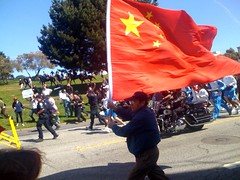
San Fran Olympic Torch Rally by tomnono
The parallels drawn between the hegemonic shifts of the 20th century at first appear credible.  Indeed, the competitive quest for empire and economic primacy on the European continent and elsewhere was the cause for the British-German arms race, ultimately which manifested in the orgiastic violence of the Great War which saw 16 million deaths and 21 million wounded, civilian and military.  This pessimistic view is countered with the absurd assertion that "Unlike the 19th-century European powers, it (China) is not looking to amass new colonies."  If colonialism was a method of expropriating the wealth of and creating markets in foreign lands, then China will surely remain at odds with the West on this basis, as both compete as Germany and Britain once did; in Asia, Africa and Latin America, employing trade agreements, capital and cooperation with corruption, as well as providing economic and military advisors to grease the wheels of neocolonialism; that which is the demonstrable policy of both the West and of China.

The Economist also looks hopefully to the main hegemonic shift of the 20th century, that from British to American.  This is ironic, since it was the devastating global conflagration of World War 2 which dismembered the British Empire and broke the British people's will to maintain it.  The British homeland itself was left in ruins, and thereby a hegemonic shift was a defacto result.  Thus it was war that ushered in the shift of global power, eventually in favor of the US.  However, the American global order was not immediately secured, but only itself born out of a further 40 years of global militaristic/economic expansion; major US wars in Korea and Vietnam; the Soviet war in Afghanistan; the littany of military actions across the third world; and a Nuclear standoff with Soviet Russia.  That this hegemonic shift "went well" as The Economist puts it, seems in the light of history preposterous.

What The Economist's hopeful bias will not permit in its report is a recognition that economic, technological and social structures are infinitely different than at any time in history, thus such a shift as it would happen today or in the future is without any useful precedent.  To start, the previous examples involve competing powers sharing in European heritage, culture and languages, and a similarity of social ethics, aspirations, and global outlook.  In the case of China, these are much different.  Not only are there vast differences in all these catergories between China and the West, but Chinese Nationalism is keenly aware of its recent history as a colonial subject of the West, and sees the economic and political elites in the US as the inheritors of that imperialist know-how and infrastructure.

Chinese Nationalism looks upon its long-time enemy Japan, perhaps correctly, as simultaneously a base for the projection of American military and economic power, and an unapologetic beligerrent whose political class still absolves and honors as heroes the Imperial Army Generals and Soldiers who committed the occupation of China and the rape of Nanking.  Offerings by Japanese Prime Ministers, most recently in 2009 by Taro Aso, at the Yasukuni Shrine and War Memorial where recognised war criminals are honored, have created tremendous popular backlashes in China.  China sees itself surrounded by the American military and its proxies in the pacific, with the US Navy sitting in South Korean and Taiwanese waters within shooting distance of the Chinese coast.  Such a situation could only be hypothetically balanced in size and proximity by China's occupying Cuba, the Bahamas and the Canadian Province of Nova Scotia with 70,000 troops and therein installing and equipping dozens of Naval, Air-Force, and Army bases to the tune of billions of dollars. This is to say nothing of the demonstrated willingness of the US to apply its military resources in China's neighborhood, such as in the Korean War and the holocaustal Vietnam War wherein millions died.  These both took place within living Chinese memory.  Taking place now: "The US Navy has begun to deploy more forces in the Pacific," The Economist reports.

A brief study into the history of China's relations with its neighbors and the West reveals fact after fact lending support to the attitude of indignation in China towards the US and Europe.  The Economist article asserts that a number of things will help to ease the transition.  These range from the briefly insightful to the absurd.  It suggests that "America and China need rules for disputes" and "America and China should try to work multilaterally (in Asia)"  But in the absence of demonstrated trust and mutual respect, rules and agreements will be broken, and multilateral discussions and organisations will be but another battlefield for diplomatic and economic clout.  The article comes close to the spirit of the answer to this terrifying question when it posits that "If America wants to bind China to the rules-based liberal order it promotes, it needs to stick to the rules itself."  This is a remarkable admission by the Economist of the US's hypocrisy.

Moreso, such is a tacit recognition that the current Empire must lead by example and act under the principles that it can only hope China will abide by once it overtakes the seat of global power.  The US must do much more to value economic equality, education and democracy at home, and respect the sovereignty and human rights of those abroad.  It must do more to promote freedom and peace for all nations; Not attempt to impose them as a pretext to military intervention in places such as Iraq and Afghanistan.  The US must make difficult decisions as to how to unwind the relationship between its military and its economy; these are understood in China and other quarters as so entwined that the US must perpetuate conflict and imperialism in order to survive.  China will never see in the US plutocracy a credible partner in any undertaking, but only a group of self-serving aristocrats guided by the ethics of capitalism, greed and consolidation.  It may be possible to avoid a conventional military conflict between China and the US during this great hegemonic shift if the US recognises China's military and economic clout and begins to bargain away its stack of chips in Taiwan, the South China Sea, Japan, Korea etc.  But such is likely to promote the further moulding of China into a militarist/imperialist economy whereby all of the fears of an opaque and unaccountable Chinese world leadership will be realised. Such will not lead to any type of greater peace.

The only chance for a true and peaceful resolution of the conflicting interests of China and the US to come about is by a change in those very interests:  Away from militaristic/economic dominion and global paternalism which sows discord, misery and disenfranchisement everywhere; toward finally abiding by the principles which the people of the West have always espoused: Peace, human rights and equality of opportunity for everyone everywhere.  Continued posturing by the US as the world's indomitable military and economic power requires China to assert itself globally through economic control of resources and military capability.  A graduation by the West to a higher moral ground; by a recognition of reality and a genuine redress of the ills of its own and society abroad, through education and democratic change; only these changes can compell lasting peace and inspire in China the changes it requires to be a more just and accountable world power. 


Read the Economist Article:
http://www.economist.com/node/17629709

Read more about it:
http://www.taipeitimes.com/News/editorials/archives/2010/09/27/2003483897
http://www.opendemocracy.net/democracy-china/nationalism_3456.jsp

Friday, January 7, 2011

British Ethics: A Dark Comedy

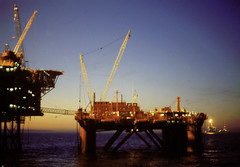
North Sea Oil Drilling by crawfish head
Yesterday, January 6th 2011, the UK Parliamentary committee appointed to look into whether the government should enact a moratorium on deep-water drilling in the wake of the Gulf of Mexico-BP oil disaster, has ruled out the need for a halt to new projects before new regulations can be put in place.  In an absurd and stunning turn of logic, the report discusses the myriad of reasons why such a moratorium is necessary, particularly in the UK, before concluding that it is not necessary.  This freshman coalition government of the UK, by this report and an already long list of betrayals of the public interest, is demonstrating to statesmen and governments everywhere that constituents are not united in their willingness to defend their rights in the face of blatant misrepresentations and misallocations of public offices and resources.

The report makes light that any clean up of a spill in the North Sea, whose conditions are much less calm than in the Gulf of Mexico, would be infinitely more difficult.  The report suggests a number of regulations which should be enacted, both to safeguard against possible accidents as well as to prepare in the event of such accidents; also the report demonstrates how British law is murky as to who could be held legally accountable in the event of a spill.  However, without imposing a moratorium, there is little impetus for government and business to work together to put such regulations in place.  Companies such as BP and Chevron have been moving ahead with their projects in the North Sea with approvals and licences, furnished by Cameron's coalition government even while the BP well in the Gulf of Mexico was still hemorrhaging oil.

Indeed, a veritably horrifying dark comedy is unfolding in the UK, which makes a mockery of ethics, representative government, and makes plain the arrogance of power.  David Cameron's pledge to make the new coalition government the "greenest government ever" seems as conniving and opportunistic a statement as the installation on his home of a wind turbine, machines which he previously cynically referred to as "bird-blenders." 


BP Deepwater Horizon Gulf Oil Disaster, by US Coast Guard
First, there are the appointments made by the incoming "austerity" Prime Minister Cameron who came to office after the Gulf Oil disaster began.  Johann Hari reports that "The Prime Minister thought the best person to be his 'Cuts Tsar' was John Browne... he was the head of BP, until he was forced to resign in 2007 because he was shown to have lied in court testimony... Browne arrived at BP promising to do exactly what Cameron is promising to do to the British state... He said you could slice out great chunks of staff and provide the same standard of service.  The workers he sacked included BP's specialist engineers... As the investigative reporter Tom Bower has written: 'Hundreds were fired and replaced by subcontractors... Browne ditched BP's in-house expertise'...  The consequences were soon clear. BP's Texas City refinery blew up, killing 15 workers, and the official investigation found that BP 'tolerated serious deviations from safe operating practices, and apparent complacency toward serious safety process risks at each refinery.' Browne carried on cutting anyway, in a process Bower argues 'led directly to the current catastrophe' (Gulf spill)... the Prime Minister believes the best person to oversee his cuts agenda is an oilman whose last cuts destroyed the Gulf of Mexico... It's an inspiring model to apply to our schools, hospitals, and transport."

There is the appointment of oilman Tim Eggar as a government liaison to oil companies.  Eggar's recommendations helped shape budgetary and energy policy which, in spite of Cameron's public stance of fiscal restraint and green government, gave major tax breaks to oil companies and incentives to continued expansion of exploration and operations in the North Sea. 

Among other appointments, there is Conservative Cameron's appointment of Lib-Dem MP Vince Cable to 'Secretary of State for Business, Innovation and Skills' as an ostensible gesture of unity in the formation of a coalition government between the Conservative and Lib-Dem parties.  Cable is a former Shell executive from back in the day when Shell was working with the Nigerian military to dispossess landholders and murder dissident leaders such as Ken Saro-Wiwa.  Recently he boldly stated to UK students that his Lib-Dems "didn't break a promise" in the wake of the trebling of their university fees, in spite of a Lib-Dem manifesto which plainly committed the Lib-Dems to explicitly opposing any changes to or increases of fees.  Cable's portfolio and ministry was directly responsible for the new fee structure, and while feeling the public heat before the vote on the matter he insinuated he might abstain from voting in parliament on the new fees - which itself would still have been a denial of his party's platform to oppose changes to the fee structure - he went ahead and voted in favor of raising tuitions anyway.  He is further chameleonic in his self re-branding as a left-wing politician, after years of supporting economic liberalisation in the form of proposals to privatise UK health insurance as well as Tony Blair's liberalisation of financial markets, which in turn helped to create bank failures and housing bubbles in the UK. 


Sherwood Forest, by Puptoes74
Perhaps bolder than all these political maneuverings is the decision by Cameron's government to put all of Britain's forests up for sale, a move that has already seen private interests move in to purchase and fence in forests previously accessible to the public.  Only a few regulatory changes stand in the way of these National treasures being razed to the ground for timber, development and a quick profit.  Indeed, there seems little other purpose than that to purchasing the land, which in its current form can provide no income for the purchasers to recoup their investment.  The irony of the famous Nottingham/Sherwood Forest being up for sale has not been lost on British journalists, who wonder aloud how Robin-Hood would react to having his hideout sold out from under him.

Those following Cameron's government more closely would point out further betrayals, not just of single promises, but of the cornerstones of his party's and supporter's political ethics:  Halting any increases to payments to the EU in a time of austerity; Protecting pensioners from increased costs of living; the list goes on.  He has baldly favored his political and business allies at the expense of his honor and credibility among the votership.  In spite of this, is it possible he believes he could win a second election?


English "Bird=blender" c. 1820, by Martin Pettitt
The actions of the coalition government in the UK have been a bold rejection of the fear of being held accountable.  They evidently know that they can say one thing plainly and just as plainly do the opposite.  They apparently believe that the public will accept the Orwellian truth that 2 + 2 = 5.  People of free will and democratic tendencies the world over have much to fear from David Cameron's government, who by example is, so far, demonstrating to the unscrupulous and unethical everywhere that people at large will mainly fail to defend themselves.  Or perhaps it was he who inherited this knowledge from George Bush?  Of course, lies and duplicity are nothing new to politics.  But is it possible that it is such the norm, that the votership, still engaged at rates around 50% in English speaking nations, not only accepts this reality, but are more and more willing to cooperate with it?  Those who are not can certainly tell it to the riot police in the streets.


Read more about

David Cameron's appointments and environmental policy:
http://www.johannhari.com/2010/07/15/now-david-cameron-shafts-the-environment

UK parliament's report on deepwater drilling:
http://www.platts.com/RSSFeedDetailedNews/RSSFeed/Oil/8376186

UK forests up for sale:
http://www.independent.co.uk/opinion/commentators/johann-hari/johann-hari-for-sale--camerons-green-credentials-2177929.html

Vince Cable:
http://www.newstatesman.com/uk-politics/2009/09/mehdi-hasan

Friday, December 17, 2010

Russia, Violence and Protest: What it is and what it is not

Reports and video footage of violent demonstration and criminality by ultra-nationalist and racist organisations in Russia this week are forming an interesting juxtaposition to recent political protests in the West. 

If one is interested in what ‘violent thuggery’ actually looks like, witness this week’s outburst of unrest in Moscow:  Rampaging gangs seeking racist revenge against non-Slavic Russians after Moscow police failed to hold in custody four suspects in the murder of a Moscow Spartak football hooligan, who died in a post-match brawl with immigrants from the North Caucasus region.  These ‘thugs’- in the true sense of the word- are affiliated with nationalist ‘football firms’ and are quite used to attacking police at football games as a matter of sport.  The firms collectively have thousands of members across the country and are loosely organised and armed: mostly with edge weapons; sticks and truncheons; in some cases tazers.  They have over the past many days readily engaged police en-masse in Moscow and attacked bystanders who were of Central Asian or similar ethnic extraction.  An ethnic-Kyrgiz man has been stabbed to death in revenge, and dozens of innocent ethnic minorities were ruthlessly beaten by the crowds, videos showing police attempting to protect bystanders, not incriminate them by kettling them with demonstrators for hours until they are provoked into active resistance by hunger, exhaustion, confusion, claustrophobia and police taunts, as has been seen in Pittsburgh, Toronto, and very recently London.  

The scenes in Moscow reveal what it looks like when police attempt to contain and quell throngs of actually violent citizens, not the notional ‘thugs’ of Western political description.  Pale in comparison are the so-called ‘violent protests’ in the West; rather the recent demonstrations in London and Toronto set next to the type of violence in Moscow (as seen in the video embedded below- watch from 0:40) seemingly depict Western police as aggressive, well-trained and highly equipped paramilitary forces acting on marching orders to illegally suppress freedom of movement, expression and peaceful demonstration.
 

The ‘football firms’ of Russia that brought the fight to Moscow this week are largely populated by unemployed or otherwise economically marginalised ex-soldiers steeped in a culture of racism and violence; while the demonstrators jailed and humiliated in Toronto were a mish-mash of peace and anti-poverty activists, political agitators, trade unionists, students, professionals and public employees.  There are virtually no women in the ranks of the Moscow rioters; perhaps the fairer sex in Russia refuses to take part in such sinister activities. In contrast, thousands of peaceful female demonstrators hit the streets of London and Toronto, scores of whom were illegally detained, strip searched and sexually humiliated; in some cases by female police indoctrinates.  So much for feminism. 

Western leaders have taken to characterizing political demonstrations in their countries as ‘violent thuggery’.  In light of the actual ‘violent thuggery’ witnessed in Moscow this week, this terminology seems a crude semantic deception for media consumption, considering there is virtually never intent of violence on the part of Western demonstrators, only occasional acts of vandalism by ideologically motivated dissenters and the occasional dilettante or working class person feeling at odds with the system.  There is a well established legal differentiation in the West between breaking heads and breaking windows, a distinction which should never be blurred. 

The BBC reports: “Simon Hardy, of the National Campaign against Fees and Cuts, said police "kettled" and beat some protesters and then accused anyone who tried to resist of being violent,” while the police justified such tactics, saying that “officers acted with professionalism and selflessness and that, if they had not, the consequences would have been ‘unthinkable’.”  (Watch kettling at the Toronto G20 Protests in the video embedded below) Apparently within the realm of ‘thinkability’ is the provocation of thousands of demonstrators by truncheon beatings, mounted police charges and overturning disabled protesters in their wheelchairs.  In Russia, there is no organised statement of purpose or ethic among the perpetrators of the violence beyond confused bigotry, while interestingly Vladimir Putin is on record admonishing both the criminality in Moscow as well as the negligence of the police in letting the murder suspects go free; the event that sparked the violence.  While the politics of relations between the government and the right-wing football firms-cum-street militias is fraught with allegations of corruption and social subterfuge, there is a clear distinction between the government’s recognition of racism and social problems in Russia and Western governments’ us vs them attitude; their blind support for and unwillingness to inquire into police abuses, and their complete denial of any validity in the concerns of its citizens who are willing to put their personal safety at risk to make their voices heard.   


All arguments and justifications of belligerents aside, there is clear and immense contrast between the hemorrhaging violence in Russia and the demonstrations typical of Western protest movements, in spite of the similar language that media and government outlets use to characterize them; ie. 'criminal' 'violent' 'hard-core', etc.  Furthermore, Russian police appear decidedly less confrontational set next to Western police forces, who appear increasingly prepared, trained, armed and willing to employ violence against non-violent demonstrators and witnesses, for no other obvious reason than to discourage corroborators and media onlookers, to silence public opposition to government policies and to quash expressions of democratic freedom which manifest at peaceful anti-war, anti-globalisation, anti-privatisation and anti-austerity demonstrations.  


The first embedded video above depicts at 0:40 Russian police corralling minorities at a van who have been beaten by the mobs, who eventually chase them down and continue to attack the bewildered and defenceless victims even while they are in protective custody.  Also depicted is a pitched battle between the rioters and police.  The video was obtained from youtube, and can be found at http://www.youtube.com/watch?v=X8wj_69OkHo, where links to other videos can be located.  The second video depicts 'kettling' by Canadian Police of hundreds of peaceful demonstrators in a large square and the tightening of a kettle around a few dozen others.  This video is also hosted on youtube, at http://www.youtube.com/watch?v=280hrwKUqKg&feature=related

Read recent reports about the violence:

December 09, 2010

December 14, 2010

December 16, 2010

Wednesday, December 8, 2010

Drones, Torture, Rendition: Democratic Values?

A Huffington Post column by Johann Hari summarizes certain revelations stemming from the leaked USG diplomatic cables by Wikileaks.  The piece posits that Julian Assange's efforts have made the world safer and are a boon to US National Security, that a better educated public with proof of government wrongdoings can better bring its government to account.

Hari's column touches on a cable which proves the US Armed Forces were operating in Yemen while denying it publicly, and references an article which discusses 'Reaper' or 'Predator' drone attacks in Pakistan.  Drone attacks there are a very messy situation; Pakistani officials publicly deny their tacit approval of US drone attacks within their territory, rejecting them as a violation of their sovereignty and of dubious value and causing massive civilian casualties. According to Pakistani Foreign Ministry spokesman Abdul Basit, drone attacks "are having long-term negative consequences.”  Indeed, the Pakistani and American governments likely will suffer "long-term negative consequences" from the resulting radicalization of Muslims when they employ drone tactics such as attacking a funeral procession; waiting for a time until villagers come out from cover after the attack in search for survivors and to pray for the newly slain; then attacking again.  Certainly they make bitter enemies of the villagers who lose their homes and family members in such wanton displays of imperial might; people who may have nothing left to do to support themselves except to take up arms, if it does not generally galvanize the entire population against them, to whom the notion that US forces are in the region to restore security and human rights must seem something of a Hitlerian joke.

The article also highlights pressure the US Government exerted on Germany to quash an investigation into the rendition of an innocent man, Khaled El-Masri, who was mistaken for an insurgent with a similar name. El-Masri was kidnapped from Europe and brought to the CIA's infamous 'Salt Pit', a secret interrogation facility in Afghanistan.  A Harper's Magazine article, The El-Masri Cable, describes the treatment he received: "Despite El-Masri’s protests that he was not al-Masri, he was beaten, stripped naked, shot full of drugs, given an enema and a diaper, and flown first to Baghdad and then to the notorious “salt pit,” the CIA’s secret interrogation facility in Afghanistan. At the salt pit, he was repeatedly beaten, drugged, and subjected to a strange food regime that he supposed was part of an experiment that his captors were performing on him. Throughout this time, El-Masri insisted that he had been falsely imprisoned, and the CIA slowly established that he was who he claimed to be. Over many further weeks of bickering over what to do, a number of CIA figures apparently argued that, though innocent, the best course was to continue to hold him incommunicado because he 'knew too much.'"  While this kidnapping, torture, sexual violation and starvation of an innocent man had already been revealed, the leaked cables show the US Government's expectation of impunity for its agents who execute these illegal actions in sovereign foreign nations; in this case, Germany's unwillingness to cooperate by dropping charges in the matter against 13 USG agents is met with threats from US diplomats.

Hari's article points to other abuses by Western governments and the lies they tell their people to cover it up.  He expresses outrage in the poignant observation that "There is a squalid little irony when you see people who are literally bombing innocent civilians every day feverishly accuse a man (Julian Assange) who has never touched a weapon in his life of being 'covered in blood.'"  He names Western governments as the prime threats to their own population's security, and suggests that the unmasking of this hypocrisy must lead to positive change, stability and security.  What will the view of the Muslim and 3rd world be, if Western 'democracies' fail to address the abuse of power by their governments?  Al Qaeda already names Western voters as sponsors of the military occupation of Palestine and the general misery of the third world, offering that ignorance is not an excuse for imperialism.  Many amongst the populations of the world's Muslim nations already view Westerners, especially Americans, as ignorant, militarist and corrupt materialists.  Now that Western tax-payers and voters cannot hide behind the veil of ignorance, how will the world view of Western 'democracies' change, should they fail to expel the ruling classes who have sown war, death, torture and poverty in their people's name?  What is the risk that Westerners come to be seen as knowingly complicit in the heinous crimes of their governments by their 'democratically' expressed unwillingness to stop these crimes, let alone rectify and bring their authors to justice?  Whatever blood Julian Assange and the American government have on them, it is more and more smeared onto each of us, here in Canada, in the US and in Europe.


Read the Johann Hari- Huffington Post article here:
http://www.huffingtonpost.com/johann-hari/julian-assange-has-made-u_b_793504.html

More on Drones by Johann Hari and others:
http://www.independent.co.uk/opinion/commentators/johann-hari/johann--hari-obamas-robot-wars-endanger-us-all-2106931.html
http://news.antiwar.com/2009/06/23/at-least-65-killed-as-us-drones-attack-south-waziristan-funeral-procession/
http://www.qatar-tribune.com/data/20101202/content.asp?section=pakistan1_3
http://geo.tv/6-24-2009/44711.htm

Harper's Magazine on El-Masri Rendition:
http://harpers.org/archive/2010/11/hbc-90007831

BBC on American intervention in Yemen:
http://www.bbc.co.uk/news/world-middle-east-11918037

Wednesday, November 17, 2010

Japanese Population Crash will be Political, not Economic Failure

There has been much discussion in the developed world over the last decades among economists and policy makers concerning their ageing populations.  Recent discussions on CBC Radio's 'The Current', as well as treatment of the issue by other news outlets as it concerns Japan are a striking demonstration of the fear of the unknown future.  Analysts are watching with a keen eye, as Japan may provide a litmus test as to how well modern democracies and economies are able to weather the demands of an ageing and shrinking population.

Compared to Western nations, Japan's immigration policy is non-existent, and Japan features near the bottom of the list in 'Total Fertility Rate' or TFR, regardless of whose doing the math.  Since 2005, deaths outnumber births in Japan.  Projections along these rates vary, some stating that by 2055 the population will have shrunk by 30% which represents more than 30 million people.  While the question of what Japanese society will look like in two or three generations as its population shrinks is fascinating, the fears stemming from this issue pertain mostly to the ageing of Japan's shrinking population, which is expected to continue. 

The implications of an ageing population are well understood:  Fewer working people paying less taxes to support more and more pensions and social services will certainly be the trigger for future attempts to reform pension, health and welfare systems, etc., which are already the point of heated debate in developed nations.  Witness recent rioting in France over pension reforms and the raising of the retirement age from 60 to 62, or G.W. Bush's failure to enact pension reforms in 2005 amid resistance from organised labour and the AARP.  Any shift in the status quo represents a shift in wealth, privilege, and the potential for both, and will be opposed doggedly by those groups seeing themselves as the losers in the trade.  The real question is, how can a democratic nation cope with growing divisions along the lines of age.  One may wryly consider that rollbacks in pensions and social programs will occur in democracies as soon as enough baby-boomers are dead or too senile to vote in their own interests.

Japan's is a special case however, and Western nations will take their cues from how Japan deals with its population problem at great risk.  Japan's is an export-based economy, making it dependent on foreign purchasing of their goods.  As their work force shrinks, so will drastically the total production and total income of their export sector, which props up household incomes, the tax base and social services, as well as the stock market and thus the private investments of its citizens.  Service economies, diversified and net importers of finished goods, such as the US, Canada and Europe, will not suffer in the same way.  These Western economies may suffer a lack of spending and conspicuous consumption in the retail sector, but they are not dependent on net inflows of currency in the same way that Japan is.

There is, however, reason to hope.  To allow the population to shrink as it ages may not be as bad as some predict.  GDP will certainly fall allong with a marked population decline, but it is less clear that per-capita-GDP would also fall.  The same can be said for almost any statistic, be it productivity v. productivity-per-capita, etc.  While Western nations invite immigration to counter low birth rates, their economies must grow to maintain, let alone improve, average living standards as population rises.  Recent economic hardships demonstrate that this is not always possible.  In a vacuum, if Japan's population were to shrink by a fifth, then the remaining four fifths would be left to split the fifth of the pie left behind, enjoying the resources which previously accommodated everyone.  With proper stewardship of Japan's available resources and economy, something along those lines may be possible.  While there may be less money around to buy things, there will be less demand on fixed assets such as land and real-estate, as well as on other domestic markets.  Incomes may increase as Japanese firms compete in a shrinking market of Japanese educated workers, technicians and specialists. 

To what degree will future Japanese generations be willing to honor the agreements and obligations of past governments?  Again, the question is, will democracy in such hugely populated jurisdictions allow for enlightened and sustainable policy?  The problem may not at all be the shrinking or ageing of a population, but the political structure's ability to handle the changing demography.  Japanese politicians are avoiding the issue for all the wrong reasons.  With so many vested interests, with so many people with so much to lose, a vocal minority may win the day, as they often do, to the detriment of sustainability, good governance, and people at large.

The truth is that there is no example in history of how a modern economy or modern democracy will react to a shrinking population.  There are sure to be "shrinking" pains, as pains, strife and unrest happen during any major demographic shift.  In the most pessimistic of predictions for Japan however, there is a lack of creative and inspired thinking. 

Read/ listen to stories about this issue:

http://www.cbc.ca/thecurrent/episode/2010/11/16/nov-1610---pt-2-japans-population-crash/

http://in.reuters.com/article/idINIndia-49967220100708

http://www.businessweek.com/lifestyle/content/aug2010/bw20100812_825983.htm