Showing posts with label Afghanistan. Show all posts

Wednesday, December 22, 2010

Afghanistan: War, Power and Illusion

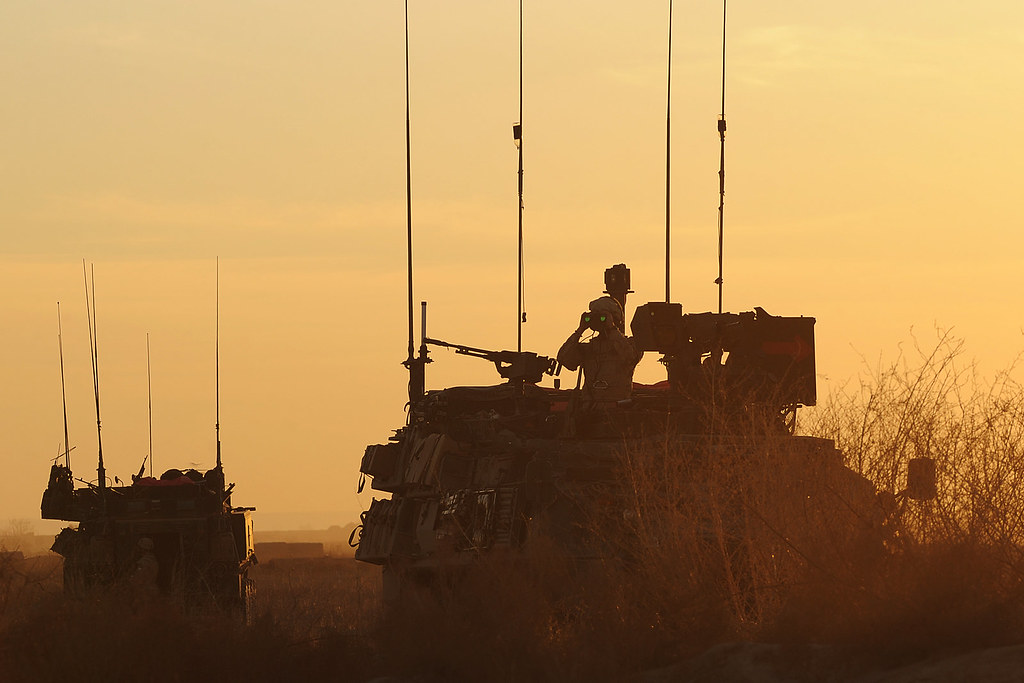
Canadian LAVs, Afghanistan, by isafmedia
This week, Project Censored has released its annual list of top 25 censored news stories in a volume entitled Censored 2011: The Top Censored Stories of 2009-2010.  An astounding article published by The Nation on November 11, 2009; How the US funds the Taliban, resurfaces as the main source for the 10th ranked censored story on the list.  Perhaps Project Censored and The Nation, and as usual the general public, have misunderstood the implications of what this story uncovers; that the West’s war and nation-building effort in Afghanistan is an exercise of utter self-deception and a complete failure. 

Recent coverage of the war in Afghanistan has surrounded revelations from the USG cables leaked by Wikileaks, which paint an endless landscape of deceptions, divided loyalties, corruption, depravity and laughable optimism in the face of virtual anarchy.  The incremental release of these documents by Wikileaks provides an ongoing stream of tidbits and fodder for headlines and public debate, especially as they concern Afghanistan; however, they so far have failed to create the mass of public interest and scrutiny required in the West to bring an end to the war.  That is a tragedy in light of the ongoing situation described a year ago in the Nation, which in spite of official representations, effectively demonstrates that NATO and the Karzai Government exert no authority anywhere in Afghanistan outside their fortified bases and government offices.

The article is entitled How the US funds the Taliban, and examines two sides of the same coin: “The first is the insider dealing that determines who wins and who loses in Afghan business, and the second is the troubling mechanism by which "private security" ensures that the US supply convoys traveling these ancient trade routes aren't ambushed by insurgents.”

While the corruption that defines the first of these realities is worth examination and condemnation, it is the implications of the second which are inescapable and final in their depth. 

The piece begins with a short bio of Ahmad Rateb Popal who is cousin to Hamid Karzai, a former Taliban official, mujahedeen fighter and a convicted drug trafficker who was released from Prison in the US in 1997.  He is now, along with his convicted drug-trafficking brother Rashid Popal, principally in control of the Watan Group, which is a consortium of communications, logistics and security companies in Afghanistan.  The Popal brothers are just the article’s introduction to the characters which fill positions of official and effective power in Afghanistan: “Welcome to the wartime contracting bazaar in Afghanistan. It is a virtual carnival of improbable characters and shady connections, with former CIA officials and ex-military officers joining hands with former Taliban and mujahedeen to collect US government funds in the name of the war effort.”

Private security firms in Afghanistan are most importantly charged in the defence of highway convoys which supply NATO’s network of bases with every last thing needed in the war effort; food to fuel to ammunition to toilet paper.  “The epicenter is Bagram Air Base, just an hour north of Kabul, from which virtually everything in Afghanistan is trucked to the outer reaches of what the Army calls "the Battlespace"--that is, the entire country.”
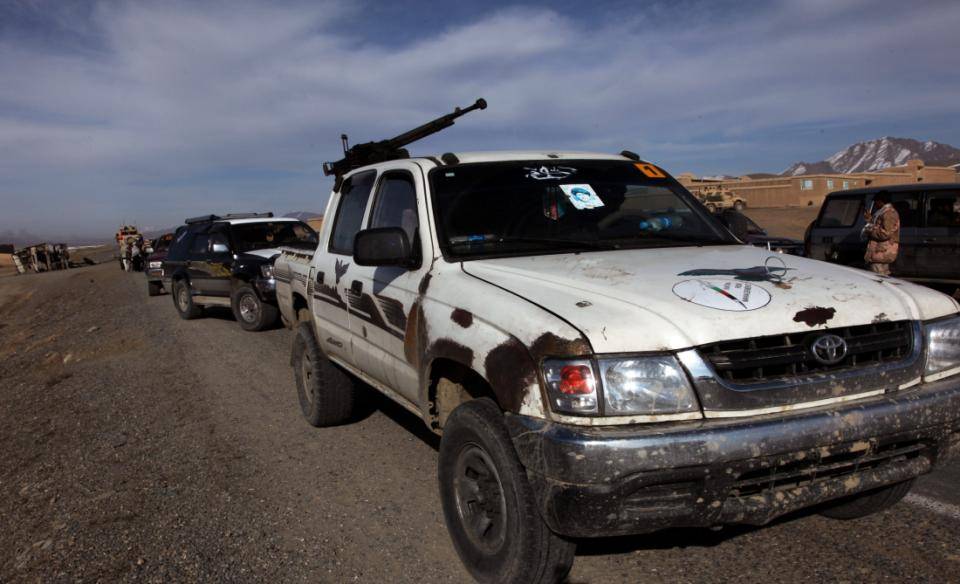
Private Afghan Security, by isafmedia
The article states, “The real secret to trucking in Afghanistan is ensuring security on the perilous roads, controlled by warlords, tribal militias, insurgents and Taliban commanders.”  It quotes an American executive: “The Army is basically paying the Taliban not to shoot at them. It is Department of Defense money;” Project Manager Mike Hanna, for trucking company Afghan American Army Services: “You are paying the people in the local areas--some are warlords, some are politicians in the police force--to move your trucks through... We're basically being extorted. Where you don't pay, you're going to get attacked. We just have our field guys go down there, and they pay off who they need to;” A veteran American manager who has worked as a soldier and a private security contractor in the field: “What we are doing is paying warlords associated with the Taliban, because none of our security elements is able to deal with the threat;” Transportation entrepreneur: “Two Taliban is enough... One in the front and one in the back.  You cannot work otherwise. Otherwise it is not possible.”

Apparently the term ‘private security company’ has in Afghanistan become something of a euphamism for Warlords and militia drawing from the deep well of Western taxpayer cash ‘intended’ to fund the stabilisation and reconstruction of the country.  “Every warlord has his security company,” is the way one executive put it to the article’s author, Aram Roston.  These ‘companies’ run by Afghan strongmen who find themselves in the favour of the corrupt Karzai administration, having divided loyalties and ulterior motives, must themselves hand over money to local powers to make the way secure along this or that highway. 

These private firms are so mistrusted by the US and Karzai, both because of their affiliations with the enemy and their own private interests which conflict with those of the Karzai family, are prohibited by law from arming themselves beyond AK-47 rifles.  In the face of Rocket-Propelled-Grenade attacks from insurgents targeting massive caravans of trucks, this seems much like trying to use brass-knuckles to protect a pack of antelope from attacking lions.

This problem is universal in Afghanistan, extending even to the most important highway there, aptly named highway 1.  The previously mentioned Watan group, run by the Popal brothers, is charged with securing this highway, the virtual jugular of the West's war complex in Afghanistan, which runs between Kabul and Bagram Airforce Base in the east; south-west toward Kandahar and the southern half of the country.  According to the article's author, "Watan's secret weapon to protect American supplies heading through Kandahar is a man named Commander Ruhullah.  Said to be a handsome man in his 40s, Ruhullah has an oddly high-pitched voice.  He wears traditional salwar kameez and a Rolex watch.  He rarely, if ever, associates with Westerners.  He commands a large group of irregular fighters with no known government affiliation, and his name, security officials tell me, inspires obedience or fear in villages along the road.  It is a dangerous business, of course: until last spring Ruhullah had competition--a one-legged warlord named Commander Abdul Khaliq.  He was killed in an ambush.  So Ruhullah is the surviving road warrior for that stretch of highway.  According to witnesses, he works like this:  he waits until there are hundreds of trucks ready to convoy south down the highway.  Then he gets his men together, setting them up in 4x4s and pickups.  Witnesses say he does not limit his arsenal to AK-47s but uses any weapons he can get.  His chief weapon is his reputation.  And for that, Watan is paid royally, collecting a fee for each truck that passes through his corridor.  The American trucking official told me that Ruhullah charges $1,500 per truck to go to Kandahar.  Just 300 kilometers."

This is clearly an extortion racket which reveals the true balance of power in Afghanistan, with the various and shadowy forces at large in the country playing the role of competing mafias and NATO that of the fearful barbershop owner, dutifully paying 'protection' money to the people who would otherwise pop his kneecaps and put him out of business.  In this strange case the Barber contends publicly that he has the extortionists on the run. 

The overarching fact is that the West’s ostensible war and reconstruction effort is impossibly dependent on collusion with the forces it is pretending to fight.  The need for local payoffs 8 years after the war began points to a reality that the US, NATO, and the Karzai government they support have established Zero effective control over the country outside of the fortified city-bases of Kabul, Kandahar, and a precious few others.  This fact is so simple it is difficult to conceptualize.  The issue is not that paying the enemy is against principle, nor that it bolsters the enemy’s resources and perception of itself, but that it is in fact direct proof of failure.  To what purpose are any efforts in Afghanistan, when Western armies have not even secured the single-most important and fundamental logistical objective of warfare, which is to secure supply lines?  NATO forces have no logistical control of Afghanistan.  They cannot even eat without the approval of those they pay off.  Is there in fact a war there?  Or are NATO’s forces just part of a complex, factionalised Western/Afghan kleptocracy, wrestling with itself as its parties secure their interests and consolidate their power against each other?  The military goals of the West seem quite unclear given that its forces cannot move anywhere without corrupting themselves by paying the enemy. 

If the publicly-stated objective of the West’s mission is in fact peace, security and freedom, it would seem that this would begin by securing freedom of movement and safe passage throughout the country.  Freedom of movement is paramount to building a free nation where goods, services and ideas can reach out and address the poverty of mind, means and opportunity that exists in Afghanistan’s isolated countryside.  If this has not been achieved, than what has been done?  Rather, there is a far-flung network of multi-billion-dollar bases providing security in provincial capitals for unpopular and fraudulently elected governments; completely dependent on payoffs to unscrupulous and opaque power structures for the maintenance of supply lines.  One can only speculate as to the exact nature of the conflicting goals existing in the strange association of interests at work in Afghanistan; an association which ties together a dizzying myriad of Western government policy and taxpayer money, billion dollar contracts, executives, bureaucrats and politicians; Afghanistan’s proximity to Iran, Russia, Pakistan and its geopolitical importance as a bottleneck for Central Asian Trade routes; as well as its mujahedeen, the Taliban, Tribalism and the Karzai family.  Western polls show a majority, even in militant America, that public opinion is against the war.  To what depths must Afghanistan’s interminable corruption, murderous war, poverty and the (sometimes self-) deceptions of Western officials descend before the Western public not only oppose, but refuse to cooperate in it?  


Read 'The Nation' article and more:


Wednesday, December 8, 2010

Drones, Torture, Rendition: Democratic Values?

A Huffington Post column by Johann Hari summarizes certain revelations stemming from the leaked USG diplomatic cables by Wikileaks.  The piece posits that Julian Assange's efforts have made the world safer and are a boon to US National Security, that a better educated public with proof of government wrongdoings can better bring its government to account.

Hari's column touches on a cable which proves the US Armed Forces were operating in Yemen while denying it publicly, and references an article which discusses 'Reaper' or 'Predator' drone attacks in Pakistan.  Drone attacks there are a very messy situation; Pakistani officials publicly deny their tacit approval of US drone attacks within their territory, rejecting them as a violation of their sovereignty and of dubious value and causing massive civilian casualties. According to Pakistani Foreign Ministry spokesman Abdul Basit, drone attacks "are having long-term negative consequences.”  Indeed, the Pakistani and American governments likely will suffer "long-term negative consequences" from the resulting radicalization of Muslims when they employ drone tactics such as attacking a funeral procession; waiting for a time until villagers come out from cover after the attack in search for survivors and to pray for the newly slain; then attacking again.  Certainly they make bitter enemies of the villagers who lose their homes and family members in such wanton displays of imperial might; people who may have nothing left to do to support themselves except to take up arms, if it does not generally galvanize the entire population against them, to whom the notion that US forces are in the region to restore security and human rights must seem something of a Hitlerian joke.

The article also highlights pressure the US Government exerted on Germany to quash an investigation into the rendition of an innocent man, Khaled El-Masri, who was mistaken for an insurgent with a similar name. El-Masri was kidnapped from Europe and brought to the CIA's infamous 'Salt Pit', a secret interrogation facility in Afghanistan.  A Harper's Magazine article, The El-Masri Cable, describes the treatment he received: "Despite El-Masri’s protests that he was not al-Masri, he was beaten, stripped naked, shot full of drugs, given an enema and a diaper, and flown first to Baghdad and then to the notorious “salt pit,” the CIA’s secret interrogation facility in Afghanistan. At the salt pit, he was repeatedly beaten, drugged, and subjected to a strange food regime that he supposed was part of an experiment that his captors were performing on him. Throughout this time, El-Masri insisted that he had been falsely imprisoned, and the CIA slowly established that he was who he claimed to be. Over many further weeks of bickering over what to do, a number of CIA figures apparently argued that, though innocent, the best course was to continue to hold him incommunicado because he 'knew too much.'"  While this kidnapping, torture, sexual violation and starvation of an innocent man had already been revealed, the leaked cables show the US Government's expectation of impunity for its agents who execute these illegal actions in sovereign foreign nations; in this case, Germany's unwillingness to cooperate by dropping charges in the matter against 13 USG agents is met with threats from US diplomats.

Hari's article points to other abuses by Western governments and the lies they tell their people to cover it up.  He expresses outrage in the poignant observation that "There is a squalid little irony when you see people who are literally bombing innocent civilians every day feverishly accuse a man (Julian Assange) who has never touched a weapon in his life of being 'covered in blood.'"  He names Western governments as the prime threats to their own population's security, and suggests that the unmasking of this hypocrisy must lead to positive change, stability and security.  What will the view of the Muslim and 3rd world be, if Western 'democracies' fail to address the abuse of power by their governments?  Al Qaeda already names Western voters as sponsors of the military occupation of Palestine and the general misery of the third world, offering that ignorance is not an excuse for imperialism.  Many amongst the populations of the world's Muslim nations already view Westerners, especially Americans, as ignorant, militarist and corrupt materialists.  Now that Western tax-payers and voters cannot hide behind the veil of ignorance, how will the world view of Western 'democracies' change, should they fail to expel the ruling classes who have sown war, death, torture and poverty in their people's name?  What is the risk that Westerners come to be seen as knowingly complicit in the heinous crimes of their governments by their 'democratically' expressed unwillingness to stop these crimes, let alone rectify and bring their authors to justice?  Whatever blood Julian Assange and the American government have on them, it is more and more smeared onto each of us, here in Canada, in the US and in Europe.


Read the Johann Hari- Huffington Post article here:
http://www.huffingtonpost.com/johann-hari/julian-assange-has-made-u_b_793504.html

More on Drones by Johann Hari and others:
http://www.independent.co.uk/opinion/commentators/johann-hari/johann--hari-obamas-robot-wars-endanger-us-all-2106931.html
http://news.antiwar.com/2009/06/23/at-least-65-killed-as-us-drones-attack-south-waziristan-funeral-procession/
http://www.qatar-tribune.com/data/20101202/content.asp?section=pakistan1_3
http://geo.tv/6-24-2009/44711.htm

Harper's Magazine on El-Masri Rendition:
http://harpers.org/archive/2010/11/hbc-90007831

BBC on American intervention in Yemen:
http://www.bbc.co.uk/news/world-middle-east-11918037

Tuesday, November 30, 2010

Wikileaks: Misanthropy and the Spectre of Scrutiny

Amid the bluster surrounding the public release of 278 of 251,287 secret and confidential USG diplomatic cables by Wikileaks as of Monday November 29th; more telling as to the behaviour and thinking of governments and vested interests is the current reaction in the world media and of public officials, than any information so far to be gleaned from these documents.  This author has read the majority of the 278 published cables, and perused the remainder, the greater share originating from embassies in Europe, the middle-east and central Asia, where the US armed forces are most active, and a smattering of cables from east-Asia, Africa and the Americas rounding out the balance.  Read in volume, they provide a fascinating glimpse as to the psychology and priorities of USG foreign policy.

The characterization by the Pentagon of Wikileaks being “reckless” in their release of the documents came in fact ahead of their release, as were Sunday’s headlines quoting the White House statement that their publication is “reckless and dangerous.”  If the documents so far released are dangerous at all, it is mostly to the continued perception by the American public that their government stands above other nations on a moral high-ground, and that USG foreign policies are in any tangible way amenable to and affected by democratic processes at home.  Wikileaks has in fact respected the danger that confidential informants and private citizens inside Iran, Afghanistan and Korea face by censoring their names, though the names of foreign diplomats, statesmen and US officials are rarely spared, as they are ostensibly publicly accountable.  Such statements from sources protected by Wikileaks’s self censorship are in any case usually the least revealing as to actual policy, and are interesting only in their insight as to what foreign insiders and parties want the USG to do or think.  

The statement by White House press secretary Robert Gibbs which has formed the leading paragraph in so many news outlet’s headlining stories: "To be clear -- such disclosures put at risk our diplomats, intelligence professionals, and people around the world who come to the United States for assistance in promoting democracy and open government," is a falsehood, as the cables themselves demonstrate that the USG, with abandon, continues to support on a quid pro quo basis innumerable corrupt dictatorial regimes such as in Bahrain, Qatar, Oman, the UAE, Saudi Arabia, Kuwait, Azerbaijan, Kazakhstan, Uzbekistan, Kyrgyzstan, Tajikistan, Turkmenistan and Afghanistan.  The notion that anyone anywhere is soliciting the USG in the aid of “promoting democracy and open government” is absurd in the light of these cables, which instead demonstrate foreign governments soliciting the USG for money, weapons and military action against their neighbours, or in the cases of Syria, Azerbaijan and Turkey, that the USG not continue to provoke the Iranian regime and desist from sponsoring terrorism, subterfuge and the foment of dissent within Iran’s borders, which they believe strengthens the Islamic leadership by providing it pretext for the further curtailing domestic freedoms of movement and expression, and which convinces the Iranian leadership that an attack by American forces is imminent and forestalled only by its current difficulties in neighbouring Afghanistan and Iraq.  The cables reveal that many representatives of middle-eastern nations believe that Iran’s operations and attempts to destabilise Iraq and Afghanistan stem from the Iranian government’s conviction that allowing a military success in Iraq or Afghanistan would precipitate a rather immediate invasion of Iran itself by Western forces. 

French President Nicholas Sarkozy has called Wikileaks a “Threat to democracy,” which seems understandable only if one extrapolates that the release of the cables will motivate people such as him to dispense with it.  For the moment, exactly how the exposure of secretive government workings to the public threatens that public’s right to rule itself (democracy), if it does not in fact do the opposite, remains unexplained.  Canada’s foreign affairs minister, Lawrence Cannon, called the leaks “deplorable” and reportedly continued that ‘leaks like this one do not serve anybody's national interests and may threaten national security.’

Hilary Clinton’s statement that the leaks are “An attack on the international community, the alliances and partnerships, the conversations and negotiations that safeguard global security and advance economic prosperity," seems ironic in light of the continual proliferation of weapons and conflict on every continent and the ongoing global economic crisis; and thereby causing one to wonder about exactly whose security and economic prosperity she speaks, and to whom she is referring when she invokes the name “international community,” a rather ambiguous and ubiquitous term of late.   There are also the calls from News outlets such as Fox News and NY Rep. Congressman Peter King that Wikileaks be deemed a terrorist organisation, and that its assets be seized and donors be considered sponsors of terrorism, which is an obvious absurdity, inconsistent even with the USG’s loose definition of terrorism, and would define innumerable US citizens as terrorists.

One of the few reasonable reactions by any government to the scandal is from David Cameron’s Conservative UK government, who as very recent newcomers to power are perhaps not (yet?) a part of Secretary Clinton’s ‘international community’.  A spokesman for the UK government discussed the matter with reporters, stopping short of branding Wikileaks as a criminal or terrorist organisation, and relating simply that the released cables and a lack of confidentiality on matters “is inhibiting the conduct of governments.”  While an honest observation, the merit of the conduct of any government and which matters merit strict confidentiality is itself a matter which clearly requires debate.

Overall, the picture is one of public leaders worldwide closing ranks in face of what they view as a clear attack on their authority and mandate to continue the types of behaviours described in the cables, which it is.  They deplore the leaks as a threat to “national” security, mistaking themselves as the nation and not merely its representatives, and are weary of the possibility that an informed public may better understand their government’s duplicity and actions against the public welfare in favour of privately profitable wars and support for autocratic/oligarchic regimes abroad, causes which almost no citizens of western nations find virtue in.  A massive PR campaign is being mobilised in the mainstream media, beginning with a repetitious doublethink mantra which in its essence suggests to the public mind that to hold its leaders to task on matters most important is antithetical to their freedoms and democratic rule.  

Only 278 of the 251,287 cables obtained by Wikileaks have thus far been released.  The relative voracity of global leadership’s reaction to the publication of these cables, which have provided very little extra insight beyond information which is already publicly available, if not conveniently located in a single place from a single source, is perhaps indicative that the ruling echelon is convinced the most damning evidence of their self-interest and misappropriation of public trust is yet to come.

Thursday, October 28, 2010

Gorbachev's Afghan Pessimism: BBC Interview

Former Soviet head of state Mikhail Gorbachev spoke plainly about the war in Afghanistan during an interview with the BBC earlier this week.

"Victory is impossible" is his leading statement on the topic of the war.  Gorbachev states that Obama is right to pull the troops out, "no matter how difficult".  Mr. Gorbachev underlines one of the 'difficulties' as being America's deep and well established ties to militants and factions within Afghanistan.  He does not miss the opportunity to remind his English speaking audience as to who the original sponsors of the current violence are: "The Americans... were training militants, the same ones who today are terrorizing Afghanistan and more and more of Pakistan."

In making such statements, Mr. Gorbachev alludes to and seems prepared to discuss the vested interests or bureaucratic and military resistance at work to slow or block a US military withdrawal from Afghanistan.  Surely Mr. Gorbachev's experience and insight in this area would have made for some fascinating and revealing news copy, however BBC correspondent Steve Rosenberg fails to engage the topic.

The clip ends with Mr. Gorbachev shrugging at the alternatives to withdrawal: "But what's the alternative?  Another Vietnam?  Sending in half-a-million troops?  That wouldn't work."  Mr. Gorbachev paints a picture of America, caught in a trap of its own making, bleeding and unable to free itself.

Mr. Gorbachev presided over the USSR's final extrication from the Soviet-Afghan war at the end of the 1980's.  Since the American invasion of Afghanistan in October 2001, a long list of former Soviet government and military officials, including Mr. Gorbachev, have gone on record saying that the west's war in Afghanistan is unwinnable.  While such predictions seem always to be hinted with pride and sour grapes, after nine years in Afghanistan, Americans can no longer hope that they will do better.  The Soviet-Afghan war ended after 9 years, and cost the Soviet Union 14,453 lives.  Troop deployments reached a height of 104,000, and a total of 620,000 Soviet soldiers served in the war.  As of this week, NATO troop levels exceed 100k, and coalition deaths in Afghanistan have reached 2,095 people, according to wikipedia.  However, this number does not include western contractors and NGO workers doing security and infrastructure work.

Read the article and watch the clip:  http://www.bbc.co.uk/news/world-south-asia-11633646

Saturday, October 9, 2010

The ANA: Afghan National Army or Afghan Notional Army?

An article in the August 21st 2010 edition of the Economist, 'Fixing the Unfixable', describes in colorful detail the challenges facing the American effort to create a cohesive Afghan National Army (ANA).  The article makes the argument that a capable ANA is a prerequisite to Western forces leaving the country, if the Afghan government is to be spared collapse.  In making its case, the article draws attention to different aspects of the ANA's situation, which reeks of amateurism from top to bottom.

While credible reports as to the the Afghan National Army and Police's moral corruption abound, whether it be the routine torture of detainees or the pedophilic practice of bachabazi, the Economist provides insightful data as to the actual capability of the ANA, or lack thereof.  The article cites a report released earlier this year by Arnold Fields, the US inspector general for Afghan reconstruction, which says that only 23% of ANA soldiers and 12% of police can be trusted to work unsupervised.  Senior officers are known to be stealing food and fuel, and are accused of stealing weapons.  Certainly the capability of the ANA to govern itself and command respect from its own members is under serious question.

As to the ANA's capability in the field, the Economist presents some interesting numbers: "During operations, they remain almost totally reliant on NATO troops, who suffer twice as many casualties."  The image this conjures is one of ANA troops taking full cover at first sign of the Taliban, before calling in Western forces to clean up the mess.  An episode is described where, without the operational support of NATO, 300 ANA soldiers managed to get themselves ambushed by the Taliban in Laghman.  A quick look into this story, reported in the Wall Street Journal, August 10, 2010, tells that the ANA commando units, such as the one defeated in the ambush "are supposed to be the force's best units."  Many were killed and captured and the unit was "missing" according to the words of Gen. Zahir Azimi of the Afghan Defense Ministry. 

Another concern raised by the Economist is over the ANA's sustainability and identity as a 'National' army.  "Less than 3% of recuits to the ANA are from the Pushtun south, from where the Taliban draw most support."  This is a huge discrepancy, as the Pushtuns are the largest ethnic group within Afghanistan.  Apparently translators are often required not just for NATO officers, but also for ANA officers when operating in Pushtun districts, where most of the insurgency is being fought.  That the makeup of the ANA is being drawn along the same divisive ethnic and tribal lines as the rest of Afghanistan is a concern to many as to the viability of the ANA, as to who the ANA truly represents and is willing to defend, and as to whether or not the ANA can help avoid a civil war after Western forces leave, or whether it would infact help precipitate one. 

The article mentions that Army pay has been increased from $120 to $165 a month.  While this is apparently good pay in Afghanistan, it does raise the question of motivation.  To speculate, it would seem likely that in such a poor and divided country, with no national military tradition, it is the pay and the pay alone that motivates recruits to keep coming back.  In combat, as we have seen, the ANA forces seem to shrink from confrontation, which may be a sign that ANA soldiers show up to work to get paid, not to risk their necks.  In many cases the pay does not seem to be enough, as the ANA's desertion rate is astronomical.  A Nov. 26, 2009 article in the Asia Times cites an Inspector General for reconstruction report revealing that one in every four combat soldiers quit the ANA during the year ending in September 2009. 

The Economist discusses all of these problems in the context of their appraisal and addressing by General William Caldwell, who upon recently taking charge of organising the ANA, is reported as "horrified" that the focus was on "quantity, not quality".  Horrifying perhaps, but unsurprising that priorities at the ANA are out of place.  That much is already evident.  But the type of training received by many recruits may also have spoken to them about the nature and strength of the West's commitment to the ANA.  Caldwell reports that "The ratio of instructors to students was 1 to 80... On one base, it was 1 to 466 - There were no training standards... It was just, eight weeks and you're done."  It may have seemed to many recruits that the type of Army they were joining was one of appearances.  "Some contractors failed even to show recruits how to calibrate the sights on their weapons" the article reports.  With this being the level of preparation, losses in the field and desertion in the ANA ranks seems to find context.

To learn that contractors are responsible for the dismal type of training given to ANA recruits is to consider another aspect which puts the viability of not only the ANA, but the entire mission into question.  While the profit motive is ever present in any military adventure, and particularly American ones, in this instance it has undermined its objectives.  It is astounding that such an integral part of the American strategy for reconstruction, the training of an effective national army, could be commoditised and offered up for contract, and then to be administered privately and with such little oversight.  It leaves one to question the administration of the entire operation, and where else profit motives are being allowed to hinder the objectives of the Afghan mission.

Perhaps General Caldwell may find it more horrifying, the prospect of forming a credible modern army out of an ill-equipped ragtag group of illiterate peasants, pedophiles, corrupt officers and amateurs with mixed loyalties, ill-trained by foreigners more interested in making a quick buck than in the future of Afghanistan.  Perhaps he is deluded: his goal is to expand the army from 134,000 to 171,600 over the next 12 months.  This would represent an increase of some 37,000 soldiers, which is as much as the ANA has grown in the last 5 years when the focus was on "quantity, not quality".  These numbers are pie in the sky, as much as the mission is itself. 

That such an army, divided against itself, could ever prop up a national government seems a far away prospect.  Indeed the ANA appears to be something of a joke, and an army more in name than in reality.

Read the Economist article at http://www.economist.com/node/16846714

Wednesday, October 6, 2010

Western taxpayers to bail out Karzai's Kabulbank?

An article in the September 11 edition of the Economist, "House of Karzai", sheds light on the corrupt regime of Hamid Karzai. It investigates the causes of a run on an Afghan bank, Kabulbank, mired in corruption and on the brink of failure.  The Economist describes a group of people working together, including Mahmoud Karzai, president Karzai's brother, who have managed to control Kabulbank and use it to invest in their own speculative ventures.  Mahmoud Karzai apparently is the 3rd biggest shareholder at the bank.  It is well known that he holds a 7% share, which he purchased for $5million by first borrowing the $5m from Kabulbank itself.

The article describes an area on Dubai's famous palm shaped peninsula refered to as "Little Afghanistan" where are found luxury mansions for "Afghanistan's business and political elite."  The article asserts directly that Kabulbank was used improperly in the funding of these Dubai real-estate ventures when it says "Hundreds of millions went into Dubai properties then handed to shareholders and their friends" and "the bill was picked up by ordinary Afghans who put money into Kabul Bank, a scandal-wracked institution..." Little Afghanistan is but one example of the missappropriation of the banks funds and lending.  According to the Economist, there is a string of loss generating companies owned by Kabulbank shareholders, into which Kabulbank loans and funds were siphoned, including an airline and a cement factory. 

Thus a run on Kabulbank?  Some may wonder how it could not have come sooner.  In proper form, Mahmoud Karzai has publicly solicited a bailout for the bank from the American taxpayer, which is hilarious and revealing on its own- after all, why shouldn't he just go right to the source?  That being turned down flat by the Americans, the article reports that the "Afghan government" aka Hamid Karzai, "said it would give the bank whatever it needed from its own reserves".  Though "American officials" have pushed for an inquiry into the fiasco, to no one's surprise, the Afghan government, aka Hamid Karzai, is not forthcoming.  The Economist article concludes first by stating that the bank is "too important to fail", and it evokes the image of civil strife should the bank "enrage almost a quarter of a million armed customers".  Are they not yet enraged?

Inquiry or not, it seems the use of the Afghan treasury to rebuild Kabulbank is inevitable.  While for all parties this is a more politically palatable solution than that proposed by Mahmoud- a direct bailout from the US treasury, it is only so because most Western voters are not aware that roughly two-thirds of the Afghan treasury is funded by their taxes, through their governments via aid payments and the World Bank.  Western nations with military involvement have already seen their voters sour at the thought of risking more lives and spending further military resources to prop up the corrupt Karzai government, but the decision to use the Afghan treasury for such a payoff should in fact raise the ire of the hundreds of millions of taxpayers in all Western nations who have invested in Afghanistan, or the World Bank for that matter. In either case, it is the Karzai family getting the best of people of Afghanistan, the US and the rest of the world. 

To be fair, it may be that the Karzais are merely a product of the system of patronnage, curruption and elitism that has divided Afghanistan for so many generations.  And while the legitmacy and the exact reach or sustainability of the institutions created under the Karzai regime are in constant question, episodes such as the Kabulbank fiasco should inspire debate in Western Democracies as to the methods and motives of their own governments and businesses, who after 8 years of war and 9 years of standing behind Mr Karzai, have managed only to help create for themselves another corrupt and dictatorial client state.  One can hope.

Read the Economist article at http://www.economist.com/node/16996926