Showing posts with label War. Show all posts

Tuesday, January 25, 2011

Tunisia's Deposed Ben Ali Family: Canadian Immigration's political statement

Yesterday reports appeared in the Canadian press, TV and radio, about the arrival in Montreal of family members of the deposed Tunisian dictator Zine El Abidine Ben Ali and his wife, Leila, nee Trabelsis.  The expatriate Tunisian community in Montreal had already been watching the situation closely as unidentified Tunisian officials had arrived there as early as last week, having been whisked away from the airport by Tunisian consulate limousines.  "The Family," also referred to as a "Quasi-mafia" by a US diplomat in a leaked cable, "gets what it wants," whether it's "cash, services, land, property, and yes, even your yacht."

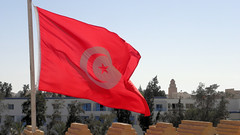
Tunisia by Keith Roper
With stories of "The Family's" corruption and opulent tastes going mainstream in Canada; appropriation of state gold and private real estate and business, theft of a yacht from France, pet tigers and mansions; amid gross poverty and repression in Tunisia; the Canadian government and its immigration department headed by Jason Kenney have scrambled to distance itself from the former dictator's clique, saying the Ben Ali extended family is "not welcome."  However, minister Kenney has pointed out that some family members already have permanent residence status and thus may legally stay in Canada.  Canadian Immigration is "investigating" the matter.

That the Conservative government in Canada is now back-pedalling speaks not to their values but to the concerns of their public-relations department.  The fact that members of the Ben Ali/Trabelsis clan already have been furnished permanent-resident status by a Canadian government well aware of its excessive criminality and human rights abuses is a statement in of itself.  That members of this family would consider Canada as a second home to where they can escape justice is another.

George Galloway by DavidMartynHunt
Almost two years ago, Jason Kenney's immigration department blocked anti-war British Member of Parliament George Galloway from entering Canada for a planned speaking tour, on the pretense that he was a threat to national security.  Mr Galloway has since been allowed to enter Canada after a federal court ruled that the decision to bar his entry was a matter of politics, not security.  Canadian Immigration officials have also consistently denied status to and attempted to deport US Army "deserters," or war resisters, who face harsh sentences in the US after fleeing to Canada when Army officials in the US refused to recognise them as conscientious objectors.  Reports of harassment by Canadian police and immigration agencies of legally landed US war-resisters also exist.

Such immigration policies are a microcosm of the Canadian government's broader policy which is demonstrably cynical, anti-democratic, pro-war and elitist.  That the government would allow Canada to be used as a base for a quasi-mafia to hide wealth pilfered from Tunisia in the form of Canadian real-estate and savings accounts by granting them permanent-residency, while tying up courts and spending public resources on persecuting US war-resisters and a democratically-elected British parliamentarian is a statement to all who are listening:  That people of conscience, who speak out for peace and social justice and who have public support are to be viewed as threats; and that criminals and abusers of human rights are welcome, as long as their crimes are profitable and committed out of sight.


Read about "The Family" coming to Canada:
http://www.vancouversun.com/news/Family+members+Ousted+Tunisian+president+reach+Montreal/4150470/story.html
http://www.theglobeandmail.com/news/national/quebec/a-tunisian-palace-in-the-heart-of-montreal/article1873921/
http://www.nationalpost.com/news/canada/Dictator+family+investigated+immigration/4160387/story.html

Read about George Galloway's recent visit to Canada:
http://www.theglobeandmail.com/news/politics/george-galloway-takes-shots-at-jason-kenney-pm-from-alberta/article1811320/

Read about a US war resistor:
http://www.globalresearch.ca/index.php?context=va&aid=4969

Read the World Headlines Review report on the Tunisian unrest which forced Ben Ali from office:
http://worldheadlinesreview.blogspot.com/2011/01/tunisia-and-algeria-north-african.html

Monday, January 10, 2011

Switzerland: Swiss Franc -ly Under Attack

Separate reports this week in the Swiss newspaper Neue Zuericher Zeitung (NZZ) are highlighting the difficult choices Switzerland, and by extension other nations, are facing in the continued onslaught of effective currency devaluation by US and Eurozone officials. The Greenback and the Euro have fallen significantly against the Franc and other currencies in the past years as their governments and central banks have created a glut of supply; by loosening monetary policy, lowering interest rates and creating massive amounts of new debt to bail out ailing banks, businesses and governments.   The choices for nations such as Switzerland are clear:  Reduce living standards and income values through inflation, or see a massive outflow of jobs and industry from their borders. 

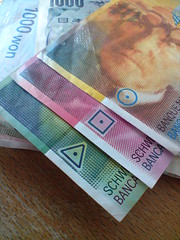
Swiss Banknotes by kalleboo
The Swiss National Bank (SNB) has announced losses of 8.5bil Swiss Francs in the first 3 quarters of 2010, resulting from their foreign exchange interventions intended to curb the effect of the inflating Euro and Greenback on their economy.  These losses stem from the SNB's massive selling of Swiss Francs and purchasing of Euros in order to simultaneously increase market supply of Swiss Francs to lower it's exchange rate; and increase competition in the Euro-dollar market to help support/increase its value.  Despite these efforts and the losses thereof, the Eur/Chf (Euro/Swiss Franc) exchange rate has fallen from late 2007 highs of 1.68 to current levels of 1.25.  This has had a severe effect on Swiss industry, most of whom must repatriate sales made in the Eurozone in order to book profits.  This peak to trough fall represents a loss to Swiss exporters of 0.43 Chf in every dollar they earn, or roughly 0.25 in aggregate terms.

Such extreme cuts to profits have Swiss industry chiefs remarking that in current conditions they cannot consider new hiring or expanding production in Switzerland, and making controversial threats to move jobs out of Switzerland and into the Eurozone, where wages have dropped along with the Euro relative to the Swiss Franc.  Retailers are also complaining that more and more Swiss shoppers are travelling the short distance to make their purchases accross the border, which is not far from any point in the small landlocked Alpine country.  The tourism industry is also feeling the pinch, as it is more expensive for Europeans to buy Francs.  Some doubt the long term viability of small and mid-sized businesses in Switzerland if the Franc's value to the Euro cannot be stabilised above 1.30.  The NZZ this week specifically quoted Georges Hayek, chief of Swatch-Group and Hans Hess, president of Swissmem, an association representing the mechanical and electrical engineering industry, as calling for government intervention in this regard.

However, such government intervention would in all cases amount to a rapid inflation of the Swiss currency.  This would cause prices of goods to rise generally, affecting the value and purchasing power of all Swiss incomes, from wage-earners to business owners to pensioners.  The Swiss authorities thus face a double-edged sword:  To take action is to lower living standards for all Swiss residents and cut the value of savings; to hold firm is to risk a general flight of industry and jobs and support a loss of value in local stock market investments.  In all cases jobs, savings and investments are threatened.  This dilemma is at the root of the murmurrings of currency war surrounding the G20 meetings in Seoul, which saw the US and Europe insisting that China allow the yuan to rise, and China along with Brasil, Korea and a host of other nations from across the globe complaining of the ill-effects to their economies caused by the effective devaluatoin of the Euro and Dollar by Western central banking authorities. 

Just as the European central bank (ECB) was forced to bail out Greece and Ireland by helping to create new money, and is currently fighting to prop up the Portuguese national budget with bond purchases, so are Federal authorities in the US now facing calls to bail out hopelessly indebted states and municipalities.  The Wall Street Journal reports that Federal Reserve chairman Bernanke has scuttled such talk by pointing out that new rules under the Dodd-Frank laws enacted by the federal government last year limit the fed`s ability to intervene should states or municipalities go into default/bankruptcy.  Such issues in Europe and America will, regardless of how they are addressed, create more instability in foreign exchange markets, to the detriment of economies outside their borders; from first world economies such as Switzerland, Canada and Japan, down to China, Brasil, India and all others dependent on the global economic model. 

Read more:

German Language Sources:
http://www.nzz.ch/nachrichten/wirtschaft/aktuell/tiefer_euro_gefaehrdet_wohlstand_1.8958738.html
http://www.nzz.ch/nachrichten/politik/schweiz/schweiz_nationalbank_verlust_85_milliarden_franken_2010_1.8356119.html

Other English Language Reports on the Swiss Franc and US Debt:
http://online.wsj.com/article/SB10001424052748704739504576067602380461160.html
http://online.wsj.com/article/BT-CO-20101112-701368.html
http://www.swissinfo.ch/eng/specials/swiss_franc/Strong_franc_continues_to_haunt_Swiss_economy.html?cid=17955460

Wednesday, December 22, 2010

Afghanistan: War, Power and Illusion

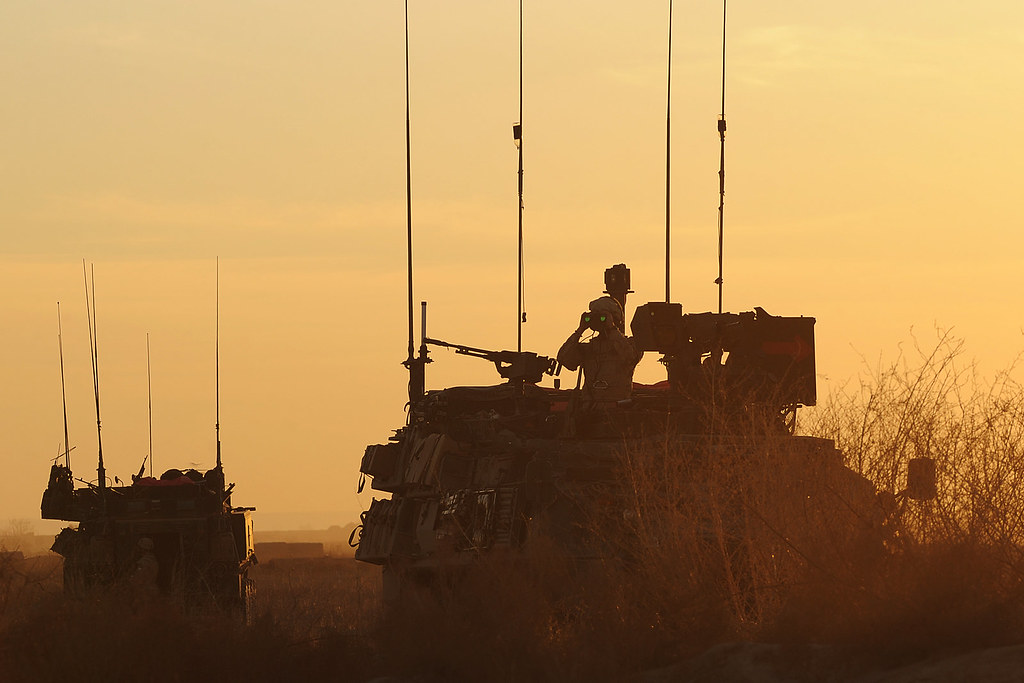
Canadian LAVs, Afghanistan, by isafmedia
This week, Project Censored has released its annual list of top 25 censored news stories in a volume entitled Censored 2011: The Top Censored Stories of 2009-2010.  An astounding article published by The Nation on November 11, 2009; How the US funds the Taliban, resurfaces as the main source for the 10th ranked censored story on the list.  Perhaps Project Censored and The Nation, and as usual the general public, have misunderstood the implications of what this story uncovers; that the West’s war and nation-building effort in Afghanistan is an exercise of utter self-deception and a complete failure. 

Recent coverage of the war in Afghanistan has surrounded revelations from the USG cables leaked by Wikileaks, which paint an endless landscape of deceptions, divided loyalties, corruption, depravity and laughable optimism in the face of virtual anarchy.  The incremental release of these documents by Wikileaks provides an ongoing stream of tidbits and fodder for headlines and public debate, especially as they concern Afghanistan; however, they so far have failed to create the mass of public interest and scrutiny required in the West to bring an end to the war.  That is a tragedy in light of the ongoing situation described a year ago in the Nation, which in spite of official representations, effectively demonstrates that NATO and the Karzai Government exert no authority anywhere in Afghanistan outside their fortified bases and government offices.

The article is entitled How the US funds the Taliban, and examines two sides of the same coin: “The first is the insider dealing that determines who wins and who loses in Afghan business, and the second is the troubling mechanism by which "private security" ensures that the US supply convoys traveling these ancient trade routes aren't ambushed by insurgents.”

While the corruption that defines the first of these realities is worth examination and condemnation, it is the implications of the second which are inescapable and final in their depth. 

The piece begins with a short bio of Ahmad Rateb Popal who is cousin to Hamid Karzai, a former Taliban official, mujahedeen fighter and a convicted drug trafficker who was released from Prison in the US in 1997.  He is now, along with his convicted drug-trafficking brother Rashid Popal, principally in control of the Watan Group, which is a consortium of communications, logistics and security companies in Afghanistan.  The Popal brothers are just the article’s introduction to the characters which fill positions of official and effective power in Afghanistan: “Welcome to the wartime contracting bazaar in Afghanistan. It is a virtual carnival of improbable characters and shady connections, with former CIA officials and ex-military officers joining hands with former Taliban and mujahedeen to collect US government funds in the name of the war effort.”

Private security firms in Afghanistan are most importantly charged in the defence of highway convoys which supply NATO’s network of bases with every last thing needed in the war effort; food to fuel to ammunition to toilet paper.  “The epicenter is Bagram Air Base, just an hour north of Kabul, from which virtually everything in Afghanistan is trucked to the outer reaches of what the Army calls "the Battlespace"--that is, the entire country.”

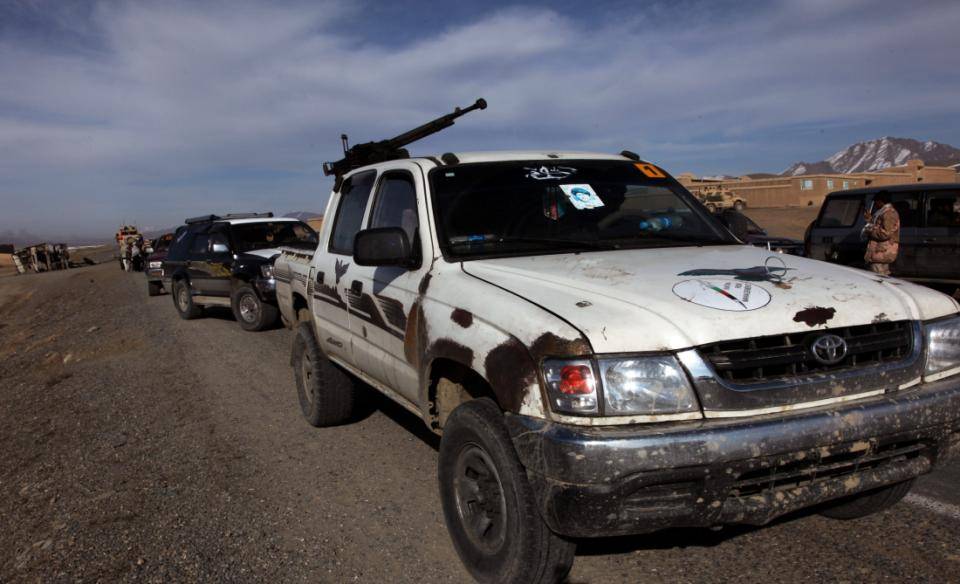
Private Afghan Security, by isafmedia
The article states, “The real secret to trucking in Afghanistan is ensuring security on the perilous roads, controlled by warlords, tribal militias, insurgents and Taliban commanders.”  It quotes an American executive: “The Army is basically paying the Taliban not to shoot at them. It is Department of Defense money;” Project Manager Mike Hanna, for trucking company Afghan American Army Services: “You are paying the people in the local areas--some are warlords, some are politicians in the police force--to move your trucks through... We're basically being extorted. Where you don't pay, you're going to get attacked. We just have our field guys go down there, and they pay off who they need to;” A veteran American manager who has worked as a soldier and a private security contractor in the field: “What we are doing is paying warlords associated with the Taliban, because none of our security elements is able to deal with the threat;” Transportation entrepreneur: “Two Taliban is enough... One in the front and one in the back.  You cannot work otherwise. Otherwise it is not possible.”

Apparently the term ‘private security company’ has in Afghanistan become something of a euphamism for Warlords and militia drawing from the deep well of Western taxpayer cash ‘intended’ to fund the stabilisation and reconstruction of the country.  “Every warlord has his security company,” is the way one executive put it to the article’s author, Aram Roston.  These ‘companies’ run by Afghan strongmen who find themselves in the favour of the corrupt Karzai administration, having divided loyalties and ulterior motives, must themselves hand over money to local powers to make the way secure along this or that highway. 

These private firms are so mistrusted by the US and Karzai, both because of their affiliations with the enemy and their own private interests which conflict with those of the Karzai family, are prohibited by law from arming themselves beyond AK-47 rifles.  In the face of Rocket-Propelled-Grenade attacks from insurgents targeting massive caravans of trucks, this seems much like trying to use brass-knuckles to protect a pack of antelope from attacking lions.

This problem is universal in Afghanistan, extending even to the most important highway there, aptly named highway 1.  The previously mentioned Watan group, run by the Popal brothers, is charged with securing this highway, the virtual jugular of the West's war complex in Afghanistan, which runs between Kabul and Bagram Airforce Base in the east; south-west toward Kandahar and the southern half of the country.  According to the article's author, "Watan's secret weapon to protect American supplies heading through Kandahar is a man named Commander Ruhullah.  Said to be a handsome man in his 40s, Ruhullah has an oddly high-pitched voice.  He wears traditional salwar kameez and a Rolex watch.  He rarely, if ever, associates with Westerners.  He commands a large group of irregular fighters with no known government affiliation, and his name, security officials tell me, inspires obedience or fear in villages along the road.  It is a dangerous business, of course: until last spring Ruhullah had competition--a one-legged warlord named Commander Abdul Khaliq.  He was killed in an ambush.  So Ruhullah is the surviving road warrior for that stretch of highway.  According to witnesses, he works like this:  he waits until there are hundreds of trucks ready to convoy south down the highway.  Then he gets his men together, setting them up in 4x4s and pickups.  Witnesses say he does not limit his arsenal to AK-47s but uses any weapons he can get.  His chief weapon is his reputation.  And for that, Watan is paid royally, collecting a fee for each truck that passes through his corridor.  The American trucking official told me that Ruhullah charges $1,500 per truck to go to Kandahar.  Just 300 kilometers."

This is clearly an extortion racket which reveals the true balance of power in Afghanistan, with the various and shadowy forces at large in the country playing the role of competing mafias and NATO that of the fearful barbershop owner, dutifully paying 'protection' money to the people who would otherwise pop his kneecaps and put him out of business.  In this strange case the Barber contends publicly that he has the extortionists on the run. 

The overarching fact is that the West’s ostensible war and reconstruction effort is impossibly dependent on collusion with the forces it is pretending to fight.  The need for local payoffs 8 years after the war began points to a reality that the US, NATO, and the Karzai government they support have established Zero effective control over the country outside of the fortified city-bases of Kabul, Kandahar, and a precious few others.  This fact is so simple it is difficult to conceptualize.  The issue is not that paying the enemy is against principle, nor that it bolsters the enemy’s resources and perception of itself, but that it is in fact direct proof of failure.  To what purpose are any efforts in Afghanistan, when Western armies have not even secured the single-most important and fundamental logistical objective of warfare, which is to secure supply lines?  NATO forces have no logistical control of Afghanistan.  They cannot even eat without the approval of those they pay off.  Is there in fact a war there?  Or are NATO’s forces just part of a complex, factionalised Western/Afghan kleptocracy, wrestling with itself as its parties secure their interests and consolidate their power against each other?  The military goals of the West seem quite unclear given that its forces cannot move anywhere without corrupting themselves by paying the enemy. 

If the publicly-stated objective of the West’s mission is in fact peace, security and freedom, it would seem that this would begin by securing freedom of movement and safe passage throughout the country.  Freedom of movement is paramount to building a free nation where goods, services and ideas can reach out and address the poverty of mind, means and opportunity that exists in Afghanistan’s isolated countryside.  If this has not been achieved, than what has been done?  Rather, there is a far-flung network of multi-billion-dollar bases providing security in provincial capitals for unpopular and fraudulently elected governments; completely dependent on payoffs to unscrupulous and opaque power structures for the maintenance of supply lines.  One can only speculate as to the exact nature of the conflicting goals existing in the strange association of interests at work in Afghanistan; an association which ties together a dizzying myriad of Western government policy and taxpayer money, billion dollar contracts, executives, bureaucrats and politicians; Afghanistan’s proximity to Iran, Russia, Pakistan and its geopolitical importance as a bottleneck for Central Asian Trade routes; as well as its mujahedeen, the Taliban, Tribalism and the Karzai family.  Western polls show a majority, even in militant America, that public opinion is against the war.  To what depths must Afghanistan’s interminable corruption, murderous war, poverty and the (sometimes self-) deceptions of Western officials descend before the Western public not only oppose, but refuse to cooperate in it?  


Read 'The Nation' article and more:


Wednesday, December 8, 2010

Drones, Torture, Rendition: Democratic Values?

A Huffington Post column by Johann Hari summarizes certain revelations stemming from the leaked USG diplomatic cables by Wikileaks.  The piece posits that Julian Assange's efforts have made the world safer and are a boon to US National Security, that a better educated public with proof of government wrongdoings can better bring its government to account.

Hari's column touches on a cable which proves the US Armed Forces were operating in Yemen while denying it publicly, and references an article which discusses 'Reaper' or 'Predator' drone attacks in Pakistan.  Drone attacks there are a very messy situation; Pakistani officials publicly deny their tacit approval of US drone attacks within their territory, rejecting them as a violation of their sovereignty and of dubious value and causing massive civilian casualties. According to Pakistani Foreign Ministry spokesman Abdul Basit, drone attacks "are having long-term negative consequences.”  Indeed, the Pakistani and American governments likely will suffer "long-term negative consequences" from the resulting radicalization of Muslims when they employ drone tactics such as attacking a funeral procession; waiting for a time until villagers come out from cover after the attack in search for survivors and to pray for the newly slain; then attacking again.  Certainly they make bitter enemies of the villagers who lose their homes and family members in such wanton displays of imperial might; people who may have nothing left to do to support themselves except to take up arms, if it does not generally galvanize the entire population against them, to whom the notion that US forces are in the region to restore security and human rights must seem something of a Hitlerian joke.

The article also highlights pressure the US Government exerted on Germany to quash an investigation into the rendition of an innocent man, Khaled El-Masri, who was mistaken for an insurgent with a similar name. El-Masri was kidnapped from Europe and brought to the CIA's infamous 'Salt Pit', a secret interrogation facility in Afghanistan.  A Harper's Magazine article, The El-Masri Cable, describes the treatment he received: "Despite El-Masri’s protests that he was not al-Masri, he was beaten, stripped naked, shot full of drugs, given an enema and a diaper, and flown first to Baghdad and then to the notorious “salt pit,” the CIA’s secret interrogation facility in Afghanistan. At the salt pit, he was repeatedly beaten, drugged, and subjected to a strange food regime that he supposed was part of an experiment that his captors were performing on him. Throughout this time, El-Masri insisted that he had been falsely imprisoned, and the CIA slowly established that he was who he claimed to be. Over many further weeks of bickering over what to do, a number of CIA figures apparently argued that, though innocent, the best course was to continue to hold him incommunicado because he 'knew too much.'"  While this kidnapping, torture, sexual violation and starvation of an innocent man had already been revealed, the leaked cables show the US Government's expectation of impunity for its agents who execute these illegal actions in sovereign foreign nations; in this case, Germany's unwillingness to cooperate by dropping charges in the matter against 13 USG agents is met with threats from US diplomats.

Hari's article points to other abuses by Western governments and the lies they tell their people to cover it up.  He expresses outrage in the poignant observation that "There is a squalid little irony when you see people who are literally bombing innocent civilians every day feverishly accuse a man (Julian Assange) who has never touched a weapon in his life of being 'covered in blood.'"  He names Western governments as the prime threats to their own population's security, and suggests that the unmasking of this hypocrisy must lead to positive change, stability and security.  What will the view of the Muslim and 3rd world be, if Western 'democracies' fail to address the abuse of power by their governments?  Al Qaeda already names Western voters as sponsors of the military occupation of Palestine and the general misery of the third world, offering that ignorance is not an excuse for imperialism.  Many amongst the populations of the world's Muslim nations already view Westerners, especially Americans, as ignorant, militarist and corrupt materialists.  Now that Western tax-payers and voters cannot hide behind the veil of ignorance, how will the world view of Western 'democracies' change, should they fail to expel the ruling classes who have sown war, death, torture and poverty in their people's name?  What is the risk that Westerners come to be seen as knowingly complicit in the heinous crimes of their governments by their 'democratically' expressed unwillingness to stop these crimes, let alone rectify and bring their authors to justice?  Whatever blood Julian Assange and the American government have on them, it is more and more smeared onto each of us, here in Canada, in the US and in Europe.


Read the Johann Hari- Huffington Post article here:
http://www.huffingtonpost.com/johann-hari/julian-assange-has-made-u_b_793504.html

More on Drones by Johann Hari and others:
http://www.independent.co.uk/opinion/commentators/johann-hari/johann--hari-obamas-robot-wars-endanger-us-all-2106931.html
http://news.antiwar.com/2009/06/23/at-least-65-killed-as-us-drones-attack-south-waziristan-funeral-procession/
http://www.qatar-tribune.com/data/20101202/content.asp?section=pakistan1_3
http://geo.tv/6-24-2009/44711.htm

Harper's Magazine on El-Masri Rendition:
http://harpers.org/archive/2010/11/hbc-90007831

BBC on American intervention in Yemen:
http://www.bbc.co.uk/news/world-middle-east-11918037

Wednesday, December 1, 2010

Peas in a Water Pod: China, India and Bangladesh; Atlanta, Alabama and Florida

Two Economist articles of recent publication draw attention to the imminent threat that the availability of water, or the lack thereof, poses to social, political and economic stability.  A Himalayan rivalry, Aug 21; and Chattahoochee blues, Sept 18; describe current and potential disputes on both domestic and international levels. 

In discussing the extremely complex nature of relations between India and China, A Himalayan rivalry briefly describes the recent Sino-Indian war which saw China attacking India while the USSR and USA were preoccupied with the 1962 October Cuban missile crisis, with China occupying disputed areas in Arunachal and Kashmir for roughly a month before peace and withdrawal.  The long border between the two countries was, in 1962, a demarcation with no real geographical, historical or even official basis after more than a century of gerrymandering by the British and Russian empires competing for control of central Asia.  To a great extent it remains so today, and its obscurity mirrors the current relationship of the two giants, whose trade has increased from “$270m in 1990” to an expected “$60 billion this year,”  yet whose militaries still manoeuvre along the borders; China making “huge improvements... in its border infrastructure, enabling a far swifter mobilisation of Chinese troops there,” and India announcing “last year that it would deploy another 60,000 troops to Arunachal,” a border province at the eastern end of India, most of which is claimed by China as “Chinese South Tibet.” 

Yarlung Tsangpo River, Tibet - by Fighting Irish 1977
Arunachal is not only a new home to 60,000 Indian troops, but also a province through which the Brahmaputra River flows; from Tibet to Bangladesh and into the Indian ocean; sustaining millions of Indians and Bangladeshis.   According to The Economist, “China appears to have reasserted its demand for most of India’s far north-eastern state,” (Arunachal) having made diplomatic mischief with citizenship and visas for Arunachalis and by objecting to Asian Development Bank loans to India “on the basis that some of the money was earmarked for irrigation schemes in Arunachal.”  Whether or not China will have Arunachal remains to be seen; however, China will have its water.  A possible motivation for the objection to the above mentioned financing of irrigation projects in India is that should China begin diverting water from the Brahmaputra, the impact would be much more measurable in its effects on agriculture and industry, thereby strengthening India’s claims of damages against China. 

The Economist reports that one dam is being built on the Brahmaputra, or the Yarlung Tsangpo River as it is known in Tibet, however the Zangmu dam is actually only one of a few that China has apparently already announced publicly.  Considering China’s penchant for great works of engineering as in the Three-Gorges-Dam, its long term view in policy matters, its demonstrated willingness to divert waters as in the ‘South-North Water Transfer Project, and as China prefers in matters most sensitive to announce their intentions and projects near or at completion as a fait-accompli; many in India and Bangladesh surmise that with the infrastructure already being put into place, a gradual if not sudden diversion of the waters that feed the Brahmaputra River is an inevitability, in light of China’s already apparent problem of feeding and watering its 1.34 billion inhabitants.  Many sources show a litany of dams currently under construction and in planning stages along the Yarlung, well beyond what is publicly admitted by Chinese officials and media.    

Aspects of the Brahmaputra/Yarlung situation are paralleled in the south-eastern US as described in Chattahoochee blues, where local water utilities are illegally supplying the growing Greater Atlanta area with more and more water from Lake Lanier, itself created by the construction of the Buford dam on the Chattahoochee river in 1956; a dam originally intended primarily to supply power.  Downstream farms, industry and communities in Georgia and Alabama want to ensure their own adequate supply of water; as do communities, environmentalists and oyster farms in Florida; where fresh water from the Chattahoochee empties into the Apalachicola river, sustaining the watershed and floodplain which feeds the complex ecosystem of forests and marshes and the special balance of fresh and salt water where the river meets the gulf of Mexico. 

 Federal courts have been forced through a process of lawsuits into a position where it must take sides in a dispute which it understands cannot be fairly resolved, as there is plainly not enough water to satisfy the overall demand, if not need.  Their decision has been to defer to the judgement of Congress or to a negotiated solution between the parties, with the caveat that should neither process produce a decision by 2012, local water suppliers in greater Atlanta will (still) no longer be able to legally use Lake Lanier as a source of water.  While the court recognises this outcome as a “Draconian result”, the status-quo being already one of illegal removal of water from Lake Lanier, watchers will await what Draconian measures the authorities will employ to stop Atlanta from supplying itself with water from the lake, if any. 

There seems to be a precedent forming both on domestic as well as international levels that is one of first-come, first-served.  Furthermore, if nations fail to properly resolve and manage their own internal water-resource problems and allow their populations to deprive each other and suffer thereof, there seems little hope that any agreement internationally as to the equitable and sustainable distribution of water is possible.   

The Economist; A Himalayan rivalry: 

The Economist; Chattahoochee blues:

More on the Brahmaputra/Yarlung River: 

Tuesday, November 30, 2010

Wikileaks: Misanthropy and the Spectre of Scrutiny

Amid the bluster surrounding the public release of 278 of 251,287 secret and confidential USG diplomatic cables by Wikileaks as of Monday November 29th; more telling as to the behaviour and thinking of governments and vested interests is the current reaction in the world media and of public officials, than any information so far to be gleaned from these documents.  This author has read the majority of the 278 published cables, and perused the remainder, the greater share originating from embassies in Europe, the middle-east and central Asia, where the US armed forces are most active, and a smattering of cables from east-Asia, Africa and the Americas rounding out the balance.  Read in volume, they provide a fascinating glimpse as to the psychology and priorities of USG foreign policy.

The characterization by the Pentagon of Wikileaks being “reckless” in their release of the documents came in fact ahead of their release, as were Sunday’s headlines quoting the White House statement that their publication is “reckless and dangerous.”  If the documents so far released are dangerous at all, it is mostly to the continued perception by the American public that their government stands above other nations on a moral high-ground, and that USG foreign policies are in any tangible way amenable to and affected by democratic processes at home.  Wikileaks has in fact respected the danger that confidential informants and private citizens inside Iran, Afghanistan and Korea face by censoring their names, though the names of foreign diplomats, statesmen and US officials are rarely spared, as they are ostensibly publicly accountable.  Such statements from sources protected by Wikileaks’s self censorship are in any case usually the least revealing as to actual policy, and are interesting only in their insight as to what foreign insiders and parties want the USG to do or think.  

The statement by White House press secretary Robert Gibbs which has formed the leading paragraph in so many news outlet’s headlining stories: "To be clear -- such disclosures put at risk our diplomats, intelligence professionals, and people around the world who come to the United States for assistance in promoting democracy and open government," is a falsehood, as the cables themselves demonstrate that the USG, with abandon, continues to support on a quid pro quo basis innumerable corrupt dictatorial regimes such as in Bahrain, Qatar, Oman, the UAE, Saudi Arabia, Kuwait, Azerbaijan, Kazakhstan, Uzbekistan, Kyrgyzstan, Tajikistan, Turkmenistan and Afghanistan.  The notion that anyone anywhere is soliciting the USG in the aid of “promoting democracy and open government” is absurd in the light of these cables, which instead demonstrate foreign governments soliciting the USG for money, weapons and military action against their neighbours, or in the cases of Syria, Azerbaijan and Turkey, that the USG not continue to provoke the Iranian regime and desist from sponsoring terrorism, subterfuge and the foment of dissent within Iran’s borders, which they believe strengthens the Islamic leadership by providing it pretext for the further curtailing domestic freedoms of movement and expression, and which convinces the Iranian leadership that an attack by American forces is imminent and forestalled only by its current difficulties in neighbouring Afghanistan and Iraq.  The cables reveal that many representatives of middle-eastern nations believe that Iran’s operations and attempts to destabilise Iraq and Afghanistan stem from the Iranian government’s conviction that allowing a military success in Iraq or Afghanistan would precipitate a rather immediate invasion of Iran itself by Western forces. 

French President Nicholas Sarkozy has called Wikileaks a “Threat to democracy,” which seems understandable only if one extrapolates that the release of the cables will motivate people such as him to dispense with it.  For the moment, exactly how the exposure of secretive government workings to the public threatens that public’s right to rule itself (democracy), if it does not in fact do the opposite, remains unexplained.  Canada’s foreign affairs minister, Lawrence Cannon, called the leaks “deplorable” and reportedly continued that ‘leaks like this one do not serve anybody's national interests and may threaten national security.’

Hilary Clinton’s statement that the leaks are “An attack on the international community, the alliances and partnerships, the conversations and negotiations that safeguard global security and advance economic prosperity," seems ironic in light of the continual proliferation of weapons and conflict on every continent and the ongoing global economic crisis; and thereby causing one to wonder about exactly whose security and economic prosperity she speaks, and to whom she is referring when she invokes the name “international community,” a rather ambiguous and ubiquitous term of late.   There are also the calls from News outlets such as Fox News and NY Rep. Congressman Peter King that Wikileaks be deemed a terrorist organisation, and that its assets be seized and donors be considered sponsors of terrorism, which is an obvious absurdity, inconsistent even with the USG’s loose definition of terrorism, and would define innumerable US citizens as terrorists.

One of the few reasonable reactions by any government to the scandal is from David Cameron’s Conservative UK government, who as very recent newcomers to power are perhaps not (yet?) a part of Secretary Clinton’s ‘international community’.  A spokesman for the UK government discussed the matter with reporters, stopping short of branding Wikileaks as a criminal or terrorist organisation, and relating simply that the released cables and a lack of confidentiality on matters “is inhibiting the conduct of governments.”  While an honest observation, the merit of the conduct of any government and which matters merit strict confidentiality is itself a matter which clearly requires debate.

Overall, the picture is one of public leaders worldwide closing ranks in face of what they view as a clear attack on their authority and mandate to continue the types of behaviours described in the cables, which it is.  They deplore the leaks as a threat to “national” security, mistaking themselves as the nation and not merely its representatives, and are weary of the possibility that an informed public may better understand their government’s duplicity and actions against the public welfare in favour of privately profitable wars and support for autocratic/oligarchic regimes abroad, causes which almost no citizens of western nations find virtue in.  A massive PR campaign is being mobilised in the mainstream media, beginning with a repetitious doublethink mantra which in its essence suggests to the public mind that to hold its leaders to task on matters most important is antithetical to their freedoms and democratic rule.  

Only 278 of the 251,287 cables obtained by Wikileaks have thus far been released.  The relative voracity of global leadership’s reaction to the publication of these cables, which have provided very little extra insight beyond information which is already publicly available, if not conveniently located in a single place from a single source, is perhaps indicative that the ruling echelon is convinced the most damning evidence of their self-interest and misappropriation of public trust is yet to come.

Tuesday, November 23, 2010

East eats West?

This week's Economist magazine's headlining articles and cover-page, 'Buying up the world- The coming wave of Chinese takeovers' highlight the process and nature of foreign takeovers by Chinese firms.  The piece offers surprisingly little discussion or speculation as to China's deeper motivations and timing in its recent takeover bids for large multinational companies, or as to the reasoning of other governments and critics who would resist the emerging trend before concluding that rejecting China's advances would "be a disservice to future generations." 

There is something absurd about the reasoning in these articles, which do point out the "opaque and arbitrary" nature of authority within large Chinese companies, and which do briefly note that takeover bids are most often made on companies working in strategic resource sectors; but which base their conclusions on speculation that Chinese firms will "bring new energy and capital to flagging companies around the world," that "Chinese companies will have to adapt" and that its investments in the global economy will help to make China's interests "increasingly aligned with the rest of the world's."  That the Economist can readily admit to not understanding the motivations and interests of "opaque" Chinese government and authority but then predict its evolution is a failure of logic and a cause for concern should policy makers around the world find agreement with this thesis.

A steady accumulation of bonds and hard currency in all denominations, especially of its largest rivals in the US and Euro-zone, coupled with a well timed and targeted increase in the rate of takeover of global means of production and access to raw materials represents an obvious, well planned, forward looking and ongoing effort to supplant Western hegemony in favor of an ill-defined future global order over which a preeminent China presides.

This is the Chinese mission according to Chinese leaders and state-owned news outlets, as discussed in a 2008 CSIS report which states among other things: "The PRC-owned Hong Kong daily Wen Wei Po opined that the elevation of the “harmonious world” theory in the congress work report indicates that Hu (Jintao) is “assuming an even more important role in international affairs that is, as ‘formulator, participant and defender of world order,’ in order push the entire world toward harmony.”  Other such thinking among leading Chinese thinkers is evident in Zhao Tingyang’s The Tianxia System: The Philosophy for the World Institution (2005) and Liu Mingfu’s book The China Dream: Great Power Thinking and Strategic Positioning of China in the Post-American Age (2010).  All of these sources are united in their assumption that a Chinese eclipse of Western economic power is inevitable, though they may differ on their view of that post-ecliptic world.  Without knowing the truth about China's aims, the West should be wary of allowing a monolithic foreign government access to its strategic resources and internal economies.  

The Economist article gives further evidence that China's entry into global capitalism is not motivated by the usual basic greed and desires of Western investors when it reports that "Natural-resources firms can become captive suppliers to China, rather than selling on the open market... Westerners realised their new objective was to maximise production, not profits" and "Chinese firms... risk political fallout if they fail.  Their sense of mission makes them 'transparent', says one European executive."  That China's is a long term view is undeniable in the context that they would forgo immediate profit by selling to the highest bid on the market in favor of repatriating newly exploited resources. 

Western economic domination of the world reached its zenith in the 20th century, when according to this weeks Economist articles "Britain owned 45% of the world's FDI (Foreign Direct Investment) in 1914; America's share peaked at 50% in 1967."  It is undeniable that, in competition and in concert, Western powers used their public institutions and militaries to further their economic-imperial goals, making the 20th century the bloodiest and most warlike known to history.  Entire continents were subjugated and looted in the pursuit of profit and 'civilisation',- including China, and large parts of Central and South America, Asia and Africa remain captive to the national and corporate institutions which have inherited that legacy.  While the West so often points out China's human rights abuses and excesses of power, the Chinese are always quick to point out the hypocrisy of such criticisms, as it did in its recent report on the US's human rights record published in the China-daily; a startling and credible list of very recent abuses.  If there are any worries among people in the West as to the waning of Western power in favor of Chinese influence, it should perhaps not be in lament of a lost golden age of economic and military triumph, but in fear that the emerging power in China, accountable to no one and secretive in their aims and motivations, will as it hijacks a global economic system which promotes greed and consolidation of power, look upon and treat the West in the same manner that the West has China and the rest of the world.  


Read the Economist reports and other related articles here:

The Economist:
http://www.economist.com/node/17463473
http://www.economist.com/node/17460954

Regarding Chinese policy and statements about US human rights abuses:
http://csis.org/files/media/csis/pubs/080129_murphydecoding.pdf
http://www.chinadaily.com.cn/china/2010-03/12/content_9582218.htm

Regarding takeovers:
http://news.bbc.co.uk/2/hi/7967604.stm
http://www.cbc.ca/money/story/2010/11/03/potash-ottawa-review.html 
http://www.thetrumpet.com/?q=6336.4792.0.0

Thursday, November 18, 2010

Seoul G20: Perplexing Conclusion, Clear Result

The conclusion of the most recent G20 summit in Seoul last Friday, hailed as a success for political reasons by attending politicians, was punctuated with the following agreed upon statement: "Uneven growth and widening imbalances are fueling the temptation to diverge from global solutions into uncoordinated action... uncoordinated policy actions will only lead to worse outcomes for all."  In other words, 'while we agree in principal that it is best to agree, we disagree.'  I can only imagine that, if only the leaders of nations in times past, who with the specter of wars and economic strife looming before them, had been privy to such wisdom, things would have turned out exactly the same...

In spite of ambiguous political statements made in Seoul last week, markets have been remarkably unified in their response.  Since markets closed on the Wednesday (Nov. 10) before the summit began in earnest, every single major US dollar denominated market has fallen.  Several of these markets had been gaining steadily leading up to the G20 summit, but all have dipped in response to the G20's conclusion.  Here is a quick statistical rundown of some of those losses up to the Wednesday Nov. 17 close:

Dow Jones   -350 points (-3.1%);
S&P 500   -40 points (-3.2%);
NYSE Comp.   -259 points (-3.3%)
Crude $/Brl   -6.77 (-7.7%)
Copper $/lb   -0.24 (-6.0%)
Gold $/oz   -62 (-4.4%)
Platinum $/oz   -97 (-5.6%)


Thus, money (or value) is coming out of stock and commodity markets across the board.  Furthermore, Treasuries, both 30yr and 5yr notes, fell 1.5% and 0.9% respectively, during the same period; markets which often gain when stock markets are in turmoil.  Taken in the context of a rise of 1.44 points (+1.9%) during the same period, in the US Dollar Index (USDX) which is a guage of the value of the dollar relative to other world currencies, we can reasonably assume that losses in the value of stocks and commodities are partly, if not mainly, a result of a strengthening US dollar.  This represents deflation.  What is the cause of this deflationary pressure?  It could be that investors have responded to the G20's failure to resolve its differences over state manipulations in currency markets by pulling out of markets and deleveraging, or paying off debts.  The US dollar being a debt-based currency, any net reduction in USD debts effectively reduces the amount of USD in the system, producing deflation. 

Perhaps the dirtiest word in modern economics, many analysts of late, even Fed chief Bernanke, have begun to broach the issue of deflation.  That it is impossible in America has been the misplaced hope of so many bank and fund chiefs.  The Japanese banking crisis of the 1990s has resulted in persistent deflation for over a decade.  The more recent global recession, particularly the crash in the summer of 2008, was a deflationary crash, which saw all markets lose value at break-neck speed after being inflated by Bush's bank bailouts and stimulus spending.  That extra money was un-created nearly as quickly as it was created when it was used by large institutions to pay off debts and deleverage.  So what to expect?  With interest rates already at historical lows and failing to stimulate more borrowing, look for the Federal Reserve to enact more quantitative easing, the modern equivalent of printing money.  This will complete another round in the cycle, and further consternate the US's G20 partners, especially China, who will see it as another salvo in the much denied currency war.  However, if they fail to do so, fear of another credit crunch may trigger another US dollar exodus from markets everywhere, and the global 'double dip' recession will be upon us.  It seems that there is no positive alternative, and no way out of the rabbit hole the US has dug for itself and the rest of us.

Perhaps the only thing keeping the floundering juggernaut of global finance afloat is the placebo effect of the actions of its masters who maintain a public image of confidence and certainty about their actions.  If at any time any major player all at once goes bust or pulls their money off the table, everyone else may just decide to cash in.  It seems since the summit, a few players at least, have decided to pocket at least a few of their chips, just in case.

Thursday, October 28, 2010

Gorbachev's Afghan Pessimism: BBC Interview

Former Soviet head of state Mikhail Gorbachev spoke plainly about the war in Afghanistan during an interview with the BBC earlier this week.

"Victory is impossible" is his leading statement on the topic of the war.  Gorbachev states that Obama is right to pull the troops out, "no matter how difficult".  Mr. Gorbachev underlines one of the 'difficulties' as being America's deep and well established ties to militants and factions within Afghanistan.  He does not miss the opportunity to remind his English speaking audience as to who the original sponsors of the current violence are: "The Americans... were training militants, the same ones who today are terrorizing Afghanistan and more and more of Pakistan."

In making such statements, Mr. Gorbachev alludes to and seems prepared to discuss the vested interests or bureaucratic and military resistance at work to slow or block a US military withdrawal from Afghanistan.  Surely Mr. Gorbachev's experience and insight in this area would have made for some fascinating and revealing news copy, however BBC correspondent Steve Rosenberg fails to engage the topic.

The clip ends with Mr. Gorbachev shrugging at the alternatives to withdrawal: "But what's the alternative?  Another Vietnam?  Sending in half-a-million troops?  That wouldn't work."  Mr. Gorbachev paints a picture of America, caught in a trap of its own making, bleeding and unable to free itself.

Mr. Gorbachev presided over the USSR's final extrication from the Soviet-Afghan war at the end of the 1980's.  Since the American invasion of Afghanistan in October 2001, a long list of former Soviet government and military officials, including Mr. Gorbachev, have gone on record saying that the west's war in Afghanistan is unwinnable.  While such predictions seem always to be hinted with pride and sour grapes, after nine years in Afghanistan, Americans can no longer hope that they will do better.  The Soviet-Afghan war ended after 9 years, and cost the Soviet Union 14,453 lives.  Troop deployments reached a height of 104,000, and a total of 620,000 Soviet soldiers served in the war.  As of this week, NATO troop levels exceed 100k, and coalition deaths in Afghanistan have reached 2,095 people, according to wikipedia.  However, this number does not include western contractors and NGO workers doing security and infrastructure work.

Read the article and watch the clip:  http://www.bbc.co.uk/news/world-south-asia-11633646