Showing posts with label economy. Show all posts

Friday, July 29, 2011

Debt Ceiling Debate is Moot: USG Owes More Dollars than in Existence

Image by Images_of_Money
The current debate in Washington as to whether or not and under what conditions to raise the debt-ceiling has for the past week dominated global news coverage and the public mind.  Absent from the debate and mainstream coverage is a discussion of the debt limit in the context of the American monetary system, which creates a structural monetary deficit in the American economy and makes inevitable ever-increasing debts and deficits in the public and private sectors.  It is this system which has fostered the current situation, which is not so simply that the federal government has hit the debt limit imposed by congress, but that it owes more US dollars than there are in existence.  The failure to recognise the structural causes of public and private debt in the US brings the debate and politicking surrounding the federal debt into focus as grand political theatre and media circus, calling into question the education and/or motives of those involved in the decision making. 

That the US debt is unsustainable at more than $14trillion, is obvious.  At the current rate, the US is adding more than $1trillion to the debt each year through deficit spending.  For each dollar that the USG earns, it spends $1.63.  These facts are being thrown around as an argument for spending cuts by Republicans and tax hikes by Democrats.  The issue has created a platform for ideologues and interest groups to point fingers at one another and attack government programs and policies which don’t fit their ideology.  However, no plan yet put forward will in any remote way relieve the debt and deficit problem of the Federal Government, or problems of solvency in the wider economy.  No plan yet discussed will prevent the need to raise the debt-ceiling now, which will be the 73rd time it has been raised since 1962, or even a 74th within a couple more years. 

US Structural Monetary Deficit

Each week the Federal Reserve publishes statistics on the US money supply.  Currently, by the Fed’s largest measure, “m2,” there is roughly $9trillion in circulation, fully $5trillion less than the USG currently owes.  The situation appears even more fantastic and preposterous when one considers the total US debt, a number which includes the debts of households, private businesses, financial institutions, as well as state, local and federal government agencies.  This stands at over $54.9trillion dollars.  In other words, Total USD denominated debt in America is 6 times greater than the amount of USD available to pay it off.  

This imbalance is a direct result of the American money creation system and its ill-conceived and poorly regulated practice of fractional reserve banking.  It is a system which fundamentally and incontrovertibly REQUIRES and makes inevitable bankruptcies and asset foreclosures: a means of automatic self-correction which wipes out debts and re-balances the economy by narrowing the gap between the total amount of money in circulation and the total existing debt.  This gap has a major impact on the volume of money that is effectively available to the economy at any given time, and this unstable availability of money is what drives the business cycle:  A nauseating pattern of boom and bust typified by alternating periods of easy credit, leveraging and asset accumulation resulting in rising stock and commodity prices; followed by deleveraging, asset divestment, tight credit markets and cash hoarding­–as soon as it becomes obvious that markets are overbought and the economy and existing money supply are too out of balance to make lending and investment profitable or desirable for those able to do so. 

US Money Creation Scheme Guarantees Structural Monetary Deficit, Insolvency

For every US dollar created, an equal and interest bearing debt obligation is created, or more plainly, money in the US is created out of nothing by commercial banks and the Federal Reserve, and lent into the economy at interest.  For instance, when a home buyer gets a mortgage from a bank, the bank simply creates the principal out of thin air, which the mortgagee will have to pay back, plus interest.  Loans/debts are the genesis of all money in circulation.  Conversely, when a debt is repaid to a commercial lending institution, the principal sum is erased from existence.  If there was no USD denominated debt, there could be no USD in circulation.  Thus, for every dollar (principal) in circulation, there is a greater amount of debt (principal + interest) that is owed to banks.  It is, for most initially, an exercise in mental gymnastics to consider how such a system could be accepted and institutionalised.  One is left to wonder where the money to pay the interest will come from, when only the principal was created.  This is the source of America’s Structural Monetary Deficit. 

The macro-economic consequence of this policy is simple:  There is never enough money in the economy to allow all entities to meet all their obligations at once, thus bad loans, bankruptcy, and wealth transfer is inevitable.  On any given day, a number of people and institutions will have financial obligations to fulfill, such as monthly or balloon payments on car-loans, student-loans, business-loans, mortgages, etc.  Naturally, because more debt than money exists, not all entities that have loans coming due can possibly have the funds to pay it back at the same time.  Some must therefore seek refinancing in order to maintain their business, car or home ownership etc.  When lenders and commercial bank reserves become so leveraged that they can no longer lend safely or legally; or when lenders and banks lose confidence that borrowers as a group can pay debts back because–ironically–the economy is too indebted relative to the amount of money in circulation, they become less willing to renew or make new loans.  The result is debt defaults, lost businesses, asset seizures and foreclosed homes. 

Economic Losers

Within this paradigm, individuals; small businesses; large companies; governments and even banks themselves–regardless of solvency, intrinsic value or profitability­–are forced into asset foreclosures, bankruptcy and austerity, simply because they hold a share of the inevitable debt in the economy at the wrong time.  Like a game of musical-chairs, the music stops when credit markets tighten in reaction to cyclical circumstances endemic to the American economic system.  Everyone must compete to find a chair (lender) to park their debt with, and those that can’t, lose. 

In the wake of the housing bubble–which is more aptly described as a credit bubble–many analysts, media figures and pundits railed against US home-owners who were foreclosed on: that they should accept the blame for their own compromised circumstances and accept that they are economic “losers” for taking bad mortgage terms and causing the US housing crisis.  This is an extremely simplistic view.  While it is true that some home-owners did accept terms which they should not have and which they could never fulfill, and while it is also true that many institutional lenders committed crimes of mortgage fraud, predatory lending and asset stripping; it must be understood that regardless of the general level of intelligence, propriety, honesty, business acumen or caution exercised by the population, the system of money creation in the US and the resulting monetary deficit will perpetually create “losers”–whose homes, assets, and even the fruits of their future labours can be legally appropriated or garnished by those who are prepared and able to take advantage of their misfortune.   

The numbers describing the housing crisis are way out of whack with historical averages, and on their own point to a systemic problem, rather than just the imprudence of a few home owners.  Since the start of 2007, roughly 3.5 million homes have been repossessed in the US.  Many more are in default, and according to analyst Rick Sharga, 5 million more home-loans are seriously delinquent and likely to go into foreclosure.  Mr. Sharga expects 3 million of these homes to be repossessed by 2013 (0.4 million have already been repossessed since he made his statements at the beginning of 2011, leaving roughly 2.6 million to go)  According to the US census bureau, there are roughly 115 million households in the US, which translates to 1 out of every 30 homes in the US having been seized by banks since 2007.  If Sharga’s prediction is correct, the ratio will change to 1 out of 20 existing US homes, 6 million in total, being seized by banks by 2013.  Furthermore, these millions of families are not the only “losers” the US financial system has created.  There are millions more who have struggled immensely through job and income loss, business failures, etc., but have managed to stay in home ownership by downsizing their homes, selling off other real assets, such as cars or collectibles, and cashing in retirement savings and investments–all at reduced prices in depressed markets, to the benefit of those sitting on their cash waiting for such a “buying opportunity.” 

An Economic System Built to Fail?

The mind is naturally boggled by a system seemingly built to fail.  But while it fails some it works for others.  It is a system designed to allow private banks to create money from nothing and charge interest on it for private profit, with the side effect that debts are created in the economy–a proportion of which mathematically cannot be repaid except by forfeiture of real-asset collateral.  It creates a massive and consistent transfer of wealth, as commercial banks reap huge profits from the interest on loans of money they create out of thin air, and from the real assets they accumulate when debtors cannot repay.  It is rather an astounding thing to think of families being made homeless because of an inability to pay “back” to the bank money which the bank never had in the first place–money which was literally created at the time the mortgage agreement was signed.   The few benefactors of this system reap immensely thereof; while Americans at large are ever vulnerable to its whims. 

In fact, one could look at borrowers as unwitting agents of this ongoing transfer of wealth.  They are armed with money the bank conjured for them out of thin air, and sent out into the economy to harvest interest and collateral goods required in the loan contract.  Either the loan + interest is paid back to the bank, or the debtor defaults and the bank seizes the collateral.  In both cases, the principal is written out of existence, and in both cases, wealth and assets flow out of the broader economy and into the coffers of the bank, who took on very little risk by lending check-book money they created on a computer at the moment the loan was executed.  Thus an “up-trickle” is created:  a lawful redistribution of wealth in favour of banking corporations and their benefactors, driving the 40 year trend of widening income and wealth gaps in the US. 

The Tea-fault Party

Many Americans, especially Tea-Partiers, seem aware on some level that monetary policy, the Federal Reserve Act, and the deregulation of the financial sector in the 1990’s were policies written for bankers, by bankers.  They are rightly outraged, that in spite of these advantages that the banking industry has over all other individuals and industries, bankers still overstep themselves and compromise the viability (and deposits) of their own institutions, as well as the broader economy, only to be rewarded by those on the other side of the revolving door with multi-billion-dollar taxpayer-money bailouts.  It is not surprising that anyone finds reason to mistrust this system and its overseers.  However, in knee-jerk fashion, the Tea Party has reacted with mindless opposition to President Obama and his Wall-Street cabinet’s insistence that the debt ceiling must be raised.  The Republican congressmen the Tea Party elected are holding the economy hostage by refusing to allow the debt ceiling to rise, posturing for their Tea Party constituents, mindful of their future political careers.

The reality, however, is that the Tea Party movement, made up mostly of middle and working-class Americans, could not have picked a position more antithetical to their aims.  If they succeed in stopping the ceiling from being raised, either through default or cutting the budget by a third, they will have left the root cause–the system of US corporate welfare and monetary policy–intact, while the repercussions and write-downs resulting from the loss of value in US bonds after a default would seize credit markets, accelerating the process of private debt-defaults and appropriation of real-wealth from the greater economy by creditors.  Many Tea-Partiers in their own right would find themselves homeless and out of jobs.  Far better would be to accept the short-term need to raise the debt ceiling, address the true causes of the debt–monetary policy, corporate welfare and ceaseless war­–and campaign for broad reforms. 

By August 2nd, so the story goes, the US government must pass a law to raise the debt ceiling, so that it can continue to borrow the money it needs to operate on a day-to-day basis.  However, both congress and President Obama have the means to extend government resources and obligations beyond August 2nd, without raising the debt ceiling, which would forestall the potential default and allow more time for further (pointless?) debate.  Thus, a default on August 2nd would seem unlikely, and any default at all is not anticipated by many serious analysts.  However, as we have seen, not all is as it appears in the US financial system.  The US dollar is not solely a means of exchange, it is a means of creating unsustainable debt-loads and a system of wealth transfer.  It throws up the illusion of free-market-capitalism, while what exists is plutocratic-socialism.  It presents the facade of equal-opportunity, while certain people have the special right to create money out of nothing, and the rest of the economy must pay to use it.  There is a well known saying–that in a depression, wealth is never destroyed, merely transferred.  There are inevitably entities which would profit immensely, financially and materially, from a US default driven depression­­–the same creditors and investors who profit from the monetary deficit.  They, along with the Tea Party, have their representatives in Washington.  The world can for now only hope that this assemblage of interests prefer to keep the status-quo-gravy-train rolling, rather than gamble on a big score.  In a country where the government can be allowed to owe more of its money than exists, anything seems possible.  A spectre looms large.


Check out the US debt clock:

Read Rick Sharga's analysis of the housing market at Bloomberg:

Monday, July 4, 2011

Greek Sovereign Debt Crisis a Sovereignty Crisis

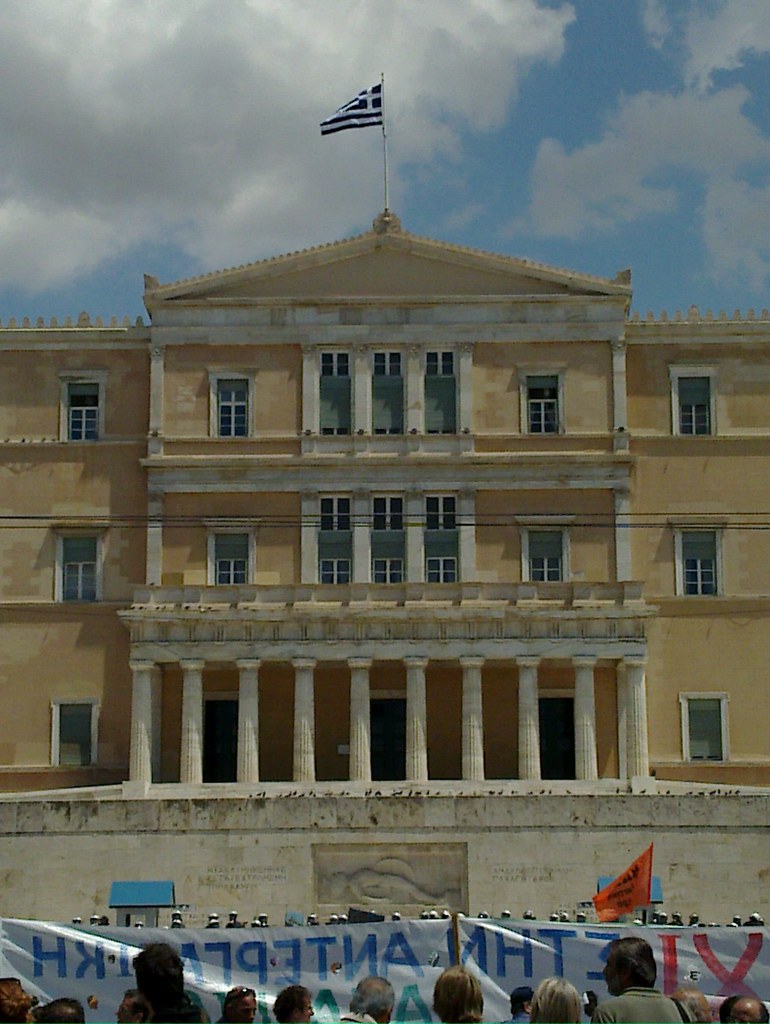
Greek Parliament, Syntagma Athens - by kouk
News outlets around the world have focused heavily on the so-called Greek Sovereign debt crisis this week.  The proposed solution–an IMF loan package requiring “austerity measures” and a fire-sale of public assets–has sparked massive unrest in the capital, where people from all walks of life are decrying a loss of democracy, sovereignty, economic means, public services- the viability of their futures and of Greece itself. 

Many have insisted that these “measures” are necessary.  If one is speaking about maintaining the share value of many European banks and institutional investors, such is true.  The IMF loan package to Greece, boiled down, is a global taxpayer bailout of European banks which have made poor investment decisions in purchasing Greek bonds. 

Even while the US debt has reached its ceiling, the US Senate has recently rejected a Republican measure attempting to restrict the IMF’s ability to dip directly into the US treasury to the tune of $100billion.  In the twisted game of hot potato that now typifies international finance, the IMF is making loans to Greece so that Greece can pay back its loans to the various private European banks and investors holding Greek bonds, while the member nations of the IMF, all of whom are similarly in debt to private banks, will have to seek more loans from private international banks (or China) in order to cover additional deficits that the IMF causes them as it takes their money and dumps it into the sieve that is the Greek economy.  Almost every tax-payer in the world will see a portion of their taxes swept into this bailout scheme for these investment institutions, which over many years have irresponsibly funded the institutionally corrupt Greek government.  More and more, the European Union–if not the globalised economy entirely–appears to be a supranational bank-controlled state-capitalism and less and less the free market as it is advertised.

Flush with this bailout of world taxpayer money channelled through the IMF–money which in a truly free market should have been lost as a consequence of the impropriety of lending to a state which everyone now seems ready to admit was rife with corruption–private European banks and investment firms will, like rapacious vultures, descend upon the carcass of the Greek economy.  The transportation and social service infrastructure of Greece will be bought up at fire-sale prices, as will small and mid-size local businesses that are struggling in an increasingly volatile economy and facing an extremely uncertain future.  As is their legal obligation to their shareholders, these foreign corporations will attempt to squeeze as much profit as possible from their Greek buyouts, through further rounds of asset-stripping and layoffs, the profits of which will be repatriated to investors outside Greece.  As Greeks lose their jobs and their businesses, as those lucky enough to keep their jobs lose income to pay cuts and higher taxes, as retirees lose income to pension cuts, as credit becomes scarce and money circulation becomes restricted, many will be forced into personal asset liquidations and home foreclosures in a depressed market paying pennies on the Euro.  This will come just as the people of Greece will desperately need reasonable access to the services being hawked by the Papandreou government and whatever remains of Greece’s gutted social security net.  

The whole enterprise reaches a higher level of absurdity in light of the fact that a similarly massive loan package last year failed to do anything but forestall the problem for a year.   Anyone who has juggled debt between two lines of credit knows that borrowing from one to pay the other leads to precisely nothing but a higher debt-load due to accumulating interest.  The only step in the right direction, and likely in any case inevitable, is a default by Greece on their debt, orderly or not.  Independent economists at the UN and elsewhere agree:  Austerity measures increase unemployment and reduce wages, thus lowering economic activity and tax revenues needed to repay national debts.  They do not work.

In this context, the governments and investment community of Europe–by their actions–seem keen to ensure that the Greek people are made destitute by having their collective assets stripped down and turned over to foreign interests before allowing a default.  That is what this is about.  Business and media have propagated the idea that the fault of the Greek debt crisis lies squarely with the Greek people, and this is the bitter pill they must now swallow.  However, those who pay the costs will not be the benefactors of Greece’s famously corrupt “culture” of bribes and patronage that everyone wants to blame.  Rather, it will be the middle and lower-classes who have all along suffered paying these bribes and corruption to have access to fundamental services.  These are the people now protesting in majority across Greece and in Syntagma square of Athens.  The police, who have lost all credibility as defenders of public security, have employed exemplary violence.  There are several videos posted to YouTube of police attacking restaurants bars and cafes near the protests, as well as the corralling and kettling people into sidestreets and subway stations, pelting them with tear gas and rocks, and beating them with shields and batons as they try to escape through police lines.  They have even been accused on Greek TV–with amateur video seeming to corroborate–of the deployment of agents-provocateurs among the protests: police posing as anarchists dressed in black, damaging property and threatening violence in order to give pretext for and initiate the police crackdowns.  While it will likely be impossible to verify these charges through police admission–as the Quebec Provincial police admitted to doing in Montebello, Canada in 2007–one might weigh the evidence and draw a parallel line:  if it is possible in Canada, it is possible in Greece. 

The schizophrenia of fiscal policy, or the flock of interests it serves, is evident when the situation in Greece is juxtaposed with the global financial crisis of a few years ago.  While it is demanded of Greece to sell off public assets and cut social spending, including gutting pensions and laying off civil servants–which is ostensibly supposed to restore the viability of and confidence in their economy- the US faced their crisis by going in the opposite direction:  Employing a Keynesian program of public spending to increase employment and economic activity.  Rather than allow critical industries to be gutted by private markets, companies such as GM were partly nationalised until they could recover, to prevent massive unemployment.  The recovery plan in the US was funded by “money creation,” when the US federal reserve wrote into existence billions of dollars to buy a new issue of US T-bills to fund the government.  While neither of these solutions is desirable, their “necessity” is rooted in the same problem.

Some time ago Greece, like most of the world, gave into the liberal economic idea that private banks should be allowed to create Greece’s money.  Evidently, under the yoke of the European Economic Community, Greece has now completely lost its sovereign right to create any of its own money at all.  They cannot repatriate their debt or use inflationary means to mitigate it.  Thus, Greece has lost its freedom and nationhood.  According to the words of Prime Minister of Canada William Lyon MacKenzie King, who in 1935 addressed the issue which is clearly at the root of the debt crises of not only Greece, but of Portugal, Spain, Ireland and the US, “Once a nation parts with the control of its currency and credit, it matters not who makes that nation's laws. Usury, once in control, will wreck any nation. Until the control of the issue of currency and credit is restored to government and recognized as its most conspicuous and sacred responsibility, all talk of the sovereignty of Parliament and of democracy is idle and futile.”


The videos below attest to the different tactics Police have used to break-up demonstrations and impose their will on the local community in Athens.
Watch Police attack a restaurant:


Watch club-wielding alleged Agents Provocateurs retreat behind Police lines:


 Watch Police corner and herd demonstrators into subway tunnel before gassing them:


Watch the above event from inside the subway tunnel:


Watch a Police line attack a peaceful march:


Watch Police move in to clear a demonstrator camp after tear gassing it:


Read more about the efficacy of "austerity" measures:

Friday, January 14, 2011

Bangladesh: Dabbling in Dhaka Stock Markets

A classic stock market boom-bust cycle is underway in Bangladesh, inciting riots after the closure of the country's main markets in Dhaka and Chittagong this week.  The picture painted by the charts and reports from Bangladesh make for an abject lesson in how markets fluctuate and are driven by salesmanship and sentiment.

The chart below demonstrates relatively stable conditions in the Dhaka Stock Index until a surge of buying in November of 2009 (Point "I") across all sectors in the market formed the catalyst for a year of bullish sentiment which drove markets ever upward.  At the time Point "I" also represented an all-time high for the market:

Chart Analysis by Phil McGavin
The peak at Point "II" on the chart represents mid February, 2010, a point in time at which stockmarket prices were already double what they had been a year before that point in February 2009.  At this time an article, Stock Market: A Ticking Time Bomb, appeared in the the Bangladeshi publication The Financial Express, discussing the phenomenon: "The surge in the price index and the associated increased market volatility, somehow reminds us about the boom and bust of 1996. A sudden influx of funds and a surge in retail investors are pushing the DSE index forward without regard to economic fundamentals...Currently the market is entirely being driven by mob frenzy, and how long this will continue is to be seen."  The article discusses M2 inflation and an influx of new and uneducated investors and margin traders as the forces behind the accumulation and higher valuation of the market's stocks, resulting in the week-to-week setting of new highs.

Point "III" on the chart represents the peak of the euphoria, which was reached in the first week of December 2010, roughly a month ago. From there prices have fallen at breakneck speed.

During the period between Points "I" and "III", ordinary Bangladeshis became enamoured with the ongoing success of the stock markets, as they watched the value of their cash savings gaining only on marginal interest.  Average Bangladeshis also understood that their savings were losing value as a cause of the severe boughts of inflation they were experiencing in food and fuel prices.  Throughout this time, investment retailers and banks, similar to those we have in the West such as CIBC Wood Gundy, the Cooperators and Edward Jones to name a few, were able to paint the market as a secure vehicle for savings and earnings as they could present data and charts which showed values and returns on an uninterrupted upward trajectory.  They made a great deal in fees and commissions by helping millions of ordinary Bangladeshis get into the market.

However, exactly as happens everywhere else, most ordinary Bangladeshis as well as the low-level investment package salespeople working for the Retailers and Banks, did not know that the Banks and Investment firms themselves were already placing sell orders at the predicted tops in the same sectors and stocks they were still enticing people to buy and earning fees on.  These large institutions correctly recognised that soon there would be no significant amount of investors or capital left to purchase further stock and continue to drive prices upwards.  They also recognised that the mindless mass-purchasing of the stock market (that they helped to create) had driven prices well beyond their fundamental value.

On Dec. 5th, a major process of unwinding began as large investors and banks began to "book profits," which is economic jargon for realising cash gains by liquidating an asset.  Even during this time less prudent Bangladeshis were still offering to buy stock at prices which had the smart money hitting the sell button.  One by one these large stock holders began to unload, and in the glut of selling prices have tumbled since early December to Monday's low.  On that day, the entire Dhaka exchange index lost 9.25% percent inside an hour, before authorities halted trading to prevent a complete collapse of the market.  The BBC reports that "police used tear gas and baton charged investors who had attacked government buildings in protest at collapsing share prices" on Monday.  Such a sharp decline likely represents a sudden awareness by many more market participants that the markets are still overvalued, and they are thus either exiting the markets or unwilling to invest in it further.  More unfortunately, it represents the self-fuelling effect of automatic execution stop/sell orders and margin calls which were triggered as prices fell, which added to the momentum of the selling frenzy.  It was this automatic and self-perpetuating triggering of sell orders which caused authorities to suspend trading on the exchanges.  The massive dip and its triggering of stop/sells and margin calls has forced book-losses on many ordinary investors, who are for the most part poorly advised and educated as to how to compete in financial markets.  

Chart Analysis by Phil McGavin
The chart to the left shows the market from just this past August until now.  "III" is the same December 5th point as that of the previous chart, the ultimate high of the market, which was 8918.5.  Point "B" is the low of 6499.5 which was formed after trading was suspended this Monday, January 10th.  While such is an astounding loss of 28.2%, this only reflects movements in the stock index, which is itself an average of the values of all stocks on the exchange.  Many investors have realised losses far worse than this as their exposure to the market is in only a number of stocks thereof; many individual stocks performed far worse than the market average.  Usually such stocks are held primarily by uninformed investors who purchase baskets of stock packages and mutual funds from retail investment firms.  These are the people rioting in the streets and claiming that they have lost most of their savings.  Though the index did recover to above 7500, it is clear that this is to a level which is still not above the upside of a forming downward channel. That levels in the index were restored to where they were a few days before Sunday and Monday's panic does not change the fact that sentiment has turned against the market and that prices are likely to continue downwards even faster than the extreme manner in which they rose, to levels which are below actual stock values.  These fluctuations will see many middle class people in Bangladesh wiped out and starting from square one in a country where there is no social safety nets and whose lowest common denominator is homeless refugees of the past years' repeated monsoon floods.

The ongoing Bangladeshi Stock Maket unravelling is a real-time view into the anatomy of a market bubble, and yet another of example of why people everywhere must be weary of investing in markets they do not understand.  To invest in any market is primarily a speculative business decision, not a method for retirement savings.  One should not undertake to do so without some education and limited experience of their own.  Furthermore, one should be leary on handing over their hard earned money to brokers and investment retailers whose organisation's primary interest is fees and commissions; organisations who are not regulated from betting against their own advice; advisors who in large part have no experience or earnings in stock markets and whose education is limited to brief certificate programs at community colleges which merely familiarize them with basic economic terminology and theory.  


Read the Financial Exchange article from Point "I", December 1, 2009:
http://www.thefinancialexpress-bd.com/more.php?news_id=85612

Read the "Ticking Timebomb" article from Point "II", February 19, 2010:
http://www.thefinancialexpress-bd.com/more.php?news_id=92946

Read about the Riots:
http://www.bbc.co.uk/news/business-12149340
http://www.bbc.co.uk/news/business-12162039

Monday, January 10, 2011

Switzerland: Swiss Franc -ly Under Attack

Separate reports this week in the Swiss newspaper Neue Zuericher Zeitung (NZZ) are highlighting the difficult choices Switzerland, and by extension other nations, are facing in the continued onslaught of effective currency devaluation by US and Eurozone officials. The Greenback and the Euro have fallen significantly against the Franc and other currencies in the past years as their governments and central banks have created a glut of supply; by loosening monetary policy, lowering interest rates and creating massive amounts of new debt to bail out ailing banks, businesses and governments.   The choices for nations such as Switzerland are clear:  Reduce living standards and income values through inflation, or see a massive outflow of jobs and industry from their borders. 

Swiss Banknotes by kalleboo
The Swiss National Bank (SNB) has announced losses of 8.5bil Swiss Francs in the first 3 quarters of 2010, resulting from their foreign exchange interventions intended to curb the effect of the inflating Euro and Greenback on their economy.  These losses stem from the SNB's massive selling of Swiss Francs and purchasing of Euros in order to simultaneously increase market supply of Swiss Francs to lower it's exchange rate; and increase competition in the Euro-dollar market to help support/increase its value.  Despite these efforts and the losses thereof, the Eur/Chf (Euro/Swiss Franc) exchange rate has fallen from late 2007 highs of 1.68 to current levels of 1.25.  This has had a severe effect on Swiss industry, most of whom must repatriate sales made in the Eurozone in order to book profits.  This peak to trough fall represents a loss to Swiss exporters of 0.43 Chf in every dollar they earn, or roughly 0.25 in aggregate terms.

Such extreme cuts to profits have Swiss industry chiefs remarking that in current conditions they cannot consider new hiring or expanding production in Switzerland, and making controversial threats to move jobs out of Switzerland and into the Eurozone, where wages have dropped along with the Euro relative to the Swiss Franc.  Retailers are also complaining that more and more Swiss shoppers are travelling the short distance to make their purchases accross the border, which is not far from any point in the small landlocked Alpine country.  The tourism industry is also feeling the pinch, as it is more expensive for Europeans to buy Francs.  Some doubt the long term viability of small and mid-sized businesses in Switzerland if the Franc's value to the Euro cannot be stabilised above 1.30.  The NZZ this week specifically quoted Georges Hayek, chief of Swatch-Group and Hans Hess, president of Swissmem, an association representing the mechanical and electrical engineering industry, as calling for government intervention in this regard.

However, such government intervention would in all cases amount to a rapid inflation of the Swiss currency.  This would cause prices of goods to rise generally, affecting the value and purchasing power of all Swiss incomes, from wage-earners to business owners to pensioners.  The Swiss authorities thus face a double-edged sword:  To take action is to lower living standards for all Swiss residents and cut the value of savings; to hold firm is to risk a general flight of industry and jobs and support a loss of value in local stock market investments.  In all cases jobs, savings and investments are threatened.  This dilemma is at the root of the murmurrings of currency war surrounding the G20 meetings in Seoul, which saw the US and Europe insisting that China allow the yuan to rise, and China along with Brasil, Korea and a host of other nations from across the globe complaining of the ill-effects to their economies caused by the effective devaluatoin of the Euro and Dollar by Western central banking authorities. 

Just as the European central bank (ECB) was forced to bail out Greece and Ireland by helping to create new money, and is currently fighting to prop up the Portuguese national budget with bond purchases, so are Federal authorities in the US now facing calls to bail out hopelessly indebted states and municipalities.  The Wall Street Journal reports that Federal Reserve chairman Bernanke has scuttled such talk by pointing out that new rules under the Dodd-Frank laws enacted by the federal government last year limit the fed`s ability to intervene should states or municipalities go into default/bankruptcy.  Such issues in Europe and America will, regardless of how they are addressed, create more instability in foreign exchange markets, to the detriment of economies outside their borders; from first world economies such as Switzerland, Canada and Japan, down to China, Brasil, India and all others dependent on the global economic model. 

Read more:

German Language Sources:
http://www.nzz.ch/nachrichten/wirtschaft/aktuell/tiefer_euro_gefaehrdet_wohlstand_1.8958738.html
http://www.nzz.ch/nachrichten/politik/schweiz/schweiz_nationalbank_verlust_85_milliarden_franken_2010_1.8356119.html

Other English Language Reports on the Swiss Franc and US Debt:
http://online.wsj.com/article/SB10001424052748704739504576067602380461160.html
http://online.wsj.com/article/BT-CO-20101112-701368.html
http://www.swissinfo.ch/eng/specials/swiss_franc/Strong_franc_continues_to_haunt_Swiss_economy.html?cid=17955460

Thursday, November 18, 2010

Seoul G20: Perplexing Conclusion, Clear Result

The conclusion of the most recent G20 summit in Seoul last Friday, hailed as a success for political reasons by attending politicians, was punctuated with the following agreed upon statement: "Uneven growth and widening imbalances are fueling the temptation to diverge from global solutions into uncoordinated action... uncoordinated policy actions will only lead to worse outcomes for all."  In other words, 'while we agree in principal that it is best to agree, we disagree.'  I can only imagine that, if only the leaders of nations in times past, who with the specter of wars and economic strife looming before them, had been privy to such wisdom, things would have turned out exactly the same...

In spite of ambiguous political statements made in Seoul last week, markets have been remarkably unified in their response.  Since markets closed on the Wednesday (Nov. 10) before the summit began in earnest, every single major US dollar denominated market has fallen.  Several of these markets had been gaining steadily leading up to the G20 summit, but all have dipped in response to the G20's conclusion.  Here is a quick statistical rundown of some of those losses up to the Wednesday Nov. 17 close:

Dow Jones   -350 points (-3.1%);
S&P 500   -40 points (-3.2%);
NYSE Comp.   -259 points (-3.3%)
Crude $/Brl   -6.77 (-7.7%)
Copper $/lb   -0.24 (-6.0%)
Gold $/oz   -62 (-4.4%)
Platinum $/oz   -97 (-5.6%)


Thus, money (or value) is coming out of stock and commodity markets across the board.  Furthermore, Treasuries, both 30yr and 5yr notes, fell 1.5% and 0.9% respectively, during the same period; markets which often gain when stock markets are in turmoil.  Taken in the context of a rise of 1.44 points (+1.9%) during the same period, in the US Dollar Index (USDX) which is a guage of the value of the dollar relative to other world currencies, we can reasonably assume that losses in the value of stocks and commodities are partly, if not mainly, a result of a strengthening US dollar.  This represents deflation.  What is the cause of this deflationary pressure?  It could be that investors have responded to the G20's failure to resolve its differences over state manipulations in currency markets by pulling out of markets and deleveraging, or paying off debts.  The US dollar being a debt-based currency, any net reduction in USD debts effectively reduces the amount of USD in the system, producing deflation. 

Perhaps the dirtiest word in modern economics, many analysts of late, even Fed chief Bernanke, have begun to broach the issue of deflation.  That it is impossible in America has been the misplaced hope of so many bank and fund chiefs.  The Japanese banking crisis of the 1990s has resulted in persistent deflation for over a decade.  The more recent global recession, particularly the crash in the summer of 2008, was a deflationary crash, which saw all markets lose value at break-neck speed after being inflated by Bush's bank bailouts and stimulus spending.  That extra money was un-created nearly as quickly as it was created when it was used by large institutions to pay off debts and deleverage.  So what to expect?  With interest rates already at historical lows and failing to stimulate more borrowing, look for the Federal Reserve to enact more quantitative easing, the modern equivalent of printing money.  This will complete another round in the cycle, and further consternate the US's G20 partners, especially China, who will see it as another salvo in the much denied currency war.  However, if they fail to do so, fear of another credit crunch may trigger another US dollar exodus from markets everywhere, and the global 'double dip' recession will be upon us.  It seems that there is no positive alternative, and no way out of the rabbit hole the US has dug for itself and the rest of us.

Perhaps the only thing keeping the floundering juggernaut of global finance afloat is the placebo effect of the actions of its masters who maintain a public image of confidence and certainty about their actions.  If at any time any major player all at once goes bust or pulls their money off the table, everyone else may just decide to cash in.  It seems since the summit, a few players at least, have decided to pocket at least a few of their chips, just in case.

Wednesday, November 17, 2010

Japanese Population Crash will be Political, not Economic Failure

There has been much discussion in the developed world over the last decades among economists and policy makers concerning their ageing populations.  Recent discussions on CBC Radio's 'The Current', as well as treatment of the issue by other news outlets as it concerns Japan are a striking demonstration of the fear of the unknown future.  Analysts are watching with a keen eye, as Japan may provide a litmus test as to how well modern democracies and economies are able to weather the demands of an ageing and shrinking population.

Compared to Western nations, Japan's immigration policy is non-existent, and Japan features near the bottom of the list in 'Total Fertility Rate' or TFR, regardless of whose doing the math.  Since 2005, deaths outnumber births in Japan.  Projections along these rates vary, some stating that by 2055 the population will have shrunk by 30% which represents more than 30 million people.  While the question of what Japanese society will look like in two or three generations as its population shrinks is fascinating, the fears stemming from this issue pertain mostly to the ageing of Japan's shrinking population, which is expected to continue. 

The implications of an ageing population are well understood:  Fewer working people paying less taxes to support more and more pensions and social services will certainly be the trigger for future attempts to reform pension, health and welfare systems, etc., which are already the point of heated debate in developed nations.  Witness recent rioting in France over pension reforms and the raising of the retirement age from 60 to 62, or G.W. Bush's failure to enact pension reforms in 2005 amid resistance from organised labour and the AARP.  Any shift in the status quo represents a shift in wealth, privilege, and the potential for both, and will be opposed doggedly by those groups seeing themselves as the losers in the trade.  The real question is, how can a democratic nation cope with growing divisions along the lines of age.  One may wryly consider that rollbacks in pensions and social programs will occur in democracies as soon as enough baby-boomers are dead or too senile to vote in their own interests.

Japan's is a special case however, and Western nations will take their cues from how Japan deals with its population problem at great risk.  Japan's is an export-based economy, making it dependent on foreign purchasing of their goods.  As their work force shrinks, so will drastically the total production and total income of their export sector, which props up household incomes, the tax base and social services, as well as the stock market and thus the private investments of its citizens.  Service economies, diversified and net importers of finished goods, such as the US, Canada and Europe, will not suffer in the same way.  These Western economies may suffer a lack of spending and conspicuous consumption in the retail sector, but they are not dependent on net inflows of currency in the same way that Japan is.

There is, however, reason to hope.  To allow the population to shrink as it ages may not be as bad as some predict.  GDP will certainly fall allong with a marked population decline, but it is less clear that per-capita-GDP would also fall.  The same can be said for almost any statistic, be it productivity v. productivity-per-capita, etc.  While Western nations invite immigration to counter low birth rates, their economies must grow to maintain, let alone improve, average living standards as population rises.  Recent economic hardships demonstrate that this is not always possible.  In a vacuum, if Japan's population were to shrink by a fifth, then the remaining four fifths would be left to split the fifth of the pie left behind, enjoying the resources which previously accommodated everyone.  With proper stewardship of Japan's available resources and economy, something along those lines may be possible.  While there may be less money around to buy things, there will be less demand on fixed assets such as land and real-estate, as well as on other domestic markets.  Incomes may increase as Japanese firms compete in a shrinking market of Japanese educated workers, technicians and specialists. 

To what degree will future Japanese generations be willing to honor the agreements and obligations of past governments?  Again, the question is, will democracy in such hugely populated jurisdictions allow for enlightened and sustainable policy?  The problem may not at all be the shrinking or ageing of a population, but the political structure's ability to handle the changing demography.  Japanese politicians are avoiding the issue for all the wrong reasons.  With so many vested interests, with so many people with so much to lose, a vocal minority may win the day, as they often do, to the detriment of sustainability, good governance, and people at large.

The truth is that there is no example in history of how a modern economy or modern democracy will react to a shrinking population.  There are sure to be "shrinking" pains, as pains, strife and unrest happen during any major demographic shift.  In the most pessimistic of predictions for Japan however, there is a lack of creative and inspired thinking. 

Read/ listen to stories about this issue:

http://www.cbc.ca/thecurrent/episode/2010/11/16/nov-1610---pt-2-japans-population-crash/

http://in.reuters.com/article/idINIndia-49967220100708

http://www.businessweek.com/lifestyle/content/aug2010/bw20100812_825983.htm