Showing posts with label IMF. Show all posts

Monday, July 4, 2011

Greek Sovereign Debt Crisis a Sovereignty Crisis

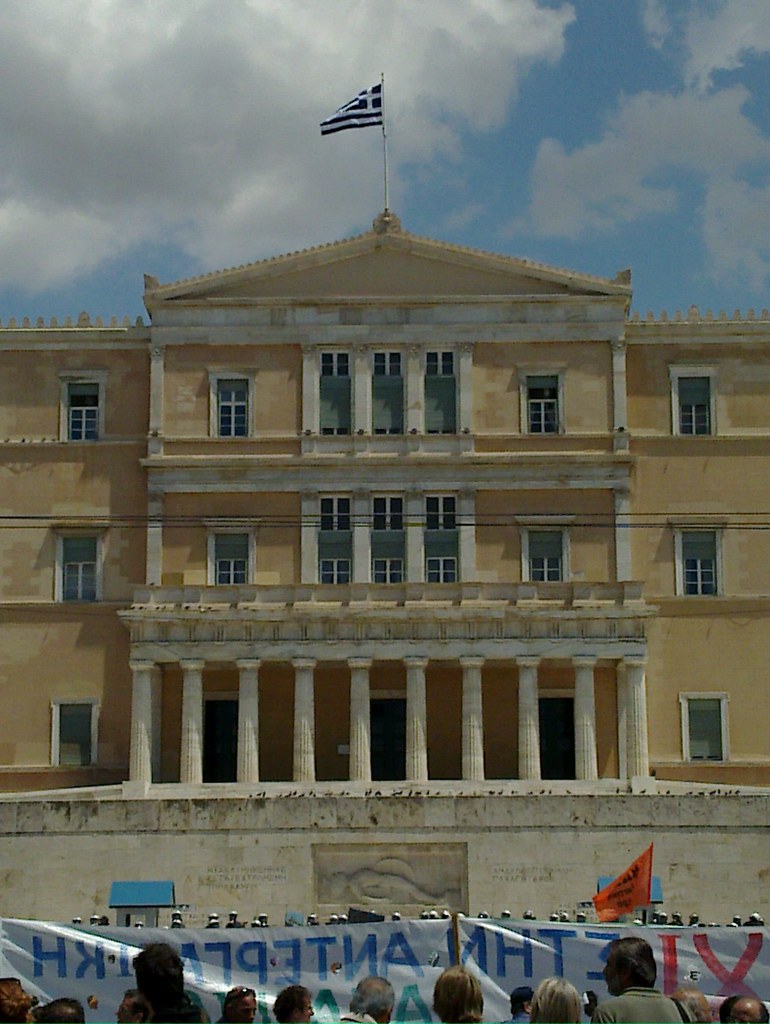
Greek Parliament, Syntagma Athens - by kouk
News outlets around the world have focused heavily on the so-called Greek Sovereign debt crisis this week.  The proposed solution–an IMF loan package requiring “austerity measures” and a fire-sale of public assets–has sparked massive unrest in the capital, where people from all walks of life are decrying a loss of democracy, sovereignty, economic means, public services- the viability of their futures and of Greece itself. 

Many have insisted that these “measures” are necessary.  If one is speaking about maintaining the share value of many European banks and institutional investors, such is true.  The IMF loan package to Greece, boiled down, is a global taxpayer bailout of European banks which have made poor investment decisions in purchasing Greek bonds. 

Even while the US debt has reached its ceiling, the US Senate has recently rejected a Republican measure attempting to restrict the IMF’s ability to dip directly into the US treasury to the tune of $100billion.  In the twisted game of hot potato that now typifies international finance, the IMF is making loans to Greece so that Greece can pay back its loans to the various private European banks and investors holding Greek bonds, while the member nations of the IMF, all of whom are similarly in debt to private banks, will have to seek more loans from private international banks (or China) in order to cover additional deficits that the IMF causes them as it takes their money and dumps it into the sieve that is the Greek economy.  Almost every tax-payer in the world will see a portion of their taxes swept into this bailout scheme for these investment institutions, which over many years have irresponsibly funded the institutionally corrupt Greek government.  More and more, the European Union–if not the globalised economy entirely–appears to be a supranational bank-controlled state-capitalism and less and less the free market as it is advertised.

Flush with this bailout of world taxpayer money channelled through the IMF–money which in a truly free market should have been lost as a consequence of the impropriety of lending to a state which everyone now seems ready to admit was rife with corruption–private European banks and investment firms will, like rapacious vultures, descend upon the carcass of the Greek economy.  The transportation and social service infrastructure of Greece will be bought up at fire-sale prices, as will small and mid-size local businesses that are struggling in an increasingly volatile economy and facing an extremely uncertain future.  As is their legal obligation to their shareholders, these foreign corporations will attempt to squeeze as much profit as possible from their Greek buyouts, through further rounds of asset-stripping and layoffs, the profits of which will be repatriated to investors outside Greece.  As Greeks lose their jobs and their businesses, as those lucky enough to keep their jobs lose income to pay cuts and higher taxes, as retirees lose income to pension cuts, as credit becomes scarce and money circulation becomes restricted, many will be forced into personal asset liquidations and home foreclosures in a depressed market paying pennies on the Euro.  This will come just as the people of Greece will desperately need reasonable access to the services being hawked by the Papandreou government and whatever remains of Greece’s gutted social security net.  

The whole enterprise reaches a higher level of absurdity in light of the fact that a similarly massive loan package last year failed to do anything but forestall the problem for a year.   Anyone who has juggled debt between two lines of credit knows that borrowing from one to pay the other leads to precisely nothing but a higher debt-load due to accumulating interest.  The only step in the right direction, and likely in any case inevitable, is a default by Greece on their debt, orderly or not.  Independent economists at the UN and elsewhere agree:  Austerity measures increase unemployment and reduce wages, thus lowering economic activity and tax revenues needed to repay national debts.  They do not work.

In this context, the governments and investment community of Europe–by their actions–seem keen to ensure that the Greek people are made destitute by having their collective assets stripped down and turned over to foreign interests before allowing a default.  That is what this is about.  Business and media have propagated the idea that the fault of the Greek debt crisis lies squarely with the Greek people, and this is the bitter pill they must now swallow.  However, those who pay the costs will not be the benefactors of Greece’s famously corrupt “culture” of bribes and patronage that everyone wants to blame.  Rather, it will be the middle and lower-classes who have all along suffered paying these bribes and corruption to have access to fundamental services.  These are the people now protesting in majority across Greece and in Syntagma square of Athens.  The police, who have lost all credibility as defenders of public security, have employed exemplary violence.  There are several videos posted to YouTube of police attacking restaurants bars and cafes near the protests, as well as the corralling and kettling people into sidestreets and subway stations, pelting them with tear gas and rocks, and beating them with shields and batons as they try to escape through police lines.  They have even been accused on Greek TV–with amateur video seeming to corroborate–of the deployment of agents-provocateurs among the protests: police posing as anarchists dressed in black, damaging property and threatening violence in order to give pretext for and initiate the police crackdowns.  While it will likely be impossible to verify these charges through police admission–as the Quebec Provincial police admitted to doing in Montebello, Canada in 2007–one might weigh the evidence and draw a parallel line:  if it is possible in Canada, it is possible in Greece. 

The schizophrenia of fiscal policy, or the flock of interests it serves, is evident when the situation in Greece is juxtaposed with the global financial crisis of a few years ago.  While it is demanded of Greece to sell off public assets and cut social spending, including gutting pensions and laying off civil servants–which is ostensibly supposed to restore the viability of and confidence in their economy- the US faced their crisis by going in the opposite direction:  Employing a Keynesian program of public spending to increase employment and economic activity.  Rather than allow critical industries to be gutted by private markets, companies such as GM were partly nationalised until they could recover, to prevent massive unemployment.  The recovery plan in the US was funded by “money creation,” when the US federal reserve wrote into existence billions of dollars to buy a new issue of US T-bills to fund the government.  While neither of these solutions is desirable, their “necessity” is rooted in the same problem.

Some time ago Greece, like most of the world, gave into the liberal economic idea that private banks should be allowed to create Greece’s money.  Evidently, under the yoke of the European Economic Community, Greece has now completely lost its sovereign right to create any of its own money at all.  They cannot repatriate their debt or use inflationary means to mitigate it.  Thus, Greece has lost its freedom and nationhood.  According to the words of Prime Minister of Canada William Lyon MacKenzie King, who in 1935 addressed the issue which is clearly at the root of the debt crises of not only Greece, but of Portugal, Spain, Ireland and the US, “Once a nation parts with the control of its currency and credit, it matters not who makes that nation's laws. Usury, once in control, will wreck any nation. Until the control of the issue of currency and credit is restored to government and recognized as its most conspicuous and sacred responsibility, all talk of the sovereignty of Parliament and of democracy is idle and futile.”


The videos below attest to the different tactics Police have used to break-up demonstrations and impose their will on the local community in Athens.
Watch Police attack a restaurant:


Watch club-wielding alleged Agents Provocateurs retreat behind Police lines:


 Watch Police corner and herd demonstrators into subway tunnel before gassing them:


Watch the above event from inside the subway tunnel:


Watch a Police line attack a peaceful march:


Watch Police move in to clear a demonstrator camp after tear gassing it:


Read more about the efficacy of "austerity" measures:

Monday, June 27, 2011

Egypt Rejects IMF, Revolution Lurches Forward

by Jonathan Rashad
Egyptians have evaded a great pitfall in their quest for freedom, democracy and sovereignty in their rejection this week of loan proposals from the IMF.  Nations across the world, especially in Africa, have time and again during periods of turmoil been tempted into bailouts and loan deals with the IMF and World Bank, always with strings attached: Steeled strings which pull the borrowing nation apart.

While successful in the ouster and trial of Hosni Mubarak, as with any revolution, the true test for Egypt is now coming after the removal of the regime’s figurehead.  A ratification of the revolution is yet to be completed, as the protest movement continues to fight against the faceless architecture of Egyptian power, which is still concentrated in the military, the oligarchy and foreign capitals.  Continued dealings with institutions such as the IMF would leave intact a central pillar of that architecture. 

Among other things which helped to destroy the Egyptian economy was the Mubarak regime’s system of patronage, as well as its borrowing from lenders such as the IMF; who always dictate how their loans are to be spent, as well as dictate economic and social policies generally as conditions for their lending.  These two forces helped to gut social projects, create massive unemployment and exacerbate poverty- ironically laying the groundwork and providing impetus for popular revolt.  Now the IMF and multinational corporations who did much business with Mubarak and who are the ultimate destination for IMF loans- loans which the taxpayers of the host nation must repay- want back in, but the Supreme Military Council has rejected the loans for now, amid popular distrust of the IMF in Egypt. 

Indeed, regardless of whether or not one would argue as to the virtue of the IMF loan package, one cannot deny that democracy has been served:  The people of Egypt do not want dealings with the IMF.  In fact, a rejection of the dictates of foreign influence, international finance and corporate power, in which the IMF is at the center, was a critical theme of the revolution.  While this fact mostly escaped the western media, Egypt’s current leadership is at least aware of it. 

Revolution:  Still in progress...

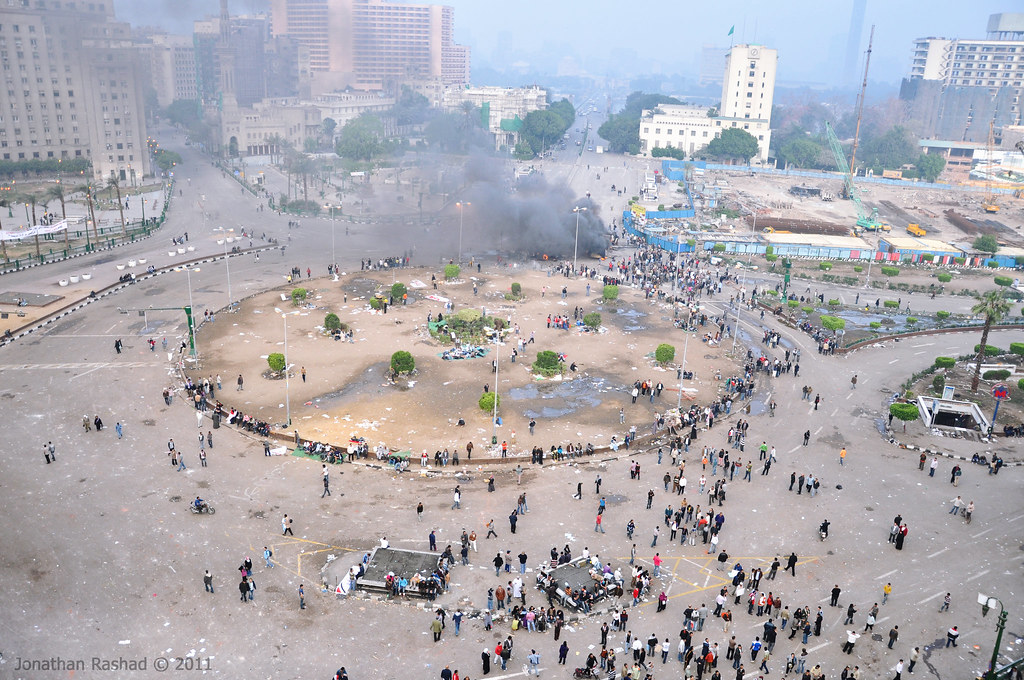
Apr 8 - Tahrir Square protests continue - Jonathan Rashad
Protests have continued since General Mubarak was finally forced from office on February 11.  There was much speculation afterwards as to how far Mubarak’s ouster would go in assuaging public outrage, which until earlier this year was for a long time a widespread but unexpressed reality.  Would the Egyptian street be placated by a simple rotation of figureheads?  This was the hope of the beneficiaries of the regime in Egypt, the US and in Israel.  According to Reuters, the Mubarak regime had been receiving an average of $2billion per year since 1979, making it the second largest recipient of US “aid” money, neighbouring Israel being the first.  It was always well known that the lion’s share of this money went to paying and equipping the coercive police/military apparatus which held the population in check through violence, subterfuge and torture.  As such, it is not surprising that the US administration did not support the ouster of their ally until the very last, until it became clear that such was already inevitable and perhaps necessary to stifle a more complete revolution which would sweep away not just Mubarak, but in one fell swoop the political, economic and military assets the US has bought in that country.  While Barack Obama spoke platitudes about freedom and democracy in Egypt, US and other foreign officials were working busily in the background to preserve the framework of Mubarak’s regime and find a successor who would be equally compliant to US interests, in spite of the aspirations to freedom of the populist, secular, anti-violent movement which demanded change at Tahrir Square and across Egypt. 

April 9 - Military crackdown continues - Jonathan Rashad
Since February 11, the Supreme Military Council of Egypt has been the official seat of power in that country.  It is made up of close allies of General Mubarak, and has been “overseeing” the transition to democracy in Egypt.  Under this “new” administration, Egyptians have continued to see crackdowns on protesters and torture of detainees.  The hope in the latter case is simply that the wretched habits of police and torturers die hard; however, in the former case the Supreme Military council is responsible for using violence to quell continued protests and criminalising the protesters through trials in military courts without due process.  Roughly 7000 sentences of groups of protesters have been meted out to up to 50,000, whom military officials continue to label as “thugs.” There is still an organised and determined enemy of the revolution wielding power in Egypt.

The land of the Pharaohs has also become a den of spies, with reports and arrests of foreign agents, most recently of one Mr. Ilan Grapel, a dual American Israeli citizen who has been in Egypt since February, and is reported as a former Israeli paratrooper wounded in the 2006 Israel-Lebanon war, a journalist, a law student and/or a spy, depending on what source one checks.  The truth of Mr. Grapel’s intentions in Egypt may never be revealed, but what is on record is that countries with vested interests in Egypt, such as Israel and the US, have in their respective and massively funded intelligence agencies a secretive behemoth with a mandate for espionage, disinformation and interference in favour of the interests of their employers.  This is while the aims of the Egyptian revolution are in vocal opposition to those interests.  Parsing between reality and contrived fiction, between honest help and the Faustian kind, between empty rhetoric and veiled threats is one of the prime challenges to the revolution in Egypt. 

How successful they are at such parsing will be in evidence later this Fall.  Former officials and collaborators of the Mubarak regime are busy rebranding themselves ahead of Presidential and Parliamentary elections set for later this year, with the hopes of maintaining their influence and access to the public treasury.  Other forces whose intentions are less clear are also clamouring; some looking perhaps to exploit divisions which in the past characterised Egyptian society.  The revolution is further threatened by the economic impact of the deconstruction of Mubarak's corrupt economic system and the loss of tourist dollars, which is to say that things always get worse before they get better.  Officials with much to lose in Egypt, foreign and domestic, are beginning to blame the revolution for continued rising unemployment and inflation- people such as the cheerleaders for the rejected IMF loans- as if Egypt’s economic woes are not the culmination of 3 decades of Mubarak’s cannibalistic policies.

However, if an honest parliament can be elected, who with the help of an engaged public can bring out of Tahrir and institutionalise the spirit of dignity, unity and humanity that struck Mubarak down and still grips most of the country, Egypt can begin to pull itself along the long road to reclaiming all that it has lost in more than a half-century:  Having suffered military invasion by Britain, France and multiple times by Israel, trade sanctions and threats by the US and the World Bank, and the wholesale looting of the country’s wealth by Mubarak’s three decades of international cronyism, Egypt now finds itself in a deep hole.  Printed everywhere on signs, painted on walls, sprayed on tanks and chanted on the streets is the continued call of the people of Egypt, as well as Arabs across Syria, Yemen, Tunisia, Bahrain and so on:   

“Aash’ab yureed issqaat in-nithahm!”
“The people want the fall of the system/regime!”
 (!الشعب يريد إسقاط النظام)

By rejecting the IMF, the people of Egypt have rejected the nonsensical idea of digging themselves out of their hole with the same tools that got them there.  


 “Aash’ab yureed issqaat in-nithahm!” 
Hear the people of Tahrir square and across the Arabic world


Read more about Egypt and the IMF:

Egypt since Mubarak’s fall:

Conflicting sources on the strange case of Ilan Grapel:

Thursday, December 16, 2010

Riots and Disparity: Rome, London and Toronto

International headlines in the last two weeks have reported a massive amount of social unrest and unsettling news across the developed world, including riots and economic data which on the surface may appear discordant and unrelated, but are united as part of larger political and economic trends. 

Fees Protest, by Andrea_F
Days of protests and rioting in London have seen the metropolitan police employing illegal crowd control tactics such as kettling, assault, and the use of horseback police charging at canter to provoke demonstrators who could not disperse to areas already cordoned off by police.  The protesters themselves have attacked government buildings and corporate franchise outlets, as well as molesting Prince Charles and Camilla Parker Bowles, who demonstrated an incredible lack of forethought in their failure to associate themselves with the objects of the 50,000 protesters’ anger when they ventured into downtown London for an evening at the theatre, their car being attacked with billiard balls, sticks and paint amid shouts of “Shame... Your government fucked us,” and “Off with their heads!” 

by Andrew Moss Photography
The London ‘fees riots’ have been precipitated by public anger over the government’s decision to allow university tuitions to rise by as much as threefold, or more precisely, the betrayal of campaign pledges and promises made by the Liberal-Democratic Party to oppose any attempt by a government to increase tuition fees.  This week the party made a fantastic U turn by abandoning this key point in their manifesto, and providing the swing vote the government needed to push the measure through; in so doing, perhaps a generation of middle-low income youth have been simultaneously denied an affordable post-secondary education and disabused of the notion that their government functions as a credible democracy.  With the perception that they have lost any means of redress or democratic expression and that the government exists to serve financial and corporate institutions after tax-payer funded bailouts, the students have lashed out against government and corporate property, and responded with violence against police who have attempted to pacify demonstrators with violence of their own.  While British papers polemicise as to whether the police and/or demonstrators have been criminally violent, it is not difficult to understand on a sociological level how such a reaction could occur when teens and twenty-somethings have had the image of their own futures swept out from under them by a duplicitous group of politicians.  After all, revolution is for the young. 

Bandana Bianco by surfstyle
Similarly, riots in Rome erupted this week after Silvio Berlusconi managed somehow to maintain his control of the office of Prime Minister by defeating 2 no-confidence votes, in the Senate and lower-house.  Berlusconi has long been something of a controversial playboy figure in Italian politics, he is a multi-billionaire, ranked by Forbes as the world’s 74th richest man, and has always been unabashed and opinionated, endearing himself to a wide base of the Italian population; his tenure as Prime Minister being the second-longest in Italian history.  However, many Italians, have throughout his career decried his virtual monopoly of control over the state and private media, as well as his many moves to change Italian law in his favour; in one instance he changed a statute of limitation to quash conflict-of-interest charges levelled against him.  He has employed his personal fortune to mire his opponents in law-suits, more recently to allegedly hire dozens of girls for a bunga-bunga-orgy-party.  His office has lied to police in the attempt to get a 17 year-old belly dancer/prostitute released from custody, with the absurd story that she was a relative of Egyptian President Hosni Mubarak, and his wife divorced him last year stating publicly that she “cannot remain with a man who consorts with minors” and “is not well.” 

Va fa'n... by Alessio85
Beyond the litany of credible allegations of corruption and solicitation of prostitution spanning his career, which one must wonder if he has throughout maintained his office only by his control of Italian media, there are the recent revelations in the leaked cables by Wikileaks that Berlusconi has moved in an attempt to curb freedom of expression on the Internet in Italy to silence his critics; that he has personally profited enormously through his nation’s rapprochement and energy deals with Vladimir Putin’s Russia, and that his long hours of partying have a narcoleptic effect on his meetings with US diplomats.  That Italy’s elected government, in light of the very recent Wikileaks revelations and prostitution scandals, would still somehow find reason to vote in confidence of him as leader of their nation is too much for his most belligerent opponents who no longer believe they can find a voice in parliament, in the senate, or in the press.  As such, they have chosen to cast their votes in the streets through violence and destruction, in rioting the likes of which has not been seen in Italy in “over 30 years.”

Toronto's Queen st. by C.G. Cunningham
While many media outlets would like to describe these violent protests in Rome and London as mindless apolitical thuggery, as was the mantra of major Canadian media outlets after G20 protests in Toronto this summer, it is much more likely that it is an expression of a deep feeling of political disenfranchisement.  The protests in Canada saw major abuses of power and a total abridgement of people’s rights to free movement, peaceful assembly, security of the person and due process.  Nearly all ‘charges’ against protesters in Toronto who were jailed have been thrown out, and there are now multiple investigations into police wrongdoings.  The protests on the second day of the G20 meetings swelled as the residents of Toronto spilled out onto the streets as they sensed that their rights were being trampled on; not by the IMF; the World Bank or the Group of 20; but by the Toronto Police and the other anti-riot squads and intelligence squads running amok in their city, indiscriminately searching and arresting people wearing "suspicious" or dark clothing, kettling areas of the city without warning and trapping peaceful demonstrators and people going about normal business.  Stories of beatings and sexual intimidation by police abound.  Reporters, video journalists and accredited media personnel, even from the CBC, were attacked by police, having their equipment seized and destroyed in an ostensible effort to control information on what was happening.  Many Canadians travelled to Toronto simply to protest the government’s eagerness to spend $1billion on security for the meetings while other social spending was being cut. 

Protest for Inquest by My Toronto Democracy
Though it may be too cold to protest in Canada now as winter approaches, there must be further consternation among all who have read a recent report by the Canadian Centre for Policy Alternatives, which discusses the continuing trend of rising income disparity in Canada since the 1970s.  As the top earning Canadian households continue to earn a greater and greater share of dollars, the result can only be a growing perception amongst lower earners that they are not getting their fair shake.   As long as a coalition government between Canada’s two major parties continues to support policies which encourage the trend of increasing disparity, which favours a numerical minority, so will there be a growing perception amongst the majority that the government is in service of that wealthy minority class, is unresponsive to the will of the majority, and that there is an erosion of democracy and social justice.  The disparity trend is the same in the US.  After the G20 summit in Toronto, it has also become public knowledge that to join a group which seeks redress against the government’s seeming anti-democratic leanings is to find oneself on a ‘security list’, and that should you present yourself at a public protest while being on such a list, you may be targeted for kidnapping and wrongful confinement in makeshift jails for the duration of the demonstrations, as happened to several activists who found themselves on government and police watch-lists. 

The British government has attacked its own future by making it harder for its citizens to educate themselves; they have stunted social mobility, and entrenched class divisions through this recent measure which was enacted in a gross and anti-democratic breach of public trust.  In Italy, a section of society would rather see Rome burn than accept the continued rule of their philandering and self-interested Prime-Minister.  Canadians and Americans are waking up to the fact that regardless of which party has formed their governments, they are facing a fourth consecutive decade of erosion of social services and increases in wealth and income disparity.  The populations of all these nations are watching their governments pay less and less attention to the will of their people, and more and more money to security and prison firms, policing and domestic surveillance initiatives.  Many view this as evidence that the protests such as we have seen in the past weeks in London and Rome, and this summer and Toronto are fruitless.  However, I’m afraid to imagine what shape the world would take in the total absence of such protests, should we proud inheritors of western democracies, whose freedoms and institutions were paid for in blood and revolution, become wholly subservient and meekly offer a carte-blanche to those who would take it.

More reading:


London's Fees Protests
http://www.guardian.co.uk/education/2010/dec/12/riots-fire-anger-defining-political-moment
http://www.independent.co.uk/news/uk/politics/footage-shows-protester-dragged-from-wheelchair-2159570.html


Riots in Rome
http://www.dailymail.co.uk/news/article-1338461/Berlusconi-win-sparks-violence-Rome-survives-just-THREE-votes.html
http://www.huffingtonpost.com/2010/12/14/silvio-berlusconis-confid_n_796566.html#s207347


Toronto G20 protests
http://www.cbc.ca/canada/toronto/story/2010/07/10/g20-rally-toronto-independent-review.html
http://littlealexinwonderland.wordpress.com/2010/06/29/report-toronto-police-molested-female-g-20-captives-video/
http://www.g20justice.com/

Increasing Canadian Income Disparity
http://www.policyalternatives.ca/publications/reports/rise-canadas-richest-1
http://www.obj.ca/Canada---World/2010-12-01/article-2008311/Canadas-wealthiest-breaking-new-frontiers-in-income-disparity%3A-report/1