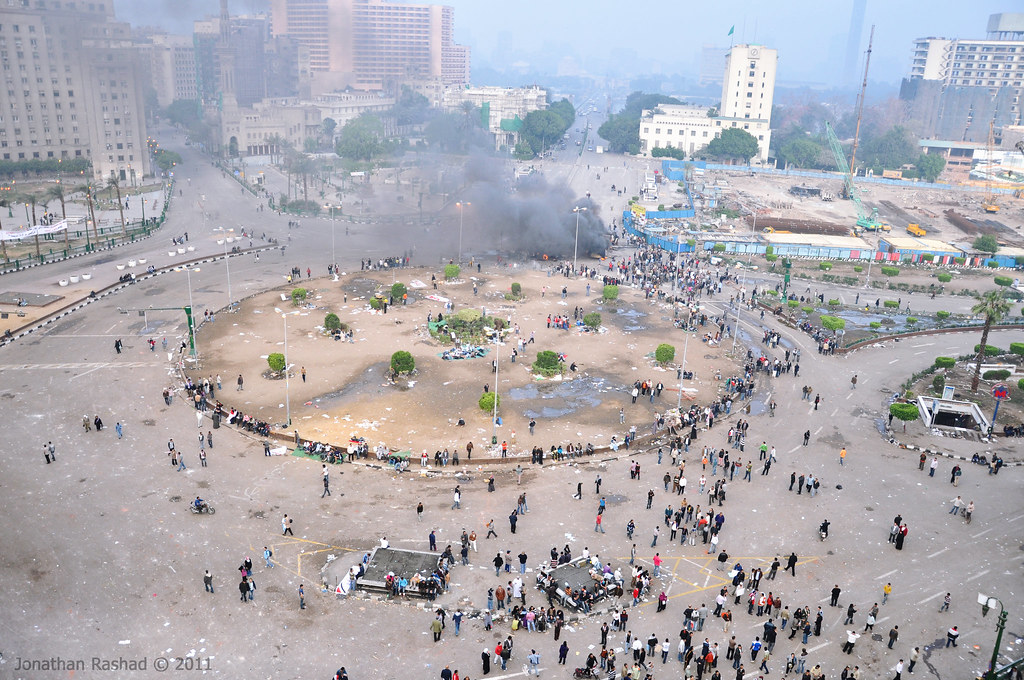
Yesterday's clashes in Tahrir square were covered here at WHR as breaking news. A more complete picture of the context and extent of the situation has emerged.
As mentioned in the previous report, the protest began in Cairo as a peaceful demonstration and public mourning by the families of those who have died in the cause of liberating Egypt. An air of gravity was upon the demonstrators and the martyrs's families as they paid their respects to the coffin of a recent victim, Mahmoud Khaled, who died on Monday. He passed in hospital, where he has been for 5 months, since he was struck by a racing US Embassy vehicle during the height of unrest on January 28, remembered in Egypt as the "day of rage." The astonishing incident can be seen in the following video, taken from a rooftop directly above the scene:
The rage the families and friends feel about the fate of their loved ones is understandable. That they have not received any justice after a "successful" revolution and "policy reforms" by a "transitional phase" government only amplifies their anguish and personal feeling of victimization. In the above mentioned case, the US Embassy insists the vehicle was stolen, however; Egyptians more and more look upon the foreign and local elites who run their country for their own purposes as one and the same. Protesters understand well that the storm troopers attacking them in Tahrir square, while perhaps Egyptian by birth, do so with American made tear-gas and foreign weapons, employed through tactics taught by foreign security firms, paid for by foreign "aid" money.
Tear Gas Canister fired at demonstrators - by lilianwagdy
While paying their respects to and demanding justice for the martyrs, demonstrators were met by insults and denied free movement by members of the Central Security Forces. They were tear gassed and tased. It likely did not escape many demonstrators that among the CSF members sneering at them could be some of those who are directly responsible for the deaths and maiming of their friends and family members. Nor did it likely escape the CSF that should demonstrators succeed in reforming Egypt, they will find themselves out of job and pay, and possibly on trial for their actions.
As word of the indignity being paid the demonstrating families began to spread, more and more people began to arrive in front of the Ministry of the Interior and in Tahrir to vent their outrage. Running and pitched battles in the square and adjacent streets ensued as the CSF attacked the crowds; these battles lasting from before dusk until after dawn this morning. Many people on the scene have reported on twitter a vengeful attitude by the CSF. While protesters were pelted with stones and tear gas, they were also taunted and threatened with death over megaphones. Today it has been reported by Egyptian authorities that more than 1000 demonstrators were injured, and more than 100 hospitalised.
Egyptian activists are calling for justice. There have been protests specifically against the military courts, which since the fall of Hosni Mubarak continue to condemn protesters, activists, journalists, bloggers, artists and even doctors who have aided or simply spoken in favour of the uprising. Activists say that without a proper functioning legal system and means of redress, no progress in any other aspect can be made or maintained. The nation will be transfixed tomorrow, Thursday June 30th, as a verdict is delivered in the trial of the 2 officers charged for the infamous beating death of Khaled Said.
The murder of Khaled Said is said to be one of the catalysts of the revolution. The story and pictures of his body circulated and created outrage after he arrested in an Internet cafe and murdered by police in June of 2010. The lack of justice for Mr. Said helped compound an ever present anger at authorities, which finally broke loose after Egyptians took the example of the Tunisian revolution. A facebook group called "We are all Khaled Said" has galvanised and informed the public throughout the revolution. It is reasonable to expect massive demonstrations in light of last night's unrest if Egyptian courts do not return a verdict finding someone responsible for his murder while in police custody. This will likely continue into Friday, which is the day of Muslim prayer and the typical day for protests as many Egyptians do not work Fridays.
Cairo's Tahrir square is once again tonight the scene of ordinary people making extraordinary efforts to free themselves from the militarist rentier regime still in power since the fall of Hosni Mubarak in February.
Earlier today in Tahrir began a protest by families of "martyrs," which in this case refers to those who've died at the hands of Egyptian security forces during the ongoing uprising. Families are still waiting for justice as there have been no substantial prosecutions or trials of those responsible for the deaths and torture of hundreds if not thousands since the year began.
Media reports are beginning to trickle in, however the twitter stream and blogosphere of the region are alight. While all credit for what has been achieved in Tunisia and Egypt belongs to the people who have bravely faced torture and death, many have credited social media as a major factor and primary tool in these events. Following are several Twitter postings by people who are in the streets of Cairo and Tahrir at this moment; fighting for ownership of their country against the CSF (Central Security Forces). While non of these can be verified, the volume of similar reports is substantiating and cannot be understated:
As the battle kicked off, descriptions and pictures of the violence poured in:
Inevitably injuries begin to be reported:
During the chaos people communicated and discussed logistical issues:
Commentary of various sorts was ongoing:
Sometime well after midnight, it seemed that the protesters had won round one and a moment of reprieve:
The situation is ongoing, it is currently early morning in Cairo. Information continues to stream in on social media outlets and in the press. Many tweets reported on the crowd chanting "The people want the fall of Mosheer," referring to Mohamed Hussein Tantawi, the leader of the Supreme Council of the Armed Forces and the de facto head of state since Mubarak's ouster in February. It remains to be seen if the ongoing unrest, including tonight's clashes, can carry the momentum which ousted Hosni Mubarak and effect real change.
Egyptians have evaded a great pitfall in their quest for freedom, democracy and sovereignty in their rejection this week of loan proposals from the IMF. Nations across the world, especially in Africa, have time and again during periods of turmoil been tempted into bailouts and loan deals with the IMF and World Bank, always with strings attached: Steeled strings which pull the borrowing nation apart.
While successful in the ouster and trial of Hosni Mubarak, as with any revolution, the true test for Egypt is now coming after the removal of the regime’s figurehead. A ratification of the revolution is yet to be completed, as the protest movement continues to fight against the faceless architecture of Egyptian power, which is still concentrated in the military, the oligarchy and foreign capitals. Continued dealings with institutions such as the IMF would leave intact a central pillar of that architecture.
Among other things which helped to destroy the Egyptian economy was the Mubarak regime’s system of patronage, as well as its borrowing from lenders such as the IMF; who always dictate how their loans are to be spent, as well as dictate economic and social policies generally as conditions for their lending. These two forces helped to gut social projects, create massive unemployment and exacerbate poverty- ironically laying the groundwork and providing impetus for popular revolt. Now the IMF and multinational corporations who did much business with Mubarak and who are the ultimate destination for IMF loans- loans which the taxpayers of the host nation must repay- want back in, but the Supreme Military Council has rejected the loans for now, amid popular distrust of the IMF in Egypt.
Indeed, regardless of whether or not one would argue as to the virtue of the IMF loan package, one cannot deny that democracy has been served: The people of Egypt do not want dealings with the IMF. In fact, a rejection of the dictates of foreign influence, international finance and corporate power, in which the IMF is at the center, was a critical theme of the revolution. While this fact mostly escaped the western media, Egypt’s current leadership is at least aware of it.
Protests have continued since General Mubarak was finally forced from office on February 11. There was much speculation afterwards as to how far Mubarak’s ouster would go in assuaging public outrage, which until earlier this year was for a long time a widespread but unexpressed reality. Would the Egyptian street be placated by a simple rotation of figureheads? This was the hope of the beneficiaries of the regime in Egypt, the US and in Israel. According to Reuters, the Mubarak regime had been receiving an average of $2billion per year since 1979, making it the second largest recipient of US “aid” money, neighbouring Israel being the first. It was always well known that the lion’s share of this money went to paying and equipping the coercive police/military apparatus which held the population in check through violence, subterfuge and torture. As such, it is not surprising that the US administration did not support the ouster of their ally until the very last, until it became clear that such was already inevitable and perhaps necessary to stifle a more complete revolution which would sweep away not just Mubarak, but in one fell swoop the political, economic and military assets the US has bought in that country. While Barack Obama spoke platitudes about freedom and democracy in Egypt, US and other foreign officials were working busily in the background to preserve the framework of Mubarak’s regime and find a successor who would be equally compliant to US interests, in spite of the aspirations to freedom of the populist, secular, anti-violent movement which demanded change at Tahrir Square and across Egypt.
Since February 11, the Supreme Military Council of Egypt has been the official seat of power in that country. It is made up of close allies of General Mubarak, and has been “overseeing” the transition to democracy in Egypt. Under this “new” administration, Egyptians have continued to see crackdowns on protesters and torture of detainees. The hope in the latter case is simply that the wretched habits of police and torturers die hard; however, in the former case the Supreme Military council is responsible for using violence to quell continued protests and criminalising the protesters through trials in military courts without due process. Roughly 7000 sentences of groups of protesters have been meted out to up to 50,000, whom military officials continue to label as “thugs.” There is still an organised and determined enemy of the revolution wielding power in Egypt.
The land of the Pharaohs has also become a den of spies, with reports and arrests of foreign agents, most recently of one Mr. Ilan Grapel, a dual American Israeli citizen who has been in Egypt since February, and is reported as a former Israeli paratrooper wounded in the 2006 Israel-Lebanon war, a journalist, a law student and/or a spy, depending on what source one checks. The truth of Mr. Grapel’s intentions in Egypt may never be revealed, but what is on record is that countries with vested interests in Egypt, such as Israel and the US, have in their respective and massively funded intelligence agencies a secretive behemoth with a mandate for espionage, disinformation and interference in favour of the interests of their employers. This is while the aims of the Egyptian revolution are in vocal opposition to those interests. Parsing between reality and contrived fiction, between honest help and the Faustian kind, between empty rhetoric and veiled threats is one of the prime challenges to the revolution in Egypt.
How successful they are at such parsing will be in evidence later this Fall. Former officials and collaborators of the Mubarak regime are busy rebranding themselves ahead of Presidential and Parliamentary elections set for later this year, with the hopes of maintaining their influence and access to the public treasury. Other forces whose intentions are less clear are also clamouring; some looking perhaps to exploit divisions which in the past characterised Egyptian society. The revolution is further threatened by the economic impact of the deconstruction of Mubarak's corrupt economic system and the loss of tourist dollars, which is to say that things always get worse before they get better. Officials with much to lose in Egypt, foreign and domestic, are beginning to blame the revolution for continued rising unemployment and inflation- people such as the cheerleaders for the rejected IMF loans- as if Egypt’s economic woes are not the culmination of 3 decades of Mubarak’s cannibalistic policies.
However, if an honest parliament can be elected, who with the help of an engaged public can bring out of Tahrir and institutionalise the spirit of dignity, unity and humanity that struck Mubarak down and still grips most of the country, Egypt can begin to pull itself along the long road to reclaiming all that it has lost in more than a half-century: Having suffered military invasion by Britain, France and multiple times by Israel, trade sanctions and threats by the US and the World Bank, and the wholesale looting of the country’s wealth by Mubarak’s three decades of international cronyism, Egypt now finds itself in a deep hole. Printed everywhere on signs, painted on walls, sprayed on tanks and chanted on the streets is the continued call of the people of Egypt, as well as Arabs across Syria, Yemen, Tunisia, Bahrain and so on:
“Aash’ab yureed issqaat in-nithahm!”
“The people want the fall of the system/regime!”
(!الشعب يريد إسقاط النظام)
By rejecting the IMF, the people of Egypt have rejected the nonsensical idea of digging themselves out of their hole with the same tools that got them there.
“Aash’ab yureed issqaat in-nithahm!”
Hear the people of Tahrir square and across the Arabic world
Coverage of the uprising in Egypt in its second week has become characterised by a number of types of reports, most of which paint colorful pictures, but do little to inform on the situation. There are the political discussions as to the West’s reaction, and how the uprising will unbalance the Arab world and its relationship with Israel. There are also personal interest stories, about tourists and tycoons fleeing Cairo. There are business reports about stock markets. Then there are vignettes into the disorder itself: Jailbreaks have been given coverage, and Hosni Mubarak, through state TV, has publicised the looting and vandalism that is occurring, primarily in wealthy neighbourhoods, where there is actual wealth to loot.
The West has been gripped by reports of vandalism at the Egyptian Museum in Cairo, with reports carrying headlines claiming “looting” and “ransacking.” In fact, reports go on to describe that there have been only 10 small artifacts damaged, 2 mummies damaged, and nothing stolen. Thus looting has not occurred, and only something of a rather polite “ransacking” when only 12 items out of a massive collection of Egyptian artifacts are affected. Stories presented in this manner seem to ask the question: Should the disorder be allowed to continue if it puts at risk the treasures of the Egyptian Museum? This is a type of sensationalism and yellow journalism which wants to paint the Egyptian uprising as mindlessly destructive. Currently, armed forces and vigilantes guard the museum.
Other reports discuss looting, vigilantes and Bedouin tribesmen breaking people out of jail. This type of press has been reaching the Egyptian people themselves. Again, it asks a negative question, as to whether the uprising is “worth it,” if it means crimes will go unpunished and criminals on the loose. However, the mass of people seem unafraid that while they are out protesting someone will ransack their house. Most Egyptians are more concerned with their government and police whose crimes have for 30 years gone unpunished, and whom remain as always “at large.” Many of the described vigilantes are also community members who are manning barricades and conducting neighbourhood watches in the vacuum of police coercion; working to stop the inevitable few people who are willing to take advantage of a lack of security to enrich themselves (or steal food and fuel). Furthermore, at this point it can’t be disproved that in many cases it is plain-clothes agents of the government who are committing these acts of vandalism, looting and robbery undercover, in order to discredit the public and the protests as criminal. Such reports have been confirmed, and this notion has great credibility on the street with Egyptians.
As for reports of jailbreaks by the Bedouin, the favourite gypsy-nomad scapegoat of popular culture and governments in the Middle East for everything from drug and gun running to indecency; it seems that "Bedouins on the loose" is a far bigger concern for Mubarak than for people on the ground, who do not seem too concerned with the familiar caricature image of camelback heathens amok on the fringes of society. While jailbreaks are a serious thing, especially to Western sensibilities, could it be that such does not concern Egyptians nearly as much at the moment, as a majority of people being broken out of prison are not in fact gang members and hardened criminals, but instead political prisoners and minorities (such as the Bedouin) who have been victims and captives of Mubarak’s suspicious and overbearing police state?
There are two sides to every story, at least. As night begins to fall on Wednesday in Egypt, reports will continue to flood out from there, and many of them will narrowly discuss the small tragedies and inconveniences that social unrest poses for Egyptians and outsiders alike. However, those stories that deserve the most attention will remind us that there are 300 people dead so far, and millions more risking their lives for their future; people who have already been subject to the organised looting, criminality and brutality of a 30+ year-old dictatorship.
A Tide of civil unrest has swept through at least 11 nations in just the past week. Media focus has been on the successes of the "Jasmine Revolution" and developments in Egypt, which is populous, geopolitically significant, and in total upheaval; but nations far and wide are experiencing mass-protests and anti-government demonstrations.
The underlying cause connecting all of these movements is the political and economic disenfranchisement of large majorities and groups of people within their nations. It could be that what now is being witnessed will be seen broadly as a sociological reaction to generally poor ongoing conditions which became exacerbated by ongoing effects of a global economic crisis and major moves in global food and fuel inflation. This situation has threatened a future of abject poverty and destitution on large populations of working poor, unemployed, pensioners, students, small business operators, professionals; anyone with debts or low incomes. In these conditions, any political or economic event can become a symbol of repression which people begin to rally against, venting their anger and will to change in street demonstrations and violent confrontation with security forces.
While the list is dominated by the Middle-East/African-Arab speaking nations of Egypt, Jordan, Yemen, Tunisia, Algeria and Lebanon, there is representation from the Sub-Sahara in Cote D'Ivoire and Ghana, as well as Europe and Asia with Albania, Bangladesh and Thailand. In no particular order:
JORDAN
Last Friday saw thousands of protestors marching in Jordan, and was the 3rd consecutive day-of-prayer protest. Jordan fits the same profile as the other Arab countries in upheaval: A large population mainly below the age of 30, under the strain of rising prices and unemployment, facing a lifetime of economic deprivation and political disenfranchisement. Today, February 1, King Abdullah has dismissed his cabinet and prime minister. His appointment of former general and PM Marouf Bakhit as the new Prime Minister will likely be seen as an empty gesture, as Bakhit is an entrenched member of the political class who was already PM from 2005-2007.
EGYPT
The Egyptian government, led for 30 years by Hosni Mubarak, on January 28 shut down all cell-phone and internet access as it faced popular calls for him and his government to step down during consecutive days of demonstrations. The entire Presidential cabinet has been purged and restaffed. Sources put today's crowds at million strong just in Cairo. Transportation has been severly restricted and night-time curfews are in place but ignored. Protestors have occupied buildings, and the army has refused to use violent coercion against the people whose demands it views as "legitimate." This represents a major break from President Mubarak, who is himself a former Air Force Commander and Chief of Staff. Clashes between demonstrators and security forces have cost more than 125 lives. The protests began in earnest on January 25, a date on which the government annually commemorates the police. Activists organised for that day a massive apolitical demonstration against police brutality, dubbed the "day of rage." The protests, unified by the rally-call "Kefaya!" (Enough!) have gathered momentum and are ongoing at the time of publication.
LEBANON
Angry demonstrations hit the streets of Beirut and elsewhere in Lebanon on January 25. Politics remain as a constant catalyst to demonstrations and unrest in Lebanon, a country which has felt the brunt of 2 wars in the past 3 decades. Lebanese society faces a lack of housing and vital state infrastructure, unemployment and rising prices, a factionalised society along religious, sectarian and political lines, and the constant threat of renewed war from its southern neighbor Israel.
YEMEN
Near daily protests since mid January in Yemen and the capital Sanaa have seen calls from tens of thousands for the ouster of 32-year President Ali Abdullah Saleh. Yemen is an extremely poor nation, located at the southern tip of the Arabian peninsula and across the gulf of Aden from Somalia. America has called Yemen an Al-Qaeda haven and has been making drone attacks inside the country. The country has already been coping with open revolt from rebel and separatist movements. With war, corruption, high unemployment and rising prices plaguing the nation, thousands of people with nothing to lose have turned out to demand rights, justice and new government. One man, Fouad Sabri, lit-himself on fire in an attempted suicide protest, immitating the act which sparked the Tunisian uprising.
ALGERIA
Rioting and protests have continued to errupt for over a month as economic turmoil engulfs the country. Algeria has suffered for a long time with a housing shortage, and the young population is acting out against their impoverished living conditions, rising prices and lack of economic opportunity. Abdelaziz Bouteflika, the 12-year president, has vowed to quash the unrest; along with employing security forces he has put in place a cooking fuel subsidy and has also ordered major purchases of wheat with the hopes of holding domestic food prices down.
TUNISIA
A month of protests which saw the ouster of Tunisia's 23-year president, Zine El Abidine Ben Ali, continue into their 6th week after being dubbed the "Jasmine Revolution." Sparked by the suicide protest of Mohammed Bouazizi on Dec 17th, general strikes and protests against indignity, police brutality, organised corruption and generally lacking rights and freedoms continue. Security forces, out of seeming habit or acculturation, continue to use deadly violence against the crowds, who are now specifically calling for the president's former cronies to resign their posts in various state ministries and the interim government.
BANGLADESH
Bangladesh is experiencing violent demonstrations as its stock market is rapidly collapsing. Since a previous report about it here at World Headlines Review, more street violence has been seen as markets hit new lows and stability has failed to return. Trading was again halted on the Dhaka exchange for a third time, on January 20, to stop rapid and massive declines which threatened a total collapse of stock values. In a seemingly unrelated story, the AFP reports that a police officer was killed and several police and civilians seriously injured in protests which saw 20,000 villagers fighting against the appropriation of their land by the government. For the masses of Bangladeshis, it seems there is no safe place to put your savings, be it stocks or real-estate.
ALBANIA
A country of some 3 million people on the Mediteranean coast of Europe, Albania's social unrest has expressed itself slightly differently from other nations. Factions within the country have fought with each other and the police over political scandals and corruption. On January 21, 3 civilians were killed when security forces fired on anti-government demonstrators. At its core, the unrest is the result of the same rising prices, unemployment and rampant corruption that is swelling the ranks of the uprisings in many other nations.
THAILAND
Anti-government protests by "red-shirts" and "yellow shirts" saw thousands of demonstrators occupying streets and neighborhoods in Bangkok this week. The Thai government has been beset by protests for years now, from groups who seem to recognise no democratic forum for redress except direct action. In December 2008 the Bangkok international airport was occupied by protestors, leaving many tourists stranded and creating international headlines. Since then, protests continue largely in the absence of international attention.
GHANA
Thousands of people demonstrated in the capital of Accra and Kumasi on January 26, calling for government action against poverty and rising food and fuel prices. The protests were peaceful.
COTE D'IVOIRE
In a poor country facing massive unemployment and inflation, a political crisis has sparked violence along social, political and ethnic lines. The UN this week reported estimates of 260 deaths in the rapidly evolving situation. Violence erupted when Laurent Gbagbo, the incumbent President, was defeated in a recent election. Gbagbo has refused the election results and is pitting the ethnic and economic prejudices of his southern support base against the growing anger of the supporters of President-elect Alassane Ouattara.
The above list briefly illustrates a number of locales experiencing unrest right now or in the past week. Haiti and Belarus are two more countries which could be added to the list if the timeframe was widened to the past month. Both countries have been mired in violent protest against corruption and anti-democratic government. In all of these countries, where there are little to no rights or freedom to associate, to gather publicly, to speak one's opinion vocally, where there are no democratic venues for ordinary people to make themselves heard and to seek redress, the only option is to defy the law, defy curfews, and face tear-gas, batons and bullets in the streets.
What seemed to happen first in Tunisia may yet inspire more people to take to the streets, but what is actually happening will continue as long as there is a reason: People facing a bleak future, with little to lose and everything to gain, finding common cause with each other and searching for hope and the power to shape their own destiny