Showing posts with label Hosni. Show all posts

Monday, June 27, 2011

Egypt Rejects IMF, Revolution Lurches Forward

by Jonathan Rashad
Egyptians have evaded a great pitfall in their quest for freedom, democracy and sovereignty in their rejection this week of loan proposals from the IMF.  Nations across the world, especially in Africa, have time and again during periods of turmoil been tempted into bailouts and loan deals with the IMF and World Bank, always with strings attached: Steeled strings which pull the borrowing nation apart.

While successful in the ouster and trial of Hosni Mubarak, as with any revolution, the true test for Egypt is now coming after the removal of the regime’s figurehead.  A ratification of the revolution is yet to be completed, as the protest movement continues to fight against the faceless architecture of Egyptian power, which is still concentrated in the military, the oligarchy and foreign capitals.  Continued dealings with institutions such as the IMF would leave intact a central pillar of that architecture. 

Among other things which helped to destroy the Egyptian economy was the Mubarak regime’s system of patronage, as well as its borrowing from lenders such as the IMF; who always dictate how their loans are to be spent, as well as dictate economic and social policies generally as conditions for their lending.  These two forces helped to gut social projects, create massive unemployment and exacerbate poverty- ironically laying the groundwork and providing impetus for popular revolt.  Now the IMF and multinational corporations who did much business with Mubarak and who are the ultimate destination for IMF loans- loans which the taxpayers of the host nation must repay- want back in, but the Supreme Military Council has rejected the loans for now, amid popular distrust of the IMF in Egypt. 

Indeed, regardless of whether or not one would argue as to the virtue of the IMF loan package, one cannot deny that democracy has been served:  The people of Egypt do not want dealings with the IMF.  In fact, a rejection of the dictates of foreign influence, international finance and corporate power, in which the IMF is at the center, was a critical theme of the revolution.  While this fact mostly escaped the western media, Egypt’s current leadership is at least aware of it. 

Revolution:  Still in progress...

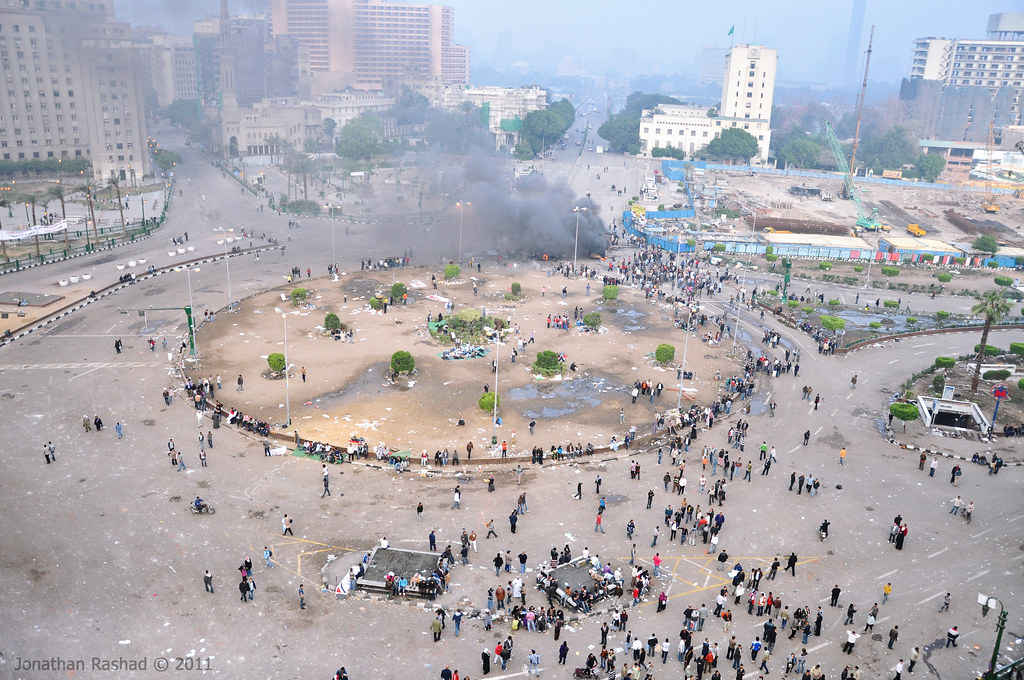
Apr 8 - Tahrir Square protests continue - Jonathan Rashad
Protests have continued since General Mubarak was finally forced from office on February 11.  There was much speculation afterwards as to how far Mubarak’s ouster would go in assuaging public outrage, which until earlier this year was for a long time a widespread but unexpressed reality.  Would the Egyptian street be placated by a simple rotation of figureheads?  This was the hope of the beneficiaries of the regime in Egypt, the US and in Israel.  According to Reuters, the Mubarak regime had been receiving an average of $2billion per year since 1979, making it the second largest recipient of US “aid” money, neighbouring Israel being the first.  It was always well known that the lion’s share of this money went to paying and equipping the coercive police/military apparatus which held the population in check through violence, subterfuge and torture.  As such, it is not surprising that the US administration did not support the ouster of their ally until the very last, until it became clear that such was already inevitable and perhaps necessary to stifle a more complete revolution which would sweep away not just Mubarak, but in one fell swoop the political, economic and military assets the US has bought in that country.  While Barack Obama spoke platitudes about freedom and democracy in Egypt, US and other foreign officials were working busily in the background to preserve the framework of Mubarak’s regime and find a successor who would be equally compliant to US interests, in spite of the aspirations to freedom of the populist, secular, anti-violent movement which demanded change at Tahrir Square and across Egypt. 

April 9 - Military crackdown continues - Jonathan Rashad
Since February 11, the Supreme Military Council of Egypt has been the official seat of power in that country.  It is made up of close allies of General Mubarak, and has been “overseeing” the transition to democracy in Egypt.  Under this “new” administration, Egyptians have continued to see crackdowns on protesters and torture of detainees.  The hope in the latter case is simply that the wretched habits of police and torturers die hard; however, in the former case the Supreme Military council is responsible for using violence to quell continued protests and criminalising the protesters through trials in military courts without due process.  Roughly 7000 sentences of groups of protesters have been meted out to up to 50,000, whom military officials continue to label as “thugs.” There is still an organised and determined enemy of the revolution wielding power in Egypt.

The land of the Pharaohs has also become a den of spies, with reports and arrests of foreign agents, most recently of one Mr. Ilan Grapel, a dual American Israeli citizen who has been in Egypt since February, and is reported as a former Israeli paratrooper wounded in the 2006 Israel-Lebanon war, a journalist, a law student and/or a spy, depending on what source one checks.  The truth of Mr. Grapel’s intentions in Egypt may never be revealed, but what is on record is that countries with vested interests in Egypt, such as Israel and the US, have in their respective and massively funded intelligence agencies a secretive behemoth with a mandate for espionage, disinformation and interference in favour of the interests of their employers.  This is while the aims of the Egyptian revolution are in vocal opposition to those interests.  Parsing between reality and contrived fiction, between honest help and the Faustian kind, between empty rhetoric and veiled threats is one of the prime challenges to the revolution in Egypt. 

How successful they are at such parsing will be in evidence later this Fall.  Former officials and collaborators of the Mubarak regime are busy rebranding themselves ahead of Presidential and Parliamentary elections set for later this year, with the hopes of maintaining their influence and access to the public treasury.  Other forces whose intentions are less clear are also clamouring; some looking perhaps to exploit divisions which in the past characterised Egyptian society.  The revolution is further threatened by the economic impact of the deconstruction of Mubarak's corrupt economic system and the loss of tourist dollars, which is to say that things always get worse before they get better.  Officials with much to lose in Egypt, foreign and domestic, are beginning to blame the revolution for continued rising unemployment and inflation- people such as the cheerleaders for the rejected IMF loans- as if Egypt’s economic woes are not the culmination of 3 decades of Mubarak’s cannibalistic policies.

However, if an honest parliament can be elected, who with the help of an engaged public can bring out of Tahrir and institutionalise the spirit of dignity, unity and humanity that struck Mubarak down and still grips most of the country, Egypt can begin to pull itself along the long road to reclaiming all that it has lost in more than a half-century:  Having suffered military invasion by Britain, France and multiple times by Israel, trade sanctions and threats by the US and the World Bank, and the wholesale looting of the country’s wealth by Mubarak’s three decades of international cronyism, Egypt now finds itself in a deep hole.  Printed everywhere on signs, painted on walls, sprayed on tanks and chanted on the streets is the continued call of the people of Egypt, as well as Arabs across Syria, Yemen, Tunisia, Bahrain and so on:   

“Aash’ab yureed issqaat in-nithahm!”
“The people want the fall of the system/regime!”
 (!الشعب يريد إسقاط النظام)

By rejecting the IMF, the people of Egypt have rejected the nonsensical idea of digging themselves out of their hole with the same tools that got them there.  


 “Aash’ab yureed issqaat in-nithahm!” 
Hear the people of Tahrir square and across the Arabic world


Read more about Egypt and the IMF:

Egypt since Mubarak’s fall:

Conflicting sources on the strange case of Ilan Grapel:

Wednesday, February 2, 2011

Egypt and the Press: Stories and Stories

Coverage of the uprising in Egypt in its second week has become characterised by a number of types of reports, most of which paint colorful pictures, but do little to inform on the situation.  There are the political discussions as to the West’s reaction, and how the uprising will unbalance the Arab world and its relationship with Israel.  There are also personal interest stories, about tourists and tycoons fleeing Cairo.  There are business reports about stock markets.  Then there are vignettes into the disorder itself:  Jailbreaks have been given coverage, and Hosni Mubarak, through state TV, has publicised the looting and vandalism that is occurring, primarily in wealthy neighbourhoods, where there is actual wealth to loot. 

Cairo - Flags, by Muhammad*#
The West has been gripped by reports of vandalism at the Egyptian Museum in Cairo, with reports carrying headlines claiming “looting” and “ransacking.”  In fact, reports go on to describe that there have been only 10 small artifacts damaged, 2 mummies damaged, and nothing stolen.  Thus looting has not occurred, and only something of a rather polite “ransacking” when only 12 items out of a massive collection of Egyptian artifacts are affected.  Stories presented in this manner seem to ask the question:  Should the disorder be allowed to continue if it puts at risk the treasures of the Egyptian Museum?  This is a type of sensationalism and yellow journalism which wants to paint the Egyptian uprising as mindlessly destructive.  Currently, armed forces and vigilantes guard the museum.

Other reports discuss looting, vigilantes and Bedouin tribesmen breaking people out of jail.  This type of press has been reaching the Egyptian people themselves.  Again, it asks a negative question, as to whether the uprising is “worth it,” if it means crimes will go unpunished and criminals on the loose.  However, the mass of people seem unafraid that while they are out protesting someone will ransack their house.  Most Egyptians are more concerned with their government and police whose crimes have for 30 years gone unpunished, and whom remain as always “at large.”  Many of the described vigilantes are also community members who are manning barricades and conducting neighbourhood watches in the vacuum of police coercion; working to stop the inevitable few people who are willing to take advantage of a lack of security to enrich themselves (or steal food and fuel).  Furthermore, at this point it can’t be disproved that in many cases it is plain-clothes agents of the government who are committing these acts of vandalism, looting and robbery undercover, in order to discredit the public and the protests as criminal.  Such reports have been confirmed, and this notion has great credibility on the street with Egyptians. 

As for reports of jailbreaks by the Bedouin, the favourite gypsy-nomad scapegoat of popular culture and governments in the Middle East for everything from drug and gun running to indecency; it seems that "Bedouins on the loose" is a far bigger concern for Mubarak than for people on the ground, who do not seem too concerned with the familiar caricature image of camelback heathens amok on the fringes of society.  While jailbreaks are a serious thing, especially to Western sensibilities, could it be that such does not concern Egyptians nearly as much at the moment, as a majority of people being broken out of prison are not in fact gang members and hardened criminals, but instead political prisoners and minorities (such as the Bedouin) who have been victims and captives of Mubarak’s suspicious and overbearing police state?

There are two sides to every story, at least.  As night begins to fall on Wednesday in Egypt, reports will continue to flood out from there, and many of them will narrowly discuss the small tragedies and inconveniences that social unrest poses for Egyptians and outsiders alike.  However, those stories that deserve the most attention will remind us that there are 300 people dead so far, and millions more risking their lives for their future; people who have already been subject to the organised looting, criminality and brutality of a 30+ year-old dictatorship.


Read More:
http://www.almasryalyoum.com/en/news/un-300-killed-nationwide-protests
http://www.reuters.com/article/2011/01/29/us-egypt-vigilante-trib-idUSTRE70S3AZ20110129
http://www.telegraph.co.uk/news/worldnews/africaandindianocean/egypt/8291661/Egypt-in-crisis-vigilantes-and-prisoners-on-the-streets.html
http://www.ibtimes.com/articles/106646/20110130/egyptian-protesters-ransack-cairo-museum-smashes-mummies-egyptian-museum-egyptian-art-egyptian-antiq.htm