Showing posts with label trade. Show all posts

Monday, June 27, 2011

Egypt Rejects IMF, Revolution Lurches Forward

by Jonathan Rashad
Egyptians have evaded a great pitfall in their quest for freedom, democracy and sovereignty in their rejection this week of loan proposals from the IMF.  Nations across the world, especially in Africa, have time and again during periods of turmoil been tempted into bailouts and loan deals with the IMF and World Bank, always with strings attached: Steeled strings which pull the borrowing nation apart.

While successful in the ouster and trial of Hosni Mubarak, as with any revolution, the true test for Egypt is now coming after the removal of the regime’s figurehead.  A ratification of the revolution is yet to be completed, as the protest movement continues to fight against the faceless architecture of Egyptian power, which is still concentrated in the military, the oligarchy and foreign capitals.  Continued dealings with institutions such as the IMF would leave intact a central pillar of that architecture. 

Among other things which helped to destroy the Egyptian economy was the Mubarak regime’s system of patronage, as well as its borrowing from lenders such as the IMF; who always dictate how their loans are to be spent, as well as dictate economic and social policies generally as conditions for their lending.  These two forces helped to gut social projects, create massive unemployment and exacerbate poverty- ironically laying the groundwork and providing impetus for popular revolt.  Now the IMF and multinational corporations who did much business with Mubarak and who are the ultimate destination for IMF loans- loans which the taxpayers of the host nation must repay- want back in, but the Supreme Military Council has rejected the loans for now, amid popular distrust of the IMF in Egypt. 

Indeed, regardless of whether or not one would argue as to the virtue of the IMF loan package, one cannot deny that democracy has been served:  The people of Egypt do not want dealings with the IMF.  In fact, a rejection of the dictates of foreign influence, international finance and corporate power, in which the IMF is at the center, was a critical theme of the revolution.  While this fact mostly escaped the western media, Egypt’s current leadership is at least aware of it. 

Revolution:  Still in progress...

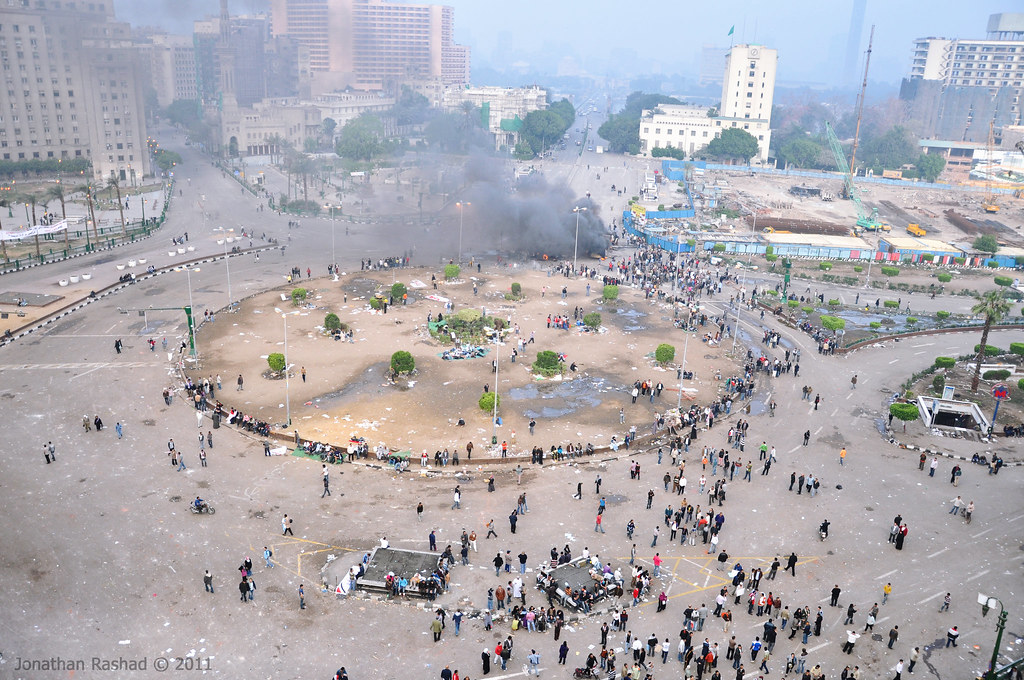
Apr 8 - Tahrir Square protests continue - Jonathan Rashad
Protests have continued since General Mubarak was finally forced from office on February 11.  There was much speculation afterwards as to how far Mubarak’s ouster would go in assuaging public outrage, which until earlier this year was for a long time a widespread but unexpressed reality.  Would the Egyptian street be placated by a simple rotation of figureheads?  This was the hope of the beneficiaries of the regime in Egypt, the US and in Israel.  According to Reuters, the Mubarak regime had been receiving an average of $2billion per year since 1979, making it the second largest recipient of US “aid” money, neighbouring Israel being the first.  It was always well known that the lion’s share of this money went to paying and equipping the coercive police/military apparatus which held the population in check through violence, subterfuge and torture.  As such, it is not surprising that the US administration did not support the ouster of their ally until the very last, until it became clear that such was already inevitable and perhaps necessary to stifle a more complete revolution which would sweep away not just Mubarak, but in one fell swoop the political, economic and military assets the US has bought in that country.  While Barack Obama spoke platitudes about freedom and democracy in Egypt, US and other foreign officials were working busily in the background to preserve the framework of Mubarak’s regime and find a successor who would be equally compliant to US interests, in spite of the aspirations to freedom of the populist, secular, anti-violent movement which demanded change at Tahrir Square and across Egypt. 

April 9 - Military crackdown continues - Jonathan Rashad
Since February 11, the Supreme Military Council of Egypt has been the official seat of power in that country.  It is made up of close allies of General Mubarak, and has been “overseeing” the transition to democracy in Egypt.  Under this “new” administration, Egyptians have continued to see crackdowns on protesters and torture of detainees.  The hope in the latter case is simply that the wretched habits of police and torturers die hard; however, in the former case the Supreme Military council is responsible for using violence to quell continued protests and criminalising the protesters through trials in military courts without due process.  Roughly 7000 sentences of groups of protesters have been meted out to up to 50,000, whom military officials continue to label as “thugs.” There is still an organised and determined enemy of the revolution wielding power in Egypt.

The land of the Pharaohs has also become a den of spies, with reports and arrests of foreign agents, most recently of one Mr. Ilan Grapel, a dual American Israeli citizen who has been in Egypt since February, and is reported as a former Israeli paratrooper wounded in the 2006 Israel-Lebanon war, a journalist, a law student and/or a spy, depending on what source one checks.  The truth of Mr. Grapel’s intentions in Egypt may never be revealed, but what is on record is that countries with vested interests in Egypt, such as Israel and the US, have in their respective and massively funded intelligence agencies a secretive behemoth with a mandate for espionage, disinformation and interference in favour of the interests of their employers.  This is while the aims of the Egyptian revolution are in vocal opposition to those interests.  Parsing between reality and contrived fiction, between honest help and the Faustian kind, between empty rhetoric and veiled threats is one of the prime challenges to the revolution in Egypt. 

How successful they are at such parsing will be in evidence later this Fall.  Former officials and collaborators of the Mubarak regime are busy rebranding themselves ahead of Presidential and Parliamentary elections set for later this year, with the hopes of maintaining their influence and access to the public treasury.  Other forces whose intentions are less clear are also clamouring; some looking perhaps to exploit divisions which in the past characterised Egyptian society.  The revolution is further threatened by the economic impact of the deconstruction of Mubarak's corrupt economic system and the loss of tourist dollars, which is to say that things always get worse before they get better.  Officials with much to lose in Egypt, foreign and domestic, are beginning to blame the revolution for continued rising unemployment and inflation- people such as the cheerleaders for the rejected IMF loans- as if Egypt’s economic woes are not the culmination of 3 decades of Mubarak’s cannibalistic policies.

However, if an honest parliament can be elected, who with the help of an engaged public can bring out of Tahrir and institutionalise the spirit of dignity, unity and humanity that struck Mubarak down and still grips most of the country, Egypt can begin to pull itself along the long road to reclaiming all that it has lost in more than a half-century:  Having suffered military invasion by Britain, France and multiple times by Israel, trade sanctions and threats by the US and the World Bank, and the wholesale looting of the country’s wealth by Mubarak’s three decades of international cronyism, Egypt now finds itself in a deep hole.  Printed everywhere on signs, painted on walls, sprayed on tanks and chanted on the streets is the continued call of the people of Egypt, as well as Arabs across Syria, Yemen, Tunisia, Bahrain and so on:   

“Aash’ab yureed issqaat in-nithahm!”
“The people want the fall of the system/regime!”
 (!الشعب يريد إسقاط النظام)

By rejecting the IMF, the people of Egypt have rejected the nonsensical idea of digging themselves out of their hole with the same tools that got them there.  


 “Aash’ab yureed issqaat in-nithahm!” 
Hear the people of Tahrir square and across the Arabic world


Read more about Egypt and the IMF:

Egypt since Mubarak’s fall:

Conflicting sources on the strange case of Ilan Grapel:

Monday, January 10, 2011

Switzerland: Swiss Franc -ly Under Attack

Separate reports this week in the Swiss newspaper Neue Zuericher Zeitung (NZZ) are highlighting the difficult choices Switzerland, and by extension other nations, are facing in the continued onslaught of effective currency devaluation by US and Eurozone officials. The Greenback and the Euro have fallen significantly against the Franc and other currencies in the past years as their governments and central banks have created a glut of supply; by loosening monetary policy, lowering interest rates and creating massive amounts of new debt to bail out ailing banks, businesses and governments.   The choices for nations such as Switzerland are clear:  Reduce living standards and income values through inflation, or see a massive outflow of jobs and industry from their borders. 

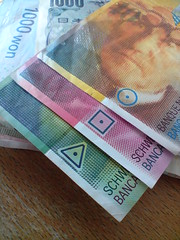
Swiss Banknotes by kalleboo
The Swiss National Bank (SNB) has announced losses of 8.5bil Swiss Francs in the first 3 quarters of 2010, resulting from their foreign exchange interventions intended to curb the effect of the inflating Euro and Greenback on their economy.  These losses stem from the SNB's massive selling of Swiss Francs and purchasing of Euros in order to simultaneously increase market supply of Swiss Francs to lower it's exchange rate; and increase competition in the Euro-dollar market to help support/increase its value.  Despite these efforts and the losses thereof, the Eur/Chf (Euro/Swiss Franc) exchange rate has fallen from late 2007 highs of 1.68 to current levels of 1.25.  This has had a severe effect on Swiss industry, most of whom must repatriate sales made in the Eurozone in order to book profits.  This peak to trough fall represents a loss to Swiss exporters of 0.43 Chf in every dollar they earn, or roughly 0.25 in aggregate terms.

Such extreme cuts to profits have Swiss industry chiefs remarking that in current conditions they cannot consider new hiring or expanding production in Switzerland, and making controversial threats to move jobs out of Switzerland and into the Eurozone, where wages have dropped along with the Euro relative to the Swiss Franc.  Retailers are also complaining that more and more Swiss shoppers are travelling the short distance to make their purchases accross the border, which is not far from any point in the small landlocked Alpine country.  The tourism industry is also feeling the pinch, as it is more expensive for Europeans to buy Francs.  Some doubt the long term viability of small and mid-sized businesses in Switzerland if the Franc's value to the Euro cannot be stabilised above 1.30.  The NZZ this week specifically quoted Georges Hayek, chief of Swatch-Group and Hans Hess, president of Swissmem, an association representing the mechanical and electrical engineering industry, as calling for government intervention in this regard.

However, such government intervention would in all cases amount to a rapid inflation of the Swiss currency.  This would cause prices of goods to rise generally, affecting the value and purchasing power of all Swiss incomes, from wage-earners to business owners to pensioners.  The Swiss authorities thus face a double-edged sword:  To take action is to lower living standards for all Swiss residents and cut the value of savings; to hold firm is to risk a general flight of industry and jobs and support a loss of value in local stock market investments.  In all cases jobs, savings and investments are threatened.  This dilemma is at the root of the murmurrings of currency war surrounding the G20 meetings in Seoul, which saw the US and Europe insisting that China allow the yuan to rise, and China along with Brasil, Korea and a host of other nations from across the globe complaining of the ill-effects to their economies caused by the effective devaluatoin of the Euro and Dollar by Western central banking authorities. 

Just as the European central bank (ECB) was forced to bail out Greece and Ireland by helping to create new money, and is currently fighting to prop up the Portuguese national budget with bond purchases, so are Federal authorities in the US now facing calls to bail out hopelessly indebted states and municipalities.  The Wall Street Journal reports that Federal Reserve chairman Bernanke has scuttled such talk by pointing out that new rules under the Dodd-Frank laws enacted by the federal government last year limit the fed`s ability to intervene should states or municipalities go into default/bankruptcy.  Such issues in Europe and America will, regardless of how they are addressed, create more instability in foreign exchange markets, to the detriment of economies outside their borders; from first world economies such as Switzerland, Canada and Japan, down to China, Brasil, India and all others dependent on the global economic model. 

Read more:

German Language Sources:
http://www.nzz.ch/nachrichten/wirtschaft/aktuell/tiefer_euro_gefaehrdet_wohlstand_1.8958738.html
http://www.nzz.ch/nachrichten/politik/schweiz/schweiz_nationalbank_verlust_85_milliarden_franken_2010_1.8356119.html

Other English Language Reports on the Swiss Franc and US Debt:
http://online.wsj.com/article/SB10001424052748704739504576067602380461160.html
http://online.wsj.com/article/BT-CO-20101112-701368.html
http://www.swissinfo.ch/eng/specials/swiss_franc/Strong_franc_continues_to_haunt_Swiss_economy.html?cid=17955460

Tuesday, November 23, 2010

East eats West?

This week's Economist magazine's headlining articles and cover-page, 'Buying up the world- The coming wave of Chinese takeovers' highlight the process and nature of foreign takeovers by Chinese firms.  The piece offers surprisingly little discussion or speculation as to China's deeper motivations and timing in its recent takeover bids for large multinational companies, or as to the reasoning of other governments and critics who would resist the emerging trend before concluding that rejecting China's advances would "be a disservice to future generations." 

There is something absurd about the reasoning in these articles, which do point out the "opaque and arbitrary" nature of authority within large Chinese companies, and which do briefly note that takeover bids are most often made on companies working in strategic resource sectors; but which base their conclusions on speculation that Chinese firms will "bring new energy and capital to flagging companies around the world," that "Chinese companies will have to adapt" and that its investments in the global economy will help to make China's interests "increasingly aligned with the rest of the world's."  That the Economist can readily admit to not understanding the motivations and interests of "opaque" Chinese government and authority but then predict its evolution is a failure of logic and a cause for concern should policy makers around the world find agreement with this thesis.

A steady accumulation of bonds and hard currency in all denominations, especially of its largest rivals in the US and Euro-zone, coupled with a well timed and targeted increase in the rate of takeover of global means of production and access to raw materials represents an obvious, well planned, forward looking and ongoing effort to supplant Western hegemony in favor of an ill-defined future global order over which a preeminent China presides.

This is the Chinese mission according to Chinese leaders and state-owned news outlets, as discussed in a 2008 CSIS report which states among other things: "The PRC-owned Hong Kong daily Wen Wei Po opined that the elevation of the “harmonious world” theory in the congress work report indicates that Hu (Jintao) is “assuming an even more important role in international affairs that is, as ‘formulator, participant and defender of world order,’ in order push the entire world toward harmony.”  Other such thinking among leading Chinese thinkers is evident in Zhao Tingyang’s The Tianxia System: The Philosophy for the World Institution (2005) and Liu Mingfu’s book The China Dream: Great Power Thinking and Strategic Positioning of China in the Post-American Age (2010).  All of these sources are united in their assumption that a Chinese eclipse of Western economic power is inevitable, though they may differ on their view of that post-ecliptic world.  Without knowing the truth about China's aims, the West should be wary of allowing a monolithic foreign government access to its strategic resources and internal economies.  

The Economist article gives further evidence that China's entry into global capitalism is not motivated by the usual basic greed and desires of Western investors when it reports that "Natural-resources firms can become captive suppliers to China, rather than selling on the open market... Westerners realised their new objective was to maximise production, not profits" and "Chinese firms... risk political fallout if they fail.  Their sense of mission makes them 'transparent', says one European executive."  That China's is a long term view is undeniable in the context that they would forgo immediate profit by selling to the highest bid on the market in favor of repatriating newly exploited resources. 

Western economic domination of the world reached its zenith in the 20th century, when according to this weeks Economist articles "Britain owned 45% of the world's FDI (Foreign Direct Investment) in 1914; America's share peaked at 50% in 1967."  It is undeniable that, in competition and in concert, Western powers used their public institutions and militaries to further their economic-imperial goals, making the 20th century the bloodiest and most warlike known to history.  Entire continents were subjugated and looted in the pursuit of profit and 'civilisation',- including China, and large parts of Central and South America, Asia and Africa remain captive to the national and corporate institutions which have inherited that legacy.  While the West so often points out China's human rights abuses and excesses of power, the Chinese are always quick to point out the hypocrisy of such criticisms, as it did in its recent report on the US's human rights record published in the China-daily; a startling and credible list of very recent abuses.  If there are any worries among people in the West as to the waning of Western power in favor of Chinese influence, it should perhaps not be in lament of a lost golden age of economic and military triumph, but in fear that the emerging power in China, accountable to no one and secretive in their aims and motivations, will as it hijacks a global economic system which promotes greed and consolidation of power, look upon and treat the West in the same manner that the West has China and the rest of the world.  


Read the Economist reports and other related articles here:

The Economist:
http://www.economist.com/node/17463473
http://www.economist.com/node/17460954

Regarding Chinese policy and statements about US human rights abuses:
http://csis.org/files/media/csis/pubs/080129_murphydecoding.pdf
http://www.chinadaily.com.cn/china/2010-03/12/content_9582218.htm

Regarding takeovers:
http://news.bbc.co.uk/2/hi/7967604.stm
http://www.cbc.ca/money/story/2010/11/03/potash-ottawa-review.html 
http://www.thetrumpet.com/?q=6336.4792.0.0

Saturday, October 16, 2010

Currency War?: Truth is the first casualty

In recent days, major news outlets across the world have been reporting on the growing rift, particularily between China and the US, and more generally between 'developped' and 'developping' nations, over currency markets and monetary policy ahead of the G20 meetings in Korea this November.  

The issue not only highlights the growing ability of emerging economies, such as China and Brazil, to stand up to the unbalanced global economic order imposed by European and American institutions, but the nature of the coverage has itself revealed a staggering bias and lack of insight by the Western media and points to an unsurprising but serious misunderstanding in the Western public as to how their economies function and relate to the global economy.

The issue has been politicized in the US for some time now, where people are being made to feel somehow that in a general way China is threatening the welfare of the American economy by holding its currency 'artificially low', causing the hemorraging US trade deficit and the continual loss of American factory jobs.  The intended message to the public is clear when the US Treasury Department's not-yet-released study of whether China manipulates its currency to gain an 'unfair' trade advantage is referred to again and again, while credible statements to the contrary go unnoticed, such as the World Bank and IMF who foresee currency 'tensions', not 'war', and who admit that allowing China's currency to rise will do little to help the balance of trade in the US.  Quite often, the fact that the yuan has already risen against the dollar by 20% since Chinese currency reforms five years ago is completely glossed over, or is noted as insignificant.

Nearly without exception, all Western news outlets decry China's 'intervention' or 'state manipulation' of the value of its own currency, along with other vaguely 'commie' sounding terminologies which are sure to raise the hairs on the back of every red-blooded American. 

A nation's currency is the lifeblood of its economy, and a government's right to manage and manipulate the value of its own currency is not only necessary for the maintenance of economic stability, but also sovereignty.  Free trading nations such as the US and EU resort to 'open market operations', manipulating interest rates, and lately 'quantitative easing'- the modern-day high-tech equivalent of printing more money.  While China 'pegs' its currency's value against a basket of currencies to maintain its stability in global markets, something that the US and EU do not do, it is the height of hypocrisy for the US and EU to enact major inflationary measures such as quantitative easing to drive down the value of its currency for selfish political and economic reasons, and then call China beligerent and interventionist when it merely allows the value of the yuan to float along with the Euro and greenback.

Western efforts to cheapen the value of US and Euro dollar denominated debts and to make foreign-produced goods more expensive in their domestic markets, to beat back looming deflation, to bailout its financial institutions and to inflate economic data, all by devaluing their currencies, is neo-mercantilism, and an extreme provocation to developping nations dependent on exports, such as China, Brazil, India, Korea, and Thailand to name a few.  Furthermore, Western governments, by lowering lending rates and increasing the supply of money in their domestic markets, have provided impetus to large financial institutions to go overseas to look for opportunities, thereby increasing competition, prices and the value of the domestic currency in those developping nations, as Western capital virtually invades and destabilizes their markets.  To then attempt to dictate how these nations should or should not react to such provocations is the height of arrogance.

The truth is that the US and European economies remain extremely vulnerable to further collapse, and politicians and bureaucrats in these economies remain willing to enact extreme measures to prevent this, or to at least give the appearance to their constituents that they are doing so.  The past few years have seen massive uncertainty and volatility in currency markets because of the banking crisis of 2008 and the Keynesian reaction to it and the recession it caused.  That such uncertainty and volatility would spill over into the relations between the West and its global trading partners is perhaps predictable.  However, painting China's monetary policy as the sponsor of Western economic woes is ridiculous, and does more to damage the accusors's credibility than it does to improve their economic situation.


Read articles on this topic, good and bad, at:

ABC News "China trying to avoid currency war"
http://abcnews.go.com/Business/wireStory?id=11865837

Xinhua News:  "Sword of Damocles dangling over China-US economic ties"
http://news.xinhuanet.com/english2010/indepth/2010-10/16/c_13560709.htm

The Council on Foreign Relations:  "Concerns over currency wars grow"
http://www.cfr.org/about/newsletters/editorial_detail.html?id=2222

The Globe and Mail:  "Averting currency war tops G20 agenda"
http://www.theglobeandmail.com/report-on-business/economy/averting-currency-war-tops-g20-agenda/article1758134/

Arirang News:  "Currency disputes heat up ahead of G20 Seoul summit"
http://www.arirang.co.kr/News/News_View.asp?nseq=108013&code=Ne2&category=2

The News Center:  "Fx tensions mount ahead of Fed's Bernanke"
http://www.moneycontrol.com/news/world-news/fx-tensions-mount-aheadfed%60s-bernanke_491477.html