Showing posts with label Currency. Show all posts

Monday, January 10, 2011

Switzerland: Swiss Franc -ly Under Attack

Separate reports this week in the Swiss newspaper Neue Zuericher Zeitung (NZZ) are highlighting the difficult choices Switzerland, and by extension other nations, are facing in the continued onslaught of effective currency devaluation by US and Eurozone officials. The Greenback and the Euro have fallen significantly against the Franc and other currencies in the past years as their governments and central banks have created a glut of supply; by loosening monetary policy, lowering interest rates and creating massive amounts of new debt to bail out ailing banks, businesses and governments.   The choices for nations such as Switzerland are clear:  Reduce living standards and income values through inflation, or see a massive outflow of jobs and industry from their borders. 

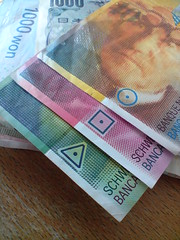
Swiss Banknotes by kalleboo
The Swiss National Bank (SNB) has announced losses of 8.5bil Swiss Francs in the first 3 quarters of 2010, resulting from their foreign exchange interventions intended to curb the effect of the inflating Euro and Greenback on their economy.  These losses stem from the SNB's massive selling of Swiss Francs and purchasing of Euros in order to simultaneously increase market supply of Swiss Francs to lower it's exchange rate; and increase competition in the Euro-dollar market to help support/increase its value.  Despite these efforts and the losses thereof, the Eur/Chf (Euro/Swiss Franc) exchange rate has fallen from late 2007 highs of 1.68 to current levels of 1.25.  This has had a severe effect on Swiss industry, most of whom must repatriate sales made in the Eurozone in order to book profits.  This peak to trough fall represents a loss to Swiss exporters of 0.43 Chf in every dollar they earn, or roughly 0.25 in aggregate terms.

Such extreme cuts to profits have Swiss industry chiefs remarking that in current conditions they cannot consider new hiring or expanding production in Switzerland, and making controversial threats to move jobs out of Switzerland and into the Eurozone, where wages have dropped along with the Euro relative to the Swiss Franc.  Retailers are also complaining that more and more Swiss shoppers are travelling the short distance to make their purchases accross the border, which is not far from any point in the small landlocked Alpine country.  The tourism industry is also feeling the pinch, as it is more expensive for Europeans to buy Francs.  Some doubt the long term viability of small and mid-sized businesses in Switzerland if the Franc's value to the Euro cannot be stabilised above 1.30.  The NZZ this week specifically quoted Georges Hayek, chief of Swatch-Group and Hans Hess, president of Swissmem, an association representing the mechanical and electrical engineering industry, as calling for government intervention in this regard.

However, such government intervention would in all cases amount to a rapid inflation of the Swiss currency.  This would cause prices of goods to rise generally, affecting the value and purchasing power of all Swiss incomes, from wage-earners to business owners to pensioners.  The Swiss authorities thus face a double-edged sword:  To take action is to lower living standards for all Swiss residents and cut the value of savings; to hold firm is to risk a general flight of industry and jobs and support a loss of value in local stock market investments.  In all cases jobs, savings and investments are threatened.  This dilemma is at the root of the murmurrings of currency war surrounding the G20 meetings in Seoul, which saw the US and Europe insisting that China allow the yuan to rise, and China along with Brasil, Korea and a host of other nations from across the globe complaining of the ill-effects to their economies caused by the effective devaluatoin of the Euro and Dollar by Western central banking authorities. 

Just as the European central bank (ECB) was forced to bail out Greece and Ireland by helping to create new money, and is currently fighting to prop up the Portuguese national budget with bond purchases, so are Federal authorities in the US now facing calls to bail out hopelessly indebted states and municipalities.  The Wall Street Journal reports that Federal Reserve chairman Bernanke has scuttled such talk by pointing out that new rules under the Dodd-Frank laws enacted by the federal government last year limit the fed`s ability to intervene should states or municipalities go into default/bankruptcy.  Such issues in Europe and America will, regardless of how they are addressed, create more instability in foreign exchange markets, to the detriment of economies outside their borders; from first world economies such as Switzerland, Canada and Japan, down to China, Brasil, India and all others dependent on the global economic model. 

Read more:

German Language Sources:
http://www.nzz.ch/nachrichten/wirtschaft/aktuell/tiefer_euro_gefaehrdet_wohlstand_1.8958738.html
http://www.nzz.ch/nachrichten/politik/schweiz/schweiz_nationalbank_verlust_85_milliarden_franken_2010_1.8356119.html

Other English Language Reports on the Swiss Franc and US Debt:
http://online.wsj.com/article/SB10001424052748704739504576067602380461160.html
http://online.wsj.com/article/BT-CO-20101112-701368.html
http://www.swissinfo.ch/eng/specials/swiss_franc/Strong_franc_continues_to_haunt_Swiss_economy.html?cid=17955460

Tuesday, November 23, 2010

East eats West?

This week's Economist magazine's headlining articles and cover-page, 'Buying up the world- The coming wave of Chinese takeovers' highlight the process and nature of foreign takeovers by Chinese firms.  The piece offers surprisingly little discussion or speculation as to China's deeper motivations and timing in its recent takeover bids for large multinational companies, or as to the reasoning of other governments and critics who would resist the emerging trend before concluding that rejecting China's advances would "be a disservice to future generations." 

There is something absurd about the reasoning in these articles, which do point out the "opaque and arbitrary" nature of authority within large Chinese companies, and which do briefly note that takeover bids are most often made on companies working in strategic resource sectors; but which base their conclusions on speculation that Chinese firms will "bring new energy and capital to flagging companies around the world," that "Chinese companies will have to adapt" and that its investments in the global economy will help to make China's interests "increasingly aligned with the rest of the world's."  That the Economist can readily admit to not understanding the motivations and interests of "opaque" Chinese government and authority but then predict its evolution is a failure of logic and a cause for concern should policy makers around the world find agreement with this thesis.

A steady accumulation of bonds and hard currency in all denominations, especially of its largest rivals in the US and Euro-zone, coupled with a well timed and targeted increase in the rate of takeover of global means of production and access to raw materials represents an obvious, well planned, forward looking and ongoing effort to supplant Western hegemony in favor of an ill-defined future global order over which a preeminent China presides.

This is the Chinese mission according to Chinese leaders and state-owned news outlets, as discussed in a 2008 CSIS report which states among other things: "The PRC-owned Hong Kong daily Wen Wei Po opined that the elevation of the “harmonious world” theory in the congress work report indicates that Hu (Jintao) is “assuming an even more important role in international affairs that is, as ‘formulator, participant and defender of world order,’ in order push the entire world toward harmony.”  Other such thinking among leading Chinese thinkers is evident in Zhao Tingyang’s The Tianxia System: The Philosophy for the World Institution (2005) and Liu Mingfu’s book The China Dream: Great Power Thinking and Strategic Positioning of China in the Post-American Age (2010).  All of these sources are united in their assumption that a Chinese eclipse of Western economic power is inevitable, though they may differ on their view of that post-ecliptic world.  Without knowing the truth about China's aims, the West should be wary of allowing a monolithic foreign government access to its strategic resources and internal economies.  

The Economist article gives further evidence that China's entry into global capitalism is not motivated by the usual basic greed and desires of Western investors when it reports that "Natural-resources firms can become captive suppliers to China, rather than selling on the open market... Westerners realised their new objective was to maximise production, not profits" and "Chinese firms... risk political fallout if they fail.  Their sense of mission makes them 'transparent', says one European executive."  That China's is a long term view is undeniable in the context that they would forgo immediate profit by selling to the highest bid on the market in favor of repatriating newly exploited resources. 

Western economic domination of the world reached its zenith in the 20th century, when according to this weeks Economist articles "Britain owned 45% of the world's FDI (Foreign Direct Investment) in 1914; America's share peaked at 50% in 1967."  It is undeniable that, in competition and in concert, Western powers used their public institutions and militaries to further their economic-imperial goals, making the 20th century the bloodiest and most warlike known to history.  Entire continents were subjugated and looted in the pursuit of profit and 'civilisation',- including China, and large parts of Central and South America, Asia and Africa remain captive to the national and corporate institutions which have inherited that legacy.  While the West so often points out China's human rights abuses and excesses of power, the Chinese are always quick to point out the hypocrisy of such criticisms, as it did in its recent report on the US's human rights record published in the China-daily; a startling and credible list of very recent abuses.  If there are any worries among people in the West as to the waning of Western power in favor of Chinese influence, it should perhaps not be in lament of a lost golden age of economic and military triumph, but in fear that the emerging power in China, accountable to no one and secretive in their aims and motivations, will as it hijacks a global economic system which promotes greed and consolidation of power, look upon and treat the West in the same manner that the West has China and the rest of the world.  


Read the Economist reports and other related articles here:

The Economist:
http://www.economist.com/node/17463473
http://www.economist.com/node/17460954

Regarding Chinese policy and statements about US human rights abuses:
http://csis.org/files/media/csis/pubs/080129_murphydecoding.pdf
http://www.chinadaily.com.cn/china/2010-03/12/content_9582218.htm

Regarding takeovers:
http://news.bbc.co.uk/2/hi/7967604.stm
http://www.cbc.ca/money/story/2010/11/03/potash-ottawa-review.html 
http://www.thetrumpet.com/?q=6336.4792.0.0

Thursday, November 18, 2010

Seoul G20: Perplexing Conclusion, Clear Result

The conclusion of the most recent G20 summit in Seoul last Friday, hailed as a success for political reasons by attending politicians, was punctuated with the following agreed upon statement: "Uneven growth and widening imbalances are fueling the temptation to diverge from global solutions into uncoordinated action... uncoordinated policy actions will only lead to worse outcomes for all."  In other words, 'while we agree in principal that it is best to agree, we disagree.'  I can only imagine that, if only the leaders of nations in times past, who with the specter of wars and economic strife looming before them, had been privy to such wisdom, things would have turned out exactly the same...

In spite of ambiguous political statements made in Seoul last week, markets have been remarkably unified in their response.  Since markets closed on the Wednesday (Nov. 10) before the summit began in earnest, every single major US dollar denominated market has fallen.  Several of these markets had been gaining steadily leading up to the G20 summit, but all have dipped in response to the G20's conclusion.  Here is a quick statistical rundown of some of those losses up to the Wednesday Nov. 17 close:

Dow Jones   -350 points (-3.1%);
S&P 500   -40 points (-3.2%);
NYSE Comp.   -259 points (-3.3%)
Crude $/Brl   -6.77 (-7.7%)
Copper $/lb   -0.24 (-6.0%)
Gold $/oz   -62 (-4.4%)
Platinum $/oz   -97 (-5.6%)


Thus, money (or value) is coming out of stock and commodity markets across the board.  Furthermore, Treasuries, both 30yr and 5yr notes, fell 1.5% and 0.9% respectively, during the same period; markets which often gain when stock markets are in turmoil.  Taken in the context of a rise of 1.44 points (+1.9%) during the same period, in the US Dollar Index (USDX) which is a guage of the value of the dollar relative to other world currencies, we can reasonably assume that losses in the value of stocks and commodities are partly, if not mainly, a result of a strengthening US dollar.  This represents deflation.  What is the cause of this deflationary pressure?  It could be that investors have responded to the G20's failure to resolve its differences over state manipulations in currency markets by pulling out of markets and deleveraging, or paying off debts.  The US dollar being a debt-based currency, any net reduction in USD debts effectively reduces the amount of USD in the system, producing deflation. 

Perhaps the dirtiest word in modern economics, many analysts of late, even Fed chief Bernanke, have begun to broach the issue of deflation.  That it is impossible in America has been the misplaced hope of so many bank and fund chiefs.  The Japanese banking crisis of the 1990s has resulted in persistent deflation for over a decade.  The more recent global recession, particularly the crash in the summer of 2008, was a deflationary crash, which saw all markets lose value at break-neck speed after being inflated by Bush's bank bailouts and stimulus spending.  That extra money was un-created nearly as quickly as it was created when it was used by large institutions to pay off debts and deleverage.  So what to expect?  With interest rates already at historical lows and failing to stimulate more borrowing, look for the Federal Reserve to enact more quantitative easing, the modern equivalent of printing money.  This will complete another round in the cycle, and further consternate the US's G20 partners, especially China, who will see it as another salvo in the much denied currency war.  However, if they fail to do so, fear of another credit crunch may trigger another US dollar exodus from markets everywhere, and the global 'double dip' recession will be upon us.  It seems that there is no positive alternative, and no way out of the rabbit hole the US has dug for itself and the rest of us.

Perhaps the only thing keeping the floundering juggernaut of global finance afloat is the placebo effect of the actions of its masters who maintain a public image of confidence and certainty about their actions.  If at any time any major player all at once goes bust or pulls their money off the table, everyone else may just decide to cash in.  It seems since the summit, a few players at least, have decided to pocket at least a few of their chips, just in case.