Showing posts with label bailout. Show all posts

Monday, July 4, 2011

Greek Sovereign Debt Crisis a Sovereignty Crisis

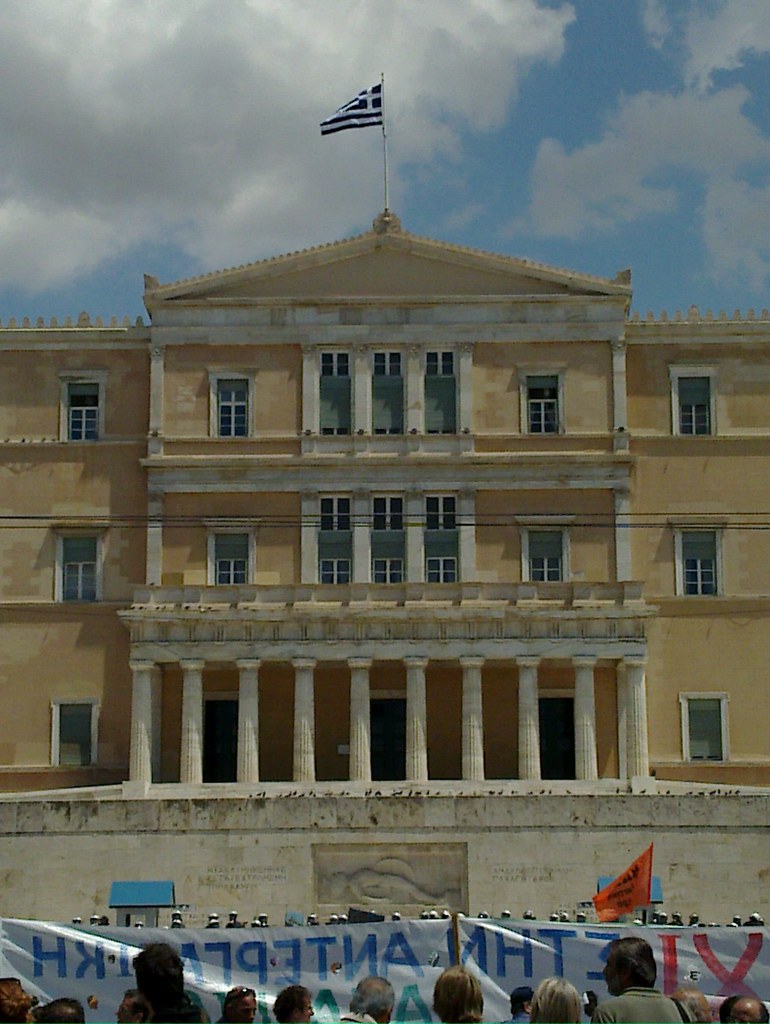
Greek Parliament, Syntagma Athens - by kouk
News outlets around the world have focused heavily on the so-called Greek Sovereign debt crisis this week.  The proposed solution–an IMF loan package requiring “austerity measures” and a fire-sale of public assets–has sparked massive unrest in the capital, where people from all walks of life are decrying a loss of democracy, sovereignty, economic means, public services- the viability of their futures and of Greece itself. 

Many have insisted that these “measures” are necessary.  If one is speaking about maintaining the share value of many European banks and institutional investors, such is true.  The IMF loan package to Greece, boiled down, is a global taxpayer bailout of European banks which have made poor investment decisions in purchasing Greek bonds. 

Even while the US debt has reached its ceiling, the US Senate has recently rejected a Republican measure attempting to restrict the IMF’s ability to dip directly into the US treasury to the tune of $100billion.  In the twisted game of hot potato that now typifies international finance, the IMF is making loans to Greece so that Greece can pay back its loans to the various private European banks and investors holding Greek bonds, while the member nations of the IMF, all of whom are similarly in debt to private banks, will have to seek more loans from private international banks (or China) in order to cover additional deficits that the IMF causes them as it takes their money and dumps it into the sieve that is the Greek economy.  Almost every tax-payer in the world will see a portion of their taxes swept into this bailout scheme for these investment institutions, which over many years have irresponsibly funded the institutionally corrupt Greek government.  More and more, the European Union–if not the globalised economy entirely–appears to be a supranational bank-controlled state-capitalism and less and less the free market as it is advertised.

Flush with this bailout of world taxpayer money channelled through the IMF–money which in a truly free market should have been lost as a consequence of the impropriety of lending to a state which everyone now seems ready to admit was rife with corruption–private European banks and investment firms will, like rapacious vultures, descend upon the carcass of the Greek economy.  The transportation and social service infrastructure of Greece will be bought up at fire-sale prices, as will small and mid-size local businesses that are struggling in an increasingly volatile economy and facing an extremely uncertain future.  As is their legal obligation to their shareholders, these foreign corporations will attempt to squeeze as much profit as possible from their Greek buyouts, through further rounds of asset-stripping and layoffs, the profits of which will be repatriated to investors outside Greece.  As Greeks lose their jobs and their businesses, as those lucky enough to keep their jobs lose income to pay cuts and higher taxes, as retirees lose income to pension cuts, as credit becomes scarce and money circulation becomes restricted, many will be forced into personal asset liquidations and home foreclosures in a depressed market paying pennies on the Euro.  This will come just as the people of Greece will desperately need reasonable access to the services being hawked by the Papandreou government and whatever remains of Greece’s gutted social security net.  

The whole enterprise reaches a higher level of absurdity in light of the fact that a similarly massive loan package last year failed to do anything but forestall the problem for a year.   Anyone who has juggled debt between two lines of credit knows that borrowing from one to pay the other leads to precisely nothing but a higher debt-load due to accumulating interest.  The only step in the right direction, and likely in any case inevitable, is a default by Greece on their debt, orderly or not.  Independent economists at the UN and elsewhere agree:  Austerity measures increase unemployment and reduce wages, thus lowering economic activity and tax revenues needed to repay national debts.  They do not work.

In this context, the governments and investment community of Europe–by their actions–seem keen to ensure that the Greek people are made destitute by having their collective assets stripped down and turned over to foreign interests before allowing a default.  That is what this is about.  Business and media have propagated the idea that the fault of the Greek debt crisis lies squarely with the Greek people, and this is the bitter pill they must now swallow.  However, those who pay the costs will not be the benefactors of Greece’s famously corrupt “culture” of bribes and patronage that everyone wants to blame.  Rather, it will be the middle and lower-classes who have all along suffered paying these bribes and corruption to have access to fundamental services.  These are the people now protesting in majority across Greece and in Syntagma square of Athens.  The police, who have lost all credibility as defenders of public security, have employed exemplary violence.  There are several videos posted to YouTube of police attacking restaurants bars and cafes near the protests, as well as the corralling and kettling people into sidestreets and subway stations, pelting them with tear gas and rocks, and beating them with shields and batons as they try to escape through police lines.  They have even been accused on Greek TV–with amateur video seeming to corroborate–of the deployment of agents-provocateurs among the protests: police posing as anarchists dressed in black, damaging property and threatening violence in order to give pretext for and initiate the police crackdowns.  While it will likely be impossible to verify these charges through police admission–as the Quebec Provincial police admitted to doing in Montebello, Canada in 2007–one might weigh the evidence and draw a parallel line:  if it is possible in Canada, it is possible in Greece. 

The schizophrenia of fiscal policy, or the flock of interests it serves, is evident when the situation in Greece is juxtaposed with the global financial crisis of a few years ago.  While it is demanded of Greece to sell off public assets and cut social spending, including gutting pensions and laying off civil servants–which is ostensibly supposed to restore the viability of and confidence in their economy- the US faced their crisis by going in the opposite direction:  Employing a Keynesian program of public spending to increase employment and economic activity.  Rather than allow critical industries to be gutted by private markets, companies such as GM were partly nationalised until they could recover, to prevent massive unemployment.  The recovery plan in the US was funded by “money creation,” when the US federal reserve wrote into existence billions of dollars to buy a new issue of US T-bills to fund the government.  While neither of these solutions is desirable, their “necessity” is rooted in the same problem.

Some time ago Greece, like most of the world, gave into the liberal economic idea that private banks should be allowed to create Greece’s money.  Evidently, under the yoke of the European Economic Community, Greece has now completely lost its sovereign right to create any of its own money at all.  They cannot repatriate their debt or use inflationary means to mitigate it.  Thus, Greece has lost its freedom and nationhood.  According to the words of Prime Minister of Canada William Lyon MacKenzie King, who in 1935 addressed the issue which is clearly at the root of the debt crises of not only Greece, but of Portugal, Spain, Ireland and the US, “Once a nation parts with the control of its currency and credit, it matters not who makes that nation's laws. Usury, once in control, will wreck any nation. Until the control of the issue of currency and credit is restored to government and recognized as its most conspicuous and sacred responsibility, all talk of the sovereignty of Parliament and of democracy is idle and futile.”


The videos below attest to the different tactics Police have used to break-up demonstrations and impose their will on the local community in Athens.
Watch Police attack a restaurant:


Watch club-wielding alleged Agents Provocateurs retreat behind Police lines:


 Watch Police corner and herd demonstrators into subway tunnel before gassing them:


Watch the above event from inside the subway tunnel:


Watch a Police line attack a peaceful march:


Watch Police move in to clear a demonstrator camp after tear gassing it:


Read more about the efficacy of "austerity" measures:

Monday, January 10, 2011

Switzerland: Swiss Franc -ly Under Attack

Separate reports this week in the Swiss newspaper Neue Zuericher Zeitung (NZZ) are highlighting the difficult choices Switzerland, and by extension other nations, are facing in the continued onslaught of effective currency devaluation by US and Eurozone officials. The Greenback and the Euro have fallen significantly against the Franc and other currencies in the past years as their governments and central banks have created a glut of supply; by loosening monetary policy, lowering interest rates and creating massive amounts of new debt to bail out ailing banks, businesses and governments.   The choices for nations such as Switzerland are clear:  Reduce living standards and income values through inflation, or see a massive outflow of jobs and industry from their borders. 

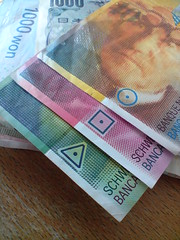
Swiss Banknotes by kalleboo
The Swiss National Bank (SNB) has announced losses of 8.5bil Swiss Francs in the first 3 quarters of 2010, resulting from their foreign exchange interventions intended to curb the effect of the inflating Euro and Greenback on their economy.  These losses stem from the SNB's massive selling of Swiss Francs and purchasing of Euros in order to simultaneously increase market supply of Swiss Francs to lower it's exchange rate; and increase competition in the Euro-dollar market to help support/increase its value.  Despite these efforts and the losses thereof, the Eur/Chf (Euro/Swiss Franc) exchange rate has fallen from late 2007 highs of 1.68 to current levels of 1.25.  This has had a severe effect on Swiss industry, most of whom must repatriate sales made in the Eurozone in order to book profits.  This peak to trough fall represents a loss to Swiss exporters of 0.43 Chf in every dollar they earn, or roughly 0.25 in aggregate terms.

Such extreme cuts to profits have Swiss industry chiefs remarking that in current conditions they cannot consider new hiring or expanding production in Switzerland, and making controversial threats to move jobs out of Switzerland and into the Eurozone, where wages have dropped along with the Euro relative to the Swiss Franc.  Retailers are also complaining that more and more Swiss shoppers are travelling the short distance to make their purchases accross the border, which is not far from any point in the small landlocked Alpine country.  The tourism industry is also feeling the pinch, as it is more expensive for Europeans to buy Francs.  Some doubt the long term viability of small and mid-sized businesses in Switzerland if the Franc's value to the Euro cannot be stabilised above 1.30.  The NZZ this week specifically quoted Georges Hayek, chief of Swatch-Group and Hans Hess, president of Swissmem, an association representing the mechanical and electrical engineering industry, as calling for government intervention in this regard.

However, such government intervention would in all cases amount to a rapid inflation of the Swiss currency.  This would cause prices of goods to rise generally, affecting the value and purchasing power of all Swiss incomes, from wage-earners to business owners to pensioners.  The Swiss authorities thus face a double-edged sword:  To take action is to lower living standards for all Swiss residents and cut the value of savings; to hold firm is to risk a general flight of industry and jobs and support a loss of value in local stock market investments.  In all cases jobs, savings and investments are threatened.  This dilemma is at the root of the murmurrings of currency war surrounding the G20 meetings in Seoul, which saw the US and Europe insisting that China allow the yuan to rise, and China along with Brasil, Korea and a host of other nations from across the globe complaining of the ill-effects to their economies caused by the effective devaluatoin of the Euro and Dollar by Western central banking authorities. 

Just as the European central bank (ECB) was forced to bail out Greece and Ireland by helping to create new money, and is currently fighting to prop up the Portuguese national budget with bond purchases, so are Federal authorities in the US now facing calls to bail out hopelessly indebted states and municipalities.  The Wall Street Journal reports that Federal Reserve chairman Bernanke has scuttled such talk by pointing out that new rules under the Dodd-Frank laws enacted by the federal government last year limit the fed`s ability to intervene should states or municipalities go into default/bankruptcy.  Such issues in Europe and America will, regardless of how they are addressed, create more instability in foreign exchange markets, to the detriment of economies outside their borders; from first world economies such as Switzerland, Canada and Japan, down to China, Brasil, India and all others dependent on the global economic model. 

Read more:

German Language Sources:
http://www.nzz.ch/nachrichten/wirtschaft/aktuell/tiefer_euro_gefaehrdet_wohlstand_1.8958738.html
http://www.nzz.ch/nachrichten/politik/schweiz/schweiz_nationalbank_verlust_85_milliarden_franken_2010_1.8356119.html

Other English Language Reports on the Swiss Franc and US Debt:
http://online.wsj.com/article/SB10001424052748704739504576067602380461160.html
http://online.wsj.com/article/BT-CO-20101112-701368.html
http://www.swissinfo.ch/eng/specials/swiss_franc/Strong_franc_continues_to_haunt_Swiss_economy.html?cid=17955460

Wednesday, October 6, 2010

Western taxpayers to bail out Karzai's Kabulbank?

An article in the September 11 edition of the Economist, "House of Karzai", sheds light on the corrupt regime of Hamid Karzai. It investigates the causes of a run on an Afghan bank, Kabulbank, mired in corruption and on the brink of failure.  The Economist describes a group of people working together, including Mahmoud Karzai, president Karzai's brother, who have managed to control Kabulbank and use it to invest in their own speculative ventures.  Mahmoud Karzai apparently is the 3rd biggest shareholder at the bank.  It is well known that he holds a 7% share, which he purchased for $5million by first borrowing the $5m from Kabulbank itself.

The article describes an area on Dubai's famous palm shaped peninsula refered to as "Little Afghanistan" where are found luxury mansions for "Afghanistan's business and political elite."  The article asserts directly that Kabulbank was used improperly in the funding of these Dubai real-estate ventures when it says "Hundreds of millions went into Dubai properties then handed to shareholders and their friends" and "the bill was picked up by ordinary Afghans who put money into Kabul Bank, a scandal-wracked institution..." Little Afghanistan is but one example of the missappropriation of the banks funds and lending.  According to the Economist, there is a string of loss generating companies owned by Kabulbank shareholders, into which Kabulbank loans and funds were siphoned, including an airline and a cement factory. 

Thus a run on Kabulbank?  Some may wonder how it could not have come sooner.  In proper form, Mahmoud Karzai has publicly solicited a bailout for the bank from the American taxpayer, which is hilarious and revealing on its own- after all, why shouldn't he just go right to the source?  That being turned down flat by the Americans, the article reports that the "Afghan government" aka Hamid Karzai, "said it would give the bank whatever it needed from its own reserves".  Though "American officials" have pushed for an inquiry into the fiasco, to no one's surprise, the Afghan government, aka Hamid Karzai, is not forthcoming.  The Economist article concludes first by stating that the bank is "too important to fail", and it evokes the image of civil strife should the bank "enrage almost a quarter of a million armed customers".  Are they not yet enraged?

Inquiry or not, it seems the use of the Afghan treasury to rebuild Kabulbank is inevitable.  While for all parties this is a more politically palatable solution than that proposed by Mahmoud- a direct bailout from the US treasury, it is only so because most Western voters are not aware that roughly two-thirds of the Afghan treasury is funded by their taxes, through their governments via aid payments and the World Bank.  Western nations with military involvement have already seen their voters sour at the thought of risking more lives and spending further military resources to prop up the corrupt Karzai government, but the decision to use the Afghan treasury for such a payoff should in fact raise the ire of the hundreds of millions of taxpayers in all Western nations who have invested in Afghanistan, or the World Bank for that matter. In either case, it is the Karzai family getting the best of people of Afghanistan, the US and the rest of the world. 

To be fair, it may be that the Karzais are merely a product of the system of patronnage, curruption and elitism that has divided Afghanistan for so many generations.  And while the legitmacy and the exact reach or sustainability of the institutions created under the Karzai regime are in constant question, episodes such as the Kabulbank fiasco should inspire debate in Western Democracies as to the methods and motives of their own governments and businesses, who after 8 years of war and 9 years of standing behind Mr Karzai, have managed only to help create for themselves another corrupt and dictatorial client state.  One can hope.

Read the Economist article at http://www.economist.com/node/16996926