A recent Economist article,
The dangers of a rising China, leads a 14 page report loosely discussing the dangers posed to the world by China's eclipsing of the USA's international economic and military order. The article attempts to draw parallels in the power-balance shift between Britain and Germany which led to the first World War, and that between the US and Britain, which is seen to have been peaceful. Alternatively positive and negative outlooks are presented as The Economist offers its superficial analysis and weak solutions, but as to how to foster peace between the People's Republic of China and the West, the article does offer one shining and perhaps accidental insight.
 |
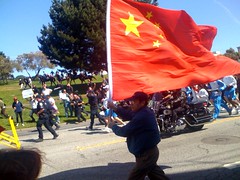
| San Fran Olympic Torch Rally by tomnono |
The parallels drawn between the hegemonic shifts of the 20th century at first appear credible. Indeed, the competitive quest for empire and economic primacy on the European continent and elsewhere was the cause for the British-German arms race, ultimately which manifested in the orgiastic violence of the Great War which saw 16 million deaths and 21 million wounded, civilian and military. This pessimistic view is countered with the absurd assertion that "Unlike the 19th-century European powers, it (China) is not looking to amass new colonies." If colonialism was a method of expropriating the wealth of and creating markets in foreign lands, then China will surely remain at odds with the West on this basis, as both compete as Germany and Britain once did; in Asia, Africa and Latin America, employing trade agreements, capital and cooperation with corruption, as well as providing economic and military advisors to grease the wheels of neocolonialism; that which is the demonstrable policy of both the West and of China.
The Economist also looks hopefully to the main hegemonic shift of the 20th century, that from British to American. This is ironic, since it was the devastating global conflagration of World War 2 which dismembered the British Empire and broke the British people's will to maintain it. The British homeland itself was left in ruins, and thereby a hegemonic shift was a defacto result. Thus it was war that ushered in the shift of global power, eventually in favor of the US. However, the American global order was not immediately secured, but only itself born out of a further 40 years of global militaristic/economic expansion; major US wars in Korea and Vietnam; the Soviet war in Afghanistan; the littany of military actions across the third world; and a Nuclear standoff with Soviet Russia. That this hegemonic shift "went well" as The Economist puts it, seems in the light of history preposterous.
What The Economist's hopeful bias will not permit in its report is a recognition that economic, technological and social structures are infinitely different than at any time in history, thus such a shift as it would happen today or in the future is without any useful precedent. To start, the previous examples involve competing powers sharing in European heritage, culture and languages, and a similarity of social ethics, aspirations, and global outlook. In the case of China, these are much different. Not only are there vast differences in all these catergories between China and the West, but Chinese Nationalism is keenly aware of its recent history as a colonial subject of the West, and sees the economic and political elites in the US as the inheritors of that imperialist know-how and infrastructure.
Chinese Nationalism looks upon its long-time enemy Japan, perhaps correctly, as simultaneously a base for the projection of American military and economic power, and an unapologetic beligerrent whose political class still absolves and honors as heroes the Imperial Army Generals and Soldiers who committed the occupation of China and the rape of Nanking. Offerings by Japanese Prime Ministers, most recently in 2009 by Taro Aso, at the Yasukuni Shrine and War Memorial where recognised war criminals are honored, have created tremendous popular backlashes in China. China sees itself surrounded by the American military and its proxies in the pacific, with the US Navy sitting in South Korean and Taiwanese waters within shooting distance of the Chinese coast. Such a situation could only be hypothetically balanced in size and proximity by China's occupying Cuba, the Bahamas and the Canadian Province of Nova Scotia with 70,000 troops and therein installing and equipping dozens of Naval, Air-Force, and Army bases to the tune of billions of dollars. This is to say nothing of the demonstrated willingness of the US to apply its military resources in China's neighborhood, such as in the Korean War and the holocaustal Vietnam War wherein millions died. These both took place within living Chinese memory. Taking place now: "The US Navy has begun to deploy more forces in the Pacific," The Economist reports.
A brief study into the history of China's relations with its neighbors and the West reveals fact after fact lending support to the attitude of indignation in China towards the US and Europe. The Economist article asserts that a number of things will help to ease the transition. These range from the briefly insightful to the absurd. It suggests that "America and China need rules for disputes" and "America and China should try to work multilaterally (in Asia)" But in the absence of demonstrated trust and mutual respect, rules and agreements will be broken, and multilateral discussions and organisations will be but another battlefield for diplomatic and economic clout. The article comes close to the spirit of the answer to this terrifying question when it posits that "If America wants to bind China to the rules-based liberal order it promotes, it needs to stick to the rules itself." This is a remarkable admission by the Economist of the US's hypocrisy.
Moreso, such is a tacit recognition that the current Empire must lead by example and act under the principles that it can only hope China will abide by once it overtakes the seat of global power. The US must do much more to value economic equality, education and democracy at home, and respect the sovereignty and human rights of those abroad. It must do more to promote freedom and peace for all nations; Not attempt to impose them as a pretext to military intervention in places such as Iraq and Afghanistan. The US must make difficult decisions as to how to unwind the relationship between its military and its economy; these are understood in China and other quarters as so entwined that the US must perpetuate conflict and imperialism in order to survive. China will never see in the US plutocracy a credible partner in any undertaking, but only a group of self-serving aristocrats guided by the ethics of capitalism, greed and consolidation. It may be possible to avoid a conventional military conflict between China and the US during this great hegemonic shift if the US recognises China's military and economic clout and begins to bargain away its stack of chips in Taiwan, the South China Sea, Japan, Korea etc. But such is likely to promote the further moulding of China into a militarist/imperialist economy whereby all of the fears of an opaque and unaccountable Chinese world leadership will be realised. Such will not lead to any type of greater peace.
The only chance for a true and peaceful resolution of the conflicting interests of China and the US to come about is by a change in those very interests: Away from militaristic/economic dominion and global paternalism which sows discord, misery and disenfranchisement everywhere; toward finally abiding by the principles which the people of the West have always espoused: Peace, human rights and equality of opportunity for everyone everywhere. Continued posturing by the US as the world's indomitable military and economic power requires China to assert itself globally through economic control of resources and military capability. A graduation by the West to a higher moral ground; by a recognition of reality and a genuine redress of the ills of its own and society abroad, through education and democratic change; only these changes can compell lasting peace and inspire in China the changes it requires to be a more just and accountable world power.
Read the Economist Article:
http://www.economist.com/node/17629709
Read more about it:
http://www.taipeitimes.com/News/editorials/archives/2010/09/27/2003483897
http://www.opendemocracy.net/democracy-china/nationalism_3456.jsp