Tuesday, January 25, 2011

Tunisia's Deposed Ben Ali Family: Canadian Immigration's political statement

Yesterday reports appeared in the Canadian press, TV and radio, about the arrival in Montreal of family members of the deposed Tunisian dictator Zine El Abidine Ben Ali and his wife, Leila, nee Trabelsis.  The expatriate Tunisian community in Montreal had already been watching the situation closely as unidentified Tunisian officials had arrived there as early as last week, having been whisked away from the airport by Tunisian consulate limousines.  "The Family," also referred to as a "Quasi-mafia" by a US diplomat in a leaked cable, "gets what it wants," whether it's "cash, services, land, property, and yes, even your yacht."

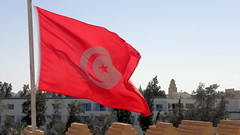
Tunisia by Keith Roper
With stories of "The Family's" corruption and opulent tastes going mainstream in Canada; appropriation of state gold and private real estate and business, theft of a yacht from France, pet tigers and mansions; amid gross poverty and repression in Tunisia; the Canadian government and its immigration department headed by Jason Kenney have scrambled to distance itself from the former dictator's clique, saying the Ben Ali extended family is "not welcome."  However, minister Kenney has pointed out that some family members already have permanent residence status and thus may legally stay in Canada.  Canadian Immigration is "investigating" the matter.

That the Conservative government in Canada is now back-pedalling speaks not to their values but to the concerns of their public-relations department.  The fact that members of the Ben Ali/Trabelsis clan already have been furnished permanent-resident status by a Canadian government well aware of its excessive criminality and human rights abuses is a statement in of itself.  That members of this family would consider Canada as a second home to where they can escape justice is another.

George Galloway by DavidMartynHunt
Almost two years ago, Jason Kenney's immigration department blocked anti-war British Member of Parliament George Galloway from entering Canada for a planned speaking tour, on the pretense that he was a threat to national security.  Mr Galloway has since been allowed to enter Canada after a federal court ruled that the decision to bar his entry was a matter of politics, not security.  Canadian Immigration officials have also consistently denied status to and attempted to deport US Army "deserters," or war resisters, who face harsh sentences in the US after fleeing to Canada when Army officials in the US refused to recognise them as conscientious objectors.  Reports of harassment by Canadian police and immigration agencies of legally landed US war-resisters also exist.

Such immigration policies are a microcosm of the Canadian government's broader policy which is demonstrably cynical, anti-democratic, pro-war and elitist.  That the government would allow Canada to be used as a base for a quasi-mafia to hide wealth pilfered from Tunisia in the form of Canadian real-estate and savings accounts by granting them permanent-residency, while tying up courts and spending public resources on persecuting US war-resisters and a democratically-elected British parliamentarian is a statement to all who are listening:  That people of conscience, who speak out for peace and social justice and who have public support are to be viewed as threats; and that criminals and abusers of human rights are welcome, as long as their crimes are profitable and committed out of sight.


Read about "The Family" coming to Canada:
http://www.vancouversun.com/news/Family+members+Ousted+Tunisian+president+reach+Montreal/4150470/story.html
http://www.theglobeandmail.com/news/national/quebec/a-tunisian-palace-in-the-heart-of-montreal/article1873921/
http://www.nationalpost.com/news/canada/Dictator+family+investigated+immigration/4160387/story.html

Read about George Galloway's recent visit to Canada:
http://www.theglobeandmail.com/news/politics/george-galloway-takes-shots-at-jason-kenney-pm-from-alberta/article1811320/

Read about a US war resistor:
http://www.globalresearch.ca/index.php?context=va&aid=4969

Read the World Headlines Review report on the Tunisian unrest which forced Ben Ali from office:
http://worldheadlinesreview.blogspot.com/2011/01/tunisia-and-algeria-north-african.html

Friday, January 21, 2011

Basra and Iraq: Oil and Expectations

A strange portrait of the Southern-Iraqi city of Basra is painted in a recent and brief Economist article.  Better than Baghdad struggles to find real evidence of improvement of quality of life or opportunity in Basra, which is Iraq's international oil and shipping hub and home to a large disenfranchised Shia population.

Basrawi Street by 17th Fires Brigade
The Economist compares the situation in Basra of three years ago, "when anti-Western Shia militia controlled the streets," with the "more business friendly" Basra of today.  With the view confined to this time frame, that the city continues to exist at all could be an improvement, given that the city in 2008 was torn apart in the "Battle of Basra" or "Operation Charge of the Knights" which saw a week of coalition airstrikes and street battles before a ceasefire with Muqtada al-Sadr and the Mahdi Army was negociated.  That "terrorist attacks are a monthly rather than daily horror" is also presented as an improvement, though "monthly" seems an exagerated infrequency.

The article describes the area around Basra as a "geological El Dorado," duly noting that the Rumaila and West Qurna oil deposits, when discovered, combined as "the second-biggest oil field in the Middle East."  Such wealth has gone largely untapped as wars and international sanctions prevented Saddam Hussein from bringing the surrounding oil fields into efficient production.  The opportunity that this presents, it would seem to the Economist, is the obvious catalyst to prosperity in Basra, as its first evidence of an "improving" situation is that "BP signed a technical-services contract for Rumaila last year... it's operations, together with its partners from Chinese and Iraqi state-owned oil companies, are gaining momentum." 

The article conveys a number of interesting images: "People eat juicy prawns in restaurants... sometimes sitting out past midnight on the balmy banks of the Shatt al-Arab; it is still unthinkable in Baghdad to relax on the edge of the Tigris... A smart hotel with a conference centre has just opened... Emirates airline is set to begin daily flights next year... sales of flashy cars have been soaring... the price of taxis and meals in good restaurants have been shooting up."  Certainly such scenes are confined to the centre of the city, where there are small enclaves of middle class wealth among a larger 'other-half'.  It describes a recent oil-and-gas conference where managers from Halliburton and a Mercedes-Benz dealer "rubbed shoulders" with average Iraqi businessmen looking for opportunities to provide local logistical support.  It would seem that Operation Iraqi Freedom and the Battle of Basra have indeed secured some type of opportunity for Iraqis; to tap a Reaganomic trickle from foreigners busily appropriating Iraq's natural wealth.

Upon describing such dubious "improvements," The Economist does not fail to admit how bad the overall facts of life in Basra are, seven years after the fall of Saddam Hussein:  "The dusty roads into the city pass miles of slums.  The canal that goes through the centre is stinking and stagnant.  The council was promised a dollar for every barrel of oil produced in the province but the cash has yet to be seen.  Many development projects have stalled... the number of jobs on offer has only slightly increased... Most foreign businessmen from Europe and America still prefer to lodge on a military base several miles outside the city, where they are still occasionally subjected to mortar fire."  The piece concludes with the ignominious statement: "Basrawis are being warned against having unrealistic expectations."  One is left to wonder what type of expectations in such conditions are unrealistic?  Any expectations of average Basrawis are in any case likely tempered by the daily news, such as the recent January 14th escape of twelve Al-Qaeda members who walked out of a fortified Basra jail wearing police uniforms; sprung from captivity by corrupt guards, Al-Qaeda infiltration of local authorities and higher authorities in Baghdad.  The jail's entire staff has been under arrest pending the full investigation.  Such corruption and displays of influence and power by terrorist groups are sure to remind the people of Basra that arrivals by Mercedes-Benz to riverside Shrimp-cocktail parties is not in the offing for all.


Read the Economist article:
http://www.economist.com/node/17633299

Read about the Basra Al-Qaeda jail-break:
http://www.thenational.ae/news/worldwide/middle-east/escaped-iraqi-al-qaeda-prisoners-had-inside-help
http://www.reuters.com/article/idUSTRE70D47P20110114